Nvidia is investigating reports that it was targeted by a foreign espionage operation, highlighting an escalating intelligence contest across the American technology sector.
The company, which stands as the world's largest and most critical manufacturer of artificial intelligence processors, faces the inquiry alongside personal disclosures from its top leadership. Chief Executive Officer Jensen Huang recently acknowledged an extramarital affair. While Huang and Nvidia did not disclose specifics or draw a connection between the matters, The New York Times reported that the United States Department of State has begun closely examining Huang's ties to an executive at Megaspeed, a technology firm based in Singapore.
Silicon Valley has emerged as an acute target for commercial espionage because regional breakthroughs in advanced computing now drive the wider global economy. Over recent weeks and months, major tech corporations including OpenAI, Google, and Apple have documented foreign and domestic espionage efforts directed at their facilities.
Matthew Waxman, a law professor specialising in cybersecurity at Columbia University, said corporate espionage has long posed a severe challenge, but it is now exceptionally troubling in sectors where American enterprises create technologies vital to national economic power, military capability, and geopolitical influence.
Human Intelligence in Silicon Valley
As information technology has grown into a dominant economic engine over recent decades, proprietary data has become one of the most lucrative commodities in the world. Corporate secrets held by major technology firms have turned into high-value prizes, and the rapid race for artificial intelligence has intensified the contest to seize commercial intellectual property.
While computer breaches and digital hacking remain widespread, the surging value of commercial secrets has returned human spycraft to center stage. Greg Pollock, director of research and analytics at risk management firm UpGuard, said that although massive quantities of data have been compromised through network intrusions, the most consequential intelligence continues to be exchanged during private discussions.
Sophisticated intelligence services rarely depend on electronic measures alone. Rebecca Krauthamer, chief executive and co-founder of encryption provider QuSecure, which works with the United States government, said cyberattacks help state adversaries and corporate rivals steal files, but human sources direct handlers toward which trade secrets matter and reveal what decisions executives intend to make.
Adversaries seeking commercial intelligence through direct human contact generally rely on two approaches: recruiting existing staff willing to leak proprietary materials, or inserting undercover operatives who cultivate relationships and earn the trust of corporate insiders.
Madhu Shashanka, co-founder of security firm Concentric AI, noted that having an operative embedded inside an organisation enables adversaries to gather data over an extended timeframe. While digital intrusions often trigger technical alarms after prolonged network activity, human spies can review sensitive documents that align with their daily responsibilities, or at least appear related to their standard workload.
Unlike computer systems, human operatives can establish deep personal rapport with staff members who hold access to sensitive systems. Krauthamer said targets extend well beyond chief executives, adding that real operations rarely resemble spy thrillers. While the typical Silicon Valley employee is alert to digital phishing attempts, interpersonal workplace trust remains an expanding security vulnerability.
Cold War Precedents in Industrial Spying
Commercial espionage long predates modern semiconductor foundries and digital algorithms. Between 1987 and 1989, during the early wave of personal computing, American technology manufacturers were decisively outcompeting Compagnie des Machines Bull, the storied but faltering French computer firm.
Determined to uncover how American rivals held such a commercial lead, the Direction Generale de la Securite Exterieure, the French foreign intelligence service equivalent to the Central Intelligence Agency, infiltrated agents into the United States headquarters of IBM and Texas Instruments. The operatives transferred proprietary trade secrets back to the French computer maker. The Federal Bureau of Investigation and the CIA eventually dismantled the operation, resulting in the dismissal of the implicated workers.
Industrial theft traces back even further into global trade history. In 1700, French Jesuit priest Francois Xavier d'Entrecolles traveled to Jingdezhen, China, on a mission far removed from conventional religious duties. With imported Chinese porcelain commanding immense prestige among European elites in the early eighteenth century, d'Entrecolles was sent to China's ceramic capital to uncover manufacturing secrets that had eluded Western producers.
Fluent in Chinese, d'Entrecolles spent two decades visiting kilns and interviewing local pottery families to uncover the craft. In 1712, he sent his first dispatch to the treasurer of Jesuit missions in China, outlining the raw ingredients, purification methods, moulding techniques, and kiln firing processes needed to produce fine porcelain.
Legal Barriers and Hidden Breaches
Security analysts agree that commercial espionage has expanded dramatically over past centuries, accelerating rapidly across the last decade. United States federal courts registered a record 1,500 trade secret lawsuits last year, and high-profile intrusions have increasingly reached the public record.
One month prior to reports surrounding Huang's extramarital relationship, OpenAI disclosed that it had found a sophisticated recording device planted within one of its United States offices. The audio equipment was allegedly installed by a Saudi employee who utilised an internal productivity tool to track the schedules and meeting locations of senior executives. The former worker has pleaded not guilty to criminal charges.
In February, the United States Department of Justice indicted three former Google employees on charges of conducting espionage on behalf of foreign governments, including Iran.
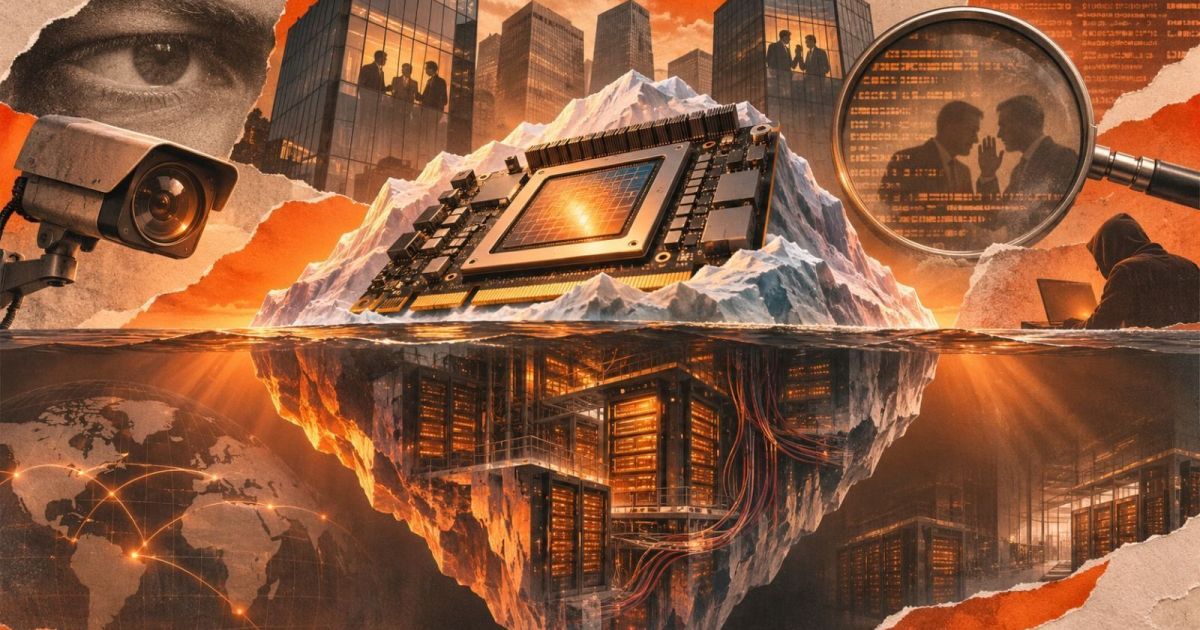
Elizabeth Rowe, a law professor at the University of Virginia specialising in trade secrets and intellectual property, said that publicized cases represent merely the tip of the iceberg of a far broader phenomenon. Rowe said the problem is substantially larger than public records indicate, noting that the avenues through which cases become public tend to underestimate how widespread the practice has become.
Federal legislation criminalising trade secret theft, enacted in the late 1990s, depends almost entirely on voluntary notifications from victimised businesses. While companies can also pursue civil remedies in court, legal proceedings require firms to air their security failures in public view.
Technology corporations face strong disincentives against reporting corporate espionage. Filing a lawsuit signals to investors that an enterprise has lost control over critical technical assets, and civil litigation over complex proprietary data can be exceedingly costly. Most critically, entering the court system risks exposing the very proprietary information companies want to protect, leaving sensitive data vulnerable to disclosure during trial proceedings or in the press. Rowe noted that because of these hurdles, whenever a single case reaches public headlines, many more remain completely unknown.