Norwegian aquaculture technology company Stingray Marine Solutions has deployed more than 2,000 underwater laser robots across fish farms in Norway to strip parasitic sea lice from salmon and trout. The automated devices currently guard more than 50 million farmed fish around the clock inside the country's coastal net pens.
The system was developed to combat sea lice outbreaks without subjecting fish to harsh conventional delousing baths. The Norwegian Veterinary Institute, a national biomedical research body that advises Norwegian authorities on fish and animal health, has identified injuries caused during delousing operations as one of the leading causes of mortality and reduced welfare in farmed salmon.
Underwater laser targeting and artificial intelligence
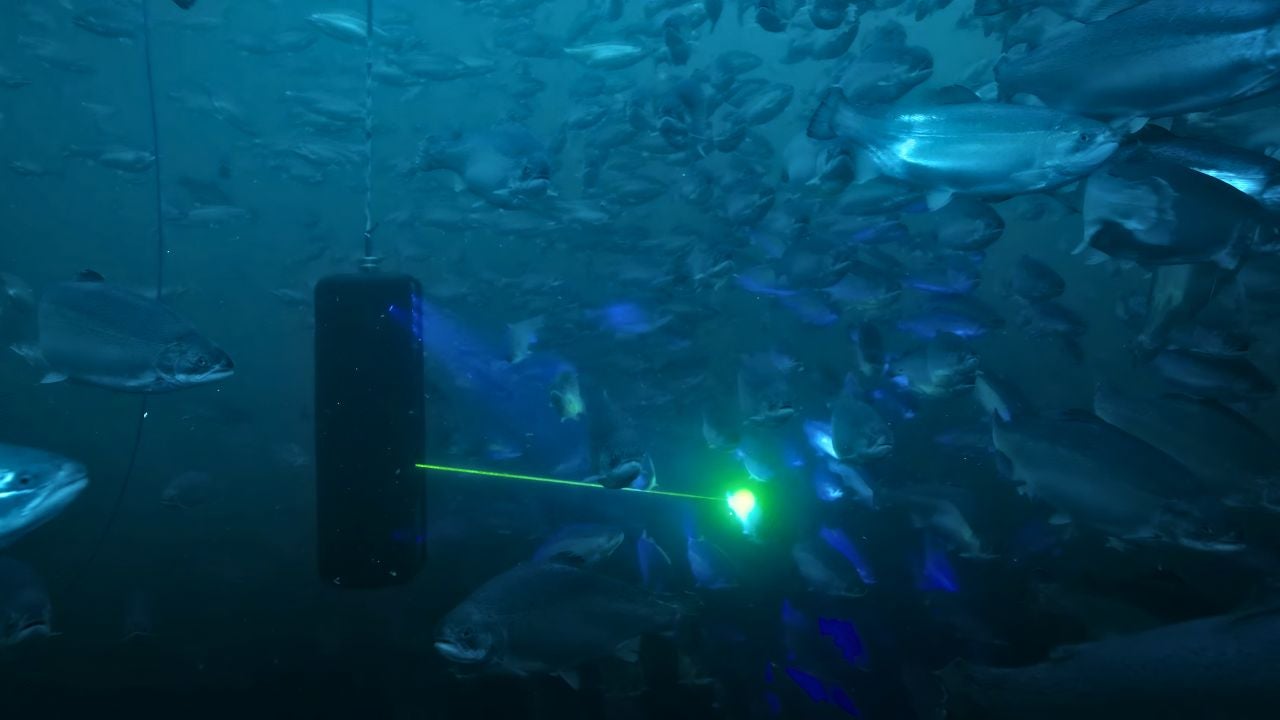
Each Stingray unit is lowered directly into an open-net sea cage, where it hunts parasites one by one throughout the day as the fish swim past freely. The submersible robot combines stereoscopic cameras, blue light illumination, and precision lasers to locate and eliminate individual lice.
Blue light is central to the targeting process because it sharpens the visual contrast between the parasite and the skin of the salmon, allowing the system's software to distinguish the pest from its host. As each salmon swims in front of the device, two integrated cameras monitor the fish while an artificial intelligence model reviews two separate video frames to confirm that the target is actually a sea louse.
Once the software verifies the target, the unit fires a green laser from a distance of up to 2 metres to kill the parasite. The robots can fire up to five laser pulses per second and operate continuously 24 hours a day, seven days a week.
In a post on X on November 9, 2026, Ole Lehmann noted that Norway now has more than 2,000 underwater artificial intelligence laser robots built by Stingray operating day and night to guard over 50 million salmon and trout by shooting sea lice off the fish. Headquartered in Oslo, Stingray Marine Solutions develops optical hardware and software specifically for commercial aquaculture pens.
Sea lice damage and chemical treatment resistance
Unlike the lice that infest humans and other mammals, salmon sea lice are small marine crustaceans from species such as Lepeophtheirus salmonis and Caligus rogercresseyi. The parasites attach themselves to the skin of the fish and feed on its dermal mucus, blood, and tissues.
The wounds they inflict weaken the salmon and can cause chronic stress, anaemia, and secondary bacterial or fungal infections that can be fatal in the worst cases. Consuming a salmon that has had sea lice poses no danger to human health because the fish is cleaned and inspected before it is sold, but severe infestations are costly for producers.
Because commercial salmon farming keeps high concentrations of fish inside open-net cages in the sea, the parasites reproduce rapidly and spread on a massive scale. Sea lice larvae that escape from the pens also reach and infect wild salmon and sea trout populations migrating through surrounding coastal waters.
Fish farms traditionally use chemical baths, freshwater baths, hydrogen peroxide, or pharmacological treatments to remove the parasites. However, several of those methods have lost their effectiveness because the lice have developed resistance to the treatments.
Stingray developed its laser units to spare fish the physical suffering associated with conventional delousing. Even so, while the laser robots can help reduce or delay some large-scale delousing interventions, there is still insufficient evidence that the technology completely eliminates the need for conventional sea lice treatments or solves the broader animal welfare problems linked to intensive salmon farming.

Record Norwegian salmon exports and global supply
Protecting farmed stocks from sea lice is a high priority for Norway, which accounts for nearly half of global Atlantic salmon production and supplies more than 150 countries. Salmon, an oily fish rich in protein and omega-3 fatty acids, represents Norway's second-largest export complex, trailing only oil and gas from the energy sector.
The fisheries and aquaculture industry is one of the foundational pillars of Norwegian trade, generating around 70 percent of the total export value of the country's seafood products. In October 2026, Norwegian salmon exports reached an all-time world record by surpassing 13 billion Norwegian kroner, or roughly 1.26 billion euros.
Unlike hydrocarbon reserves, which are finite, the Norwegian government and aquaculture industry manage Atlantic salmon as a long-term sustainable source of national wealth, despite ongoing debates and biological challenges across the sector.