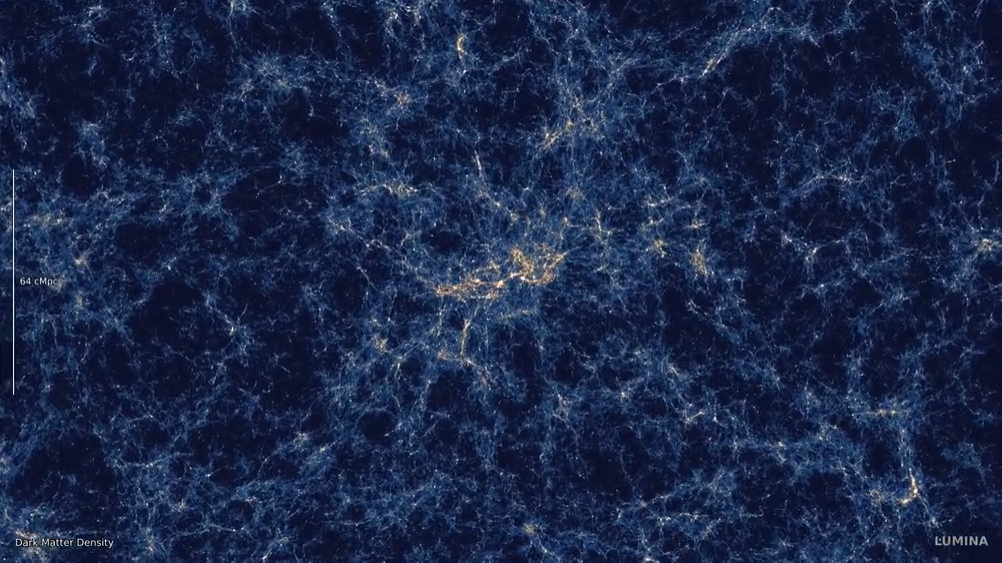
An international team of researchers has unveiled Lumina, a supercomputer simulation mapping the first two billion years of the universe in unprecedented detail.
The landmark project recreates how the earliest stars and black holes drove cosmic reionisation, according to a study published in the Monthly Notices of the Royal Astronomical Society.
During reionisation, intense ultraviolet radiation from primordial light sources stripped electrons from hydrogen atoms, the most common element in space. This process cleared the dense cosmic fog following the Big Bang, allowing light to travel across the cosmos and fundamentally altering how galaxies formed.
Cosmologists refer to this era as the cosmic dawn. In the hundreds of millions of years immediately after the Big Bang, the universe was plunged into cosmic dark ages, filled almost entirely with cold, neutral gas before the first stellar nurseries ignited and reionised the surrounding medium.
Massive cosmic scale
Oliver Zier, the lead author and a postdoctoral researcher at the Institute for Theory and Computation at the Center for Astrophysics | Harvard & Smithsonian in Cambridge, Massachusetts, said Lumina covers more than 100 times the space of previous simulations.
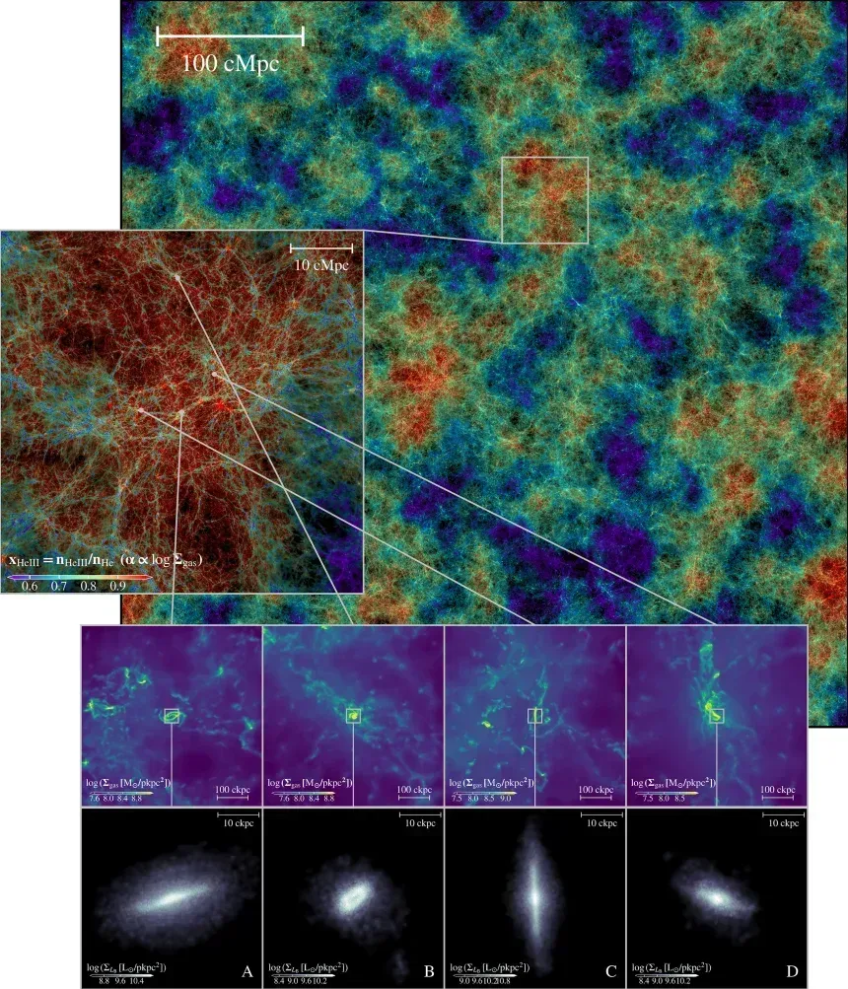
Zier explained that the simulation provides an expansive cosmological volume where researchers can observe the cosmic web and galaxy clusters while simultaneously resolving the intricate structures of individual galaxies.
Astronomers increasingly treat the early universe as a vital frontier for understanding cosmic evolution. Because light travels at a finite speed, powerful observatories capture snapshots of distant galaxies as they existed billions of years ago. However, tracking such an extensive period of cosmic history requires computational models of comparable scale.
NASA's James Webb Space Telescope, which orbits nearly one million miles from Earth, uses highly sensitive infrared instruments to observe those distant epochs. Because cosmic expansion stretches light into longer infrared wavelengths, the observatory is uniquely equipped to spot galaxies formed during the infancy of the universe.
Zier noted that researchers can test ideas about cosmic development by comparing Lumina's models against actual observations from telescopes like James Webb. If the findings align, scientists can have greater confidence in their theories.
However, Zier said discrepancies are even more valuable than agreements. Unexpected differences between models and observations indicate that current theories are missing critical elements, offering scientists crucial clues to undiscovered physics.
Supercomputer power at Oak Ridge
Lumina spans a region measuring approximately 1.5 billion light-years in diameter in each direction. By comparison, the Milky Way galaxy measures about 100,000 light-years across, according to NASA figures.
Completing the massive calculation took nearly three years of continuous computation. The team used more than 15,000 graphics processing units on Frontier, an advanced supercomputer housed at Oak Ridge National Laboratory in Tennessee, to deliver the necessary computing power.
Operated for the United States Department of Energy, Oak Ridge National Laboratory is a premier computing facility. Its Frontier system is an exascale supercomputer capable of performing more than one quintillion calculations per second, designed specifically to tackle monumental scientific modeling projects.
The Lumina simulation has not yet been released in full to the public. However, simulation video clips highlight the sheer expanse of space by zooming in on individual galaxies before pulling back to reveal how small they appear against the wider cosmic web.
Zier observed that while Earth feels immense, it is merely one planet within the Milky Way, which itself is only one of countless galaxies across the cosmos. He added that despite Lumina's vast size, the simulated region represents only a small slice of the entire universe.
Helium and dark matter dynamics
For the first time, Lumina enables researchers to study how transformations in both hydrogen and helium, the second most abundant element in space, altered the early universe within a single unified simulation.
Julian Munoz, an assistant professor of astronomy at the University of Texas at Austin who was not involved in the research, described Lumina as an impressive technical achievement.
In an email, Munoz explained that simulating how early galaxies form and ionise the infant universe is computationally expensive. As a result, past studies typically tracked small regions of the cosmos over brief intervals. Munoz said Lumina covers both a larger spatial area and a longer cosmic duration than earlier detailed models of its kind.
The early universe did not evolve uniformly, with certain sectors developing faster than others. Munoz noted that Lumina's broad scale allows scientists to monitor how distinct cosmic environments transformed over time.
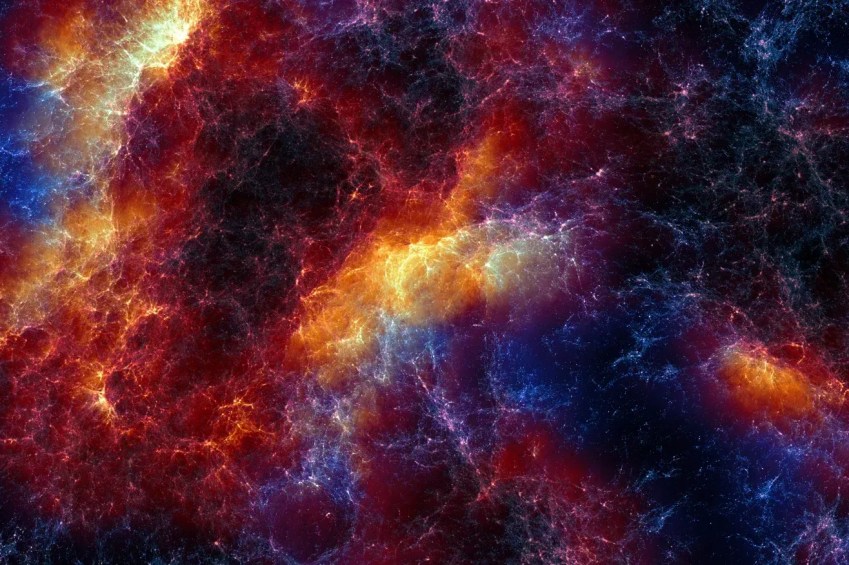
Munoz added that the simulation could help astronomers explore how ordinary matter and dark matter travel differently through space. Computational models of early galaxy formation traditionally examine the relationships between three core cosmic components: ordinary matter, dark matter, and radiation.
Ordinary matter forms visible structures like stars, planets, and living beings, whereas invisible dark matter constitutes the vast majority of matter in the cosmos. Unlike dark matter, ordinary matter interacts directly with light, causing the two substances to move at different velocities across space.
During the early history of the universe, those velocity differences generated cosmic patterns extending across millions of light-years. While telescopes cannot observe those patterns directly, simulations such as Lumina can map their variations, allowing researchers to study how matter dynamics shaped the ancient cosmos, Munoz said.
Ilian Iliev, a professor of astrophysics at the University of Sussex in the United Kingdom who was not involved in the study, said the simulation will assist researchers in analyzing rare galaxies that smaller models overlook.
Iliev said he is eager to see how observations from Lumina and next-generation telescopes complement each other to construct a more complete and precise understanding of the universe.