

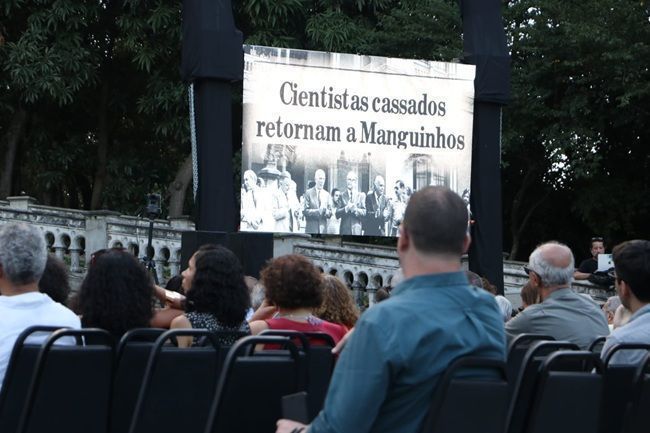
Brazil's Oswaldo Cruz Foundation has awarded posthumous emeritus researcher titles to 10 scientists stripped of their rights during the country's military dictatorship. The tribute took place on Wednesday, August 5, at the historic Fiocruz Castle in Rio de Janeiro.
The ceremony was held on National Health Day on the steps of the castle, marking the exact location where the researchers were reincorporated into the institution in 1986 after having their political rights restored. Officially known as the Fundação Oswaldo Cruz, Fiocruz is Brazil's leading public health research institution and is named after pioneering epidemiologist Oswaldo Cruz.
The posthumous honour recognises Augusto Cid de Mello Perissé, Tito Arcoverde de Albuquerque Cavalcanti, Haity Moussatché, Fernando Braga Ubatuba, Moacyr Vaz de Andrade, Hugo de Souza Lopes, Masao Goto, Sebastião José de Oliveira, and Domingos Arthur Machado Filho.
A symbolic delivery of the title was also conducted for Herman Lent, who was named an emeritus researcher at the institution in 2004, and Walter Oswaldo Cruz, the son of the foundation's patron and a founding member of the Brazilian Society for the Progress of Science.
Persecution under military rule
The scientists were targeted during a 1970 purge known as the Massacre of Manguinhos, when the military regime stripped ten researchers of their political rights and forced them into compulsory retirement. The episode severely damaged scientific research across Brazil during the military dictatorship that ruled from 1964 to 1985.
According to the Deliberative Council of Fiocruz, the tribute acknowledges the trajectories of the ten researchers as historic milestones in the scientific development of both the institution and the country. Organisers framed the event as a manifesto for freedom connecting 1986 to 2026, based on the principle that science requires democracy.
Fiocruz President Mario Moreira said there were dark times when rulers viewed free and sovereign science as a threat. He said the ceremony took place precisely so those events would not be repeated, adding that the political statement remained necessary 56 years after the revocation of the researchers' rights.
Moreira added that the actions serve as a manifesto so that science, education and democracy are never again seen as threats, but as essential components of a fairer, more developed country with dignity for all.
Memory and historic reparation
The event included a presentation on the socio-historical context of the purge, tracing the researchers' path from the military government period to their reinstatement in 1986. Family members and scientific heirs of the honoured researchers attended the ceremony in Rio de Janeiro.
Gilberto Hochman, a historian at the House of Oswaldo Cruz, said the tribute represented an act of memory and reparation for researchers persecuted by the dictatorship. He described it as an occasion to remember the violence committed by the regime against Brazilian universities and scientific institutions, and to celebrate the scientists' life and work.
The ceremony featured a reading of a letter from emeritus researchers in memory of those who were purged, presented by researcher Renato Cordeiro. Attendees were also shown a print copy of the book O Massacre de Manguinhos, published by Herman Lent in 1978 to document the persecution.
Video messages were delivered by Minister of Health Alexandre Padilha, Brazilian Academy of Sciences President Helena Nader, and Brazilian Society for the Progress of Science President Francilene Procópio Garcia.



