

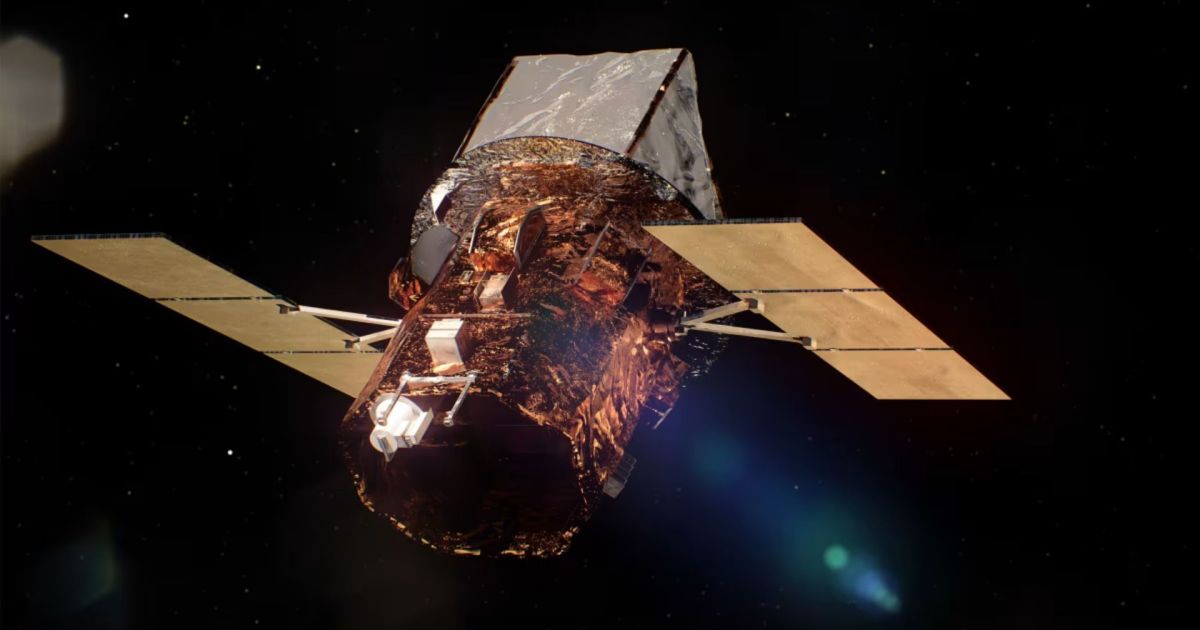
NASA's mission to rescue the Neil Gehrels Swift Observatory from an uncontrolled fall to Earth has run into serious trouble of its own, after the spacecraft sent to save it began spinning in space, though the agency says there may still be hope both craft can pull through.
The robotic satellite, called LINK, was launched by Katalyst Space Technologies on July 3 to meet up with the aging Swift observatory and push it back into a higher orbit. But around July 25, LINK started spinning uncontrollably, cutting off communication with mission controllers, Katalyst and NASA said in statements on July 28.
The Neil Gehrels Swift Observatory has served as a multipurpose astrophysics tool in low Earth orbit since it launched almost 22 years ago, acting as NASA's first responder in space whenever celestial objects show intense activity, according to mission scientists.
Atmospheric drag, intensified by solar activity, has been pulling at the observatory. Without intervention, NASA predicts Swift will likely reenter Earth's atmosphere this autumn, once it drops below an altitude of about 300 kilometers (185 miles).
NASA picked Arizona-based Katalyst Space Technologies to design, build, test and launch, all within nine months, a spacecraft capable of meeting Swift and boosting its orbit. LINK lifted off on a Northrop Grumman Pegasus XL rocket, which was released mid-air by the company's modified L-1011 aircraft, Stargazer.
Although LINK's spin now appears largely under control, its rendezvous with Swift has been delayed, and it is unclear whether the satellite will reach the observatory in time.
Shawn Domagal-Goldman, director of NASA's astrophysics division, said at a June 17 press conference that one of the hardest things to convey was how incredible it was that the mission had come this far. He said that even if everyone did everything perfectly, there could still be risks beyond their control, adding that he was deeply grateful they were even attempting it.
A Rocky Road to Orbit
After LINK's successful launch into orbit, Katalyst's mission operations team confirmed it was in communication with the satellite. The company's original plan included several weeks of health checks on LINK's navigation and sensor systems in space.
About a week after launch, both Katalyst and NASA reported that commissioning was proceeding as planned, with the satellite having deployed its solar panels and begun firing its thrusters.
Katalyst said on July 13 that the LINK project was halfway through its activation phase. Two days later, NASA published a similar update but noted that the team had run into some problems.
In a July 15 post, NASA said Katalyst's team had quickly resolved initial communication and attitude control issues observed during flight operations, including a problem with one of the spacecraft's three reaction wheels. After identifying the cause, the team implemented flight software fixes and operational updates that restored reliable communication and stable attitude control.
More than a week later, Katalyst said the team was validating LINK's performance and preparing the spacecraft for its coming encounter with Swift, including lengthening the satellite's thruster burns to ready it for the multi-hour firings needed to dock with the observatory.
But on July 28, the company said LINK had been spinning on multiple axes for three days. NASA said the same day that a preliminary investigation showed two of LINK's three reaction wheels were not operational and that its cold-gas thruster system had lost some functionality. Katalyst had a plan to reduce the spin, NASA said, and would reassess any plans related to Swift.
Two days later, Katalyst reported that the team had reduced LINK's spin rate from about 9 degrees per second to 4 degrees per second using a series of thruster firings. In a July 31 post, NASA said teams had further assessed LINK's functionality and determined there were still potential paths to improvement, and that the agency was working closely with Katalyst on revised and innovative approaches.
Katalyst confirmed the mission team had cut LINK's spin rate further, to 1.47 degrees per second, and said the satellite would hold that rate while the team prepared its next steps, the company said on August 5. It said the team had used one of LINK's electric thrusters to slow the spacecraft, using less than 100 grams of propellant to conserve fuel for the mission's rendezvous and acceleration phase. The mission team plans to send a flight software update that will restore LINK's orientation in space and enable the maneuvers needed to align the satellite's orbit with the observatory's.
A High-Risk Rescue
LINK had originally been expected to survey Swift, probably in late July, to determine the best places to attach to the observatory, but that survey is now expected about a month later than planned.
Once Swift's stability is secured, LINK will carefully fire its three ion thrusters, aiming to push the observatory back into its original orbit over two to three months.
It is not clear how the delay will affect the mission's original plans. But before LINK's launch, members of both the Swift and LINK teams acknowledged that the path to boosting the observatory was full of risks that could cause the mission to fail.
Kieran Wilson, principal investigator for the LINK project at Katalyst, said at the June 17 press conference that all of it was challenging and risky, noting that many spacecraft with much longer development cycles and far more funding had failed for trivial reasons.
Swift was named after fast-flying birds because of its ability to swivel quickly to observe cosmic events and their afterglows, and it has allowed scientists to study comets, gravitational waves and black holes over long stretches of time.
With no plans for a telescope with Swift's unique capabilities on the horizon, NASA decided it would be more cost-effective to try to save the observatory instead. To avoid draining its power, Swift is not currently carrying out scientific observations, though NASA says that could change this autumn if the LINK project succeeds.


