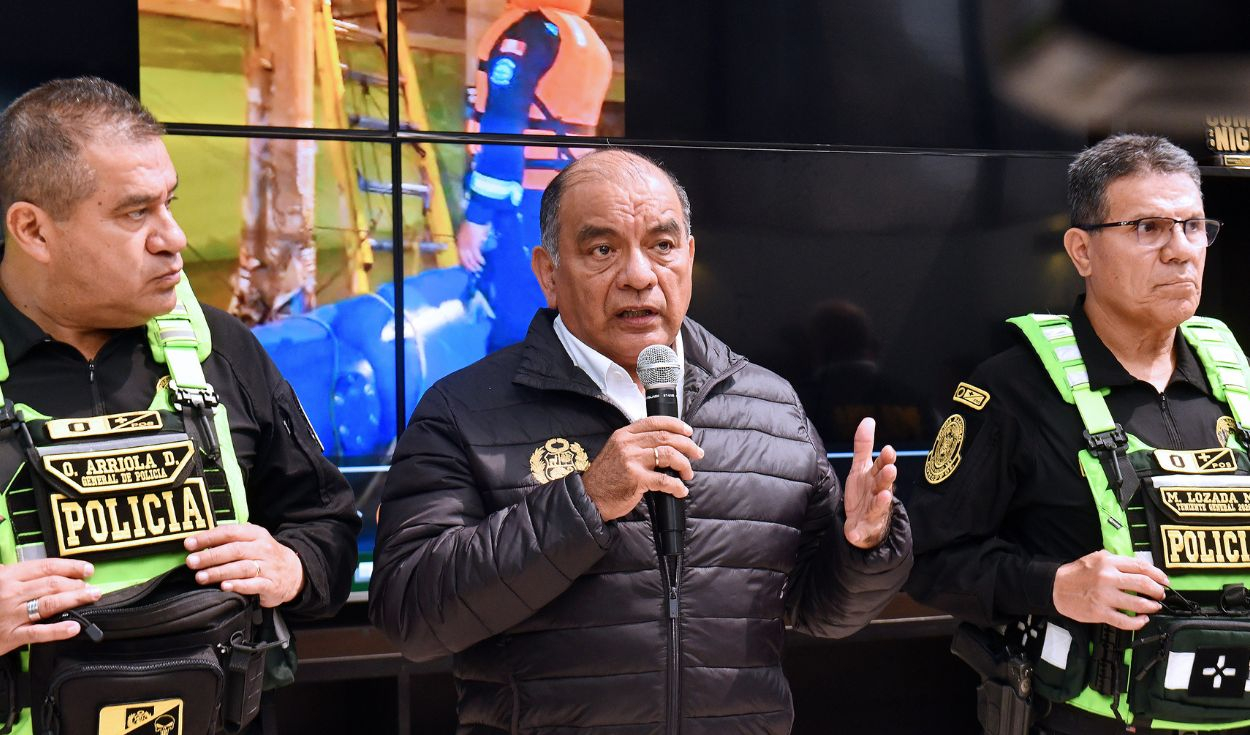
Peru Interior Minister César Astudillo told the Chamber of Deputies that current legislation prevents the government from removing National Police commander general Óscar Arriola from office.
The legal restriction stems from Law 31570, passed during the administration of former President Pedro Castillo with backing from Fujimorist lawmakers who now serve in Congress under President Keiko Fujimori.
Addressing lawmakers, Astudillo explained that the executive branch must proceed with strict adherence to the legal framework. He stated that the outgoing legislature passed a law establishing a mandatory two-year term for the police chief, adding that he would not sign any document violating the law or force a non-existent cause for dismissal.
Sources previously indicated that distancing between Arriola and high-ranking police commanders had widened in recent weeks, leading to expectations within the institution that his departure was only a matter of time. Under the current statute, Arriola cannot be replaced until late 2027 unless specific legal conditions are met.
Astudillo noted that his department does not support the restriction as enacted and announced that the ministry will propose modifying the law. He emphasized that his stance does not constitute an endorsement of Arriola's management, following a joint press conference where the two officials reported a downward national trend in homicides.
Legal Protections and Congressional Backing
Law 31570 mandates that the commander general of the National Police of Peru (PNP) is designated by the President of the Republic for a two-year period, with the possibility of an exceptional one-year extension. The statute restricts early dismissal to specific grounds, including death, voluntary retirement, permanent physical incapacity, very serious misconduct, or criminal offences, thereby curtailing discretionary removal.
The legislation was created during the government of former President Pedro Castillo to stabilize police leadership after five different officers held the commander general position within his first 13 months in office.
The bill passed with 82 votes in favor and was later approved by insistence following executive observations. It received broad support from Fujimorist members of Congress who currently hold seats across the Senate and the Chamber of Deputies, including David Jiménez, Alejandro Aguinaga, Mery Infantes, Rosangela Barbarán, Martha Moyano, Auristela Obando, Patricia Juárez, and César Revilla.
Lawmakers from Renovación Popular, a group aligned with the governing coalition, also supported the measure. During floor debate, then-congressman and current senator Alejandro Muñante argued that the PNP required order and dignity to continue its essential work in the country.
The Precedent of Executive Dismissal
Despite the legal protections surrounding the command tenure, precedent exists for removing a police chief prior to completing the two-year period. In January 2024, former President Dina Boluarte removed General Jorge Angulo from the PNP leadership through Supreme Resolution N.° 19-2024.
The official resolution stated that Angulo was removed due to very serious negligence in the control and command of the police force, which constituted incompatibility and a lack of suitability for the position. Angulo had taken command of the institution in March 2023, serving less than a year prior to his dismissal.
Angulo denounced his removal and forced retirement as irregular. Months later, the judiciary set aside his retirement after ruling that his right to due process had been violated, though the court did not order his reinstatement as commander general.
Expert Critique and Operational Profile
Security specialists have raised concerns over Arriola's continuation at the head of the PNP. Retired general Eduardo Pérez Rocha, a former director of the police force, told La República that Arriola's profile is unsuitable for addressing the country's crime wave.
Pérez Rocha noted that more than 100 firearm homicides were recorded during the first 18 days of Keiko Fujimori's administration, surpassing figures from previous years. He argued that effective crime reduction requires a leader specializing in crime prevention rather than criminal investigation, noting that international standards prioritize deploying most personnel to prevent offences before they occur.
Pérez Rocha also criticized severe deficits in police equipment and infrastructure, pointing out that former President Ollanta Humala was the last leader to purchase dedicated patrol cars. Subsequent administrations opted to lease commercial vehicles for public relations rather than acquiring proper police units equipped with reinforced glass and doors.
During her campaign, President Keiko Fujimori promised to issue emergency decrees during her first 100 days to fund 1,000 smart patrol cars, 10,000 interconnected security cameras, and the modernization of 200 police stations. However, none of these measures have been executed during the initial 20 days of her administration, while annual officer departures continue to outpace new recruit graduations.
Lawmakers Demand Immediate Police Leadership Change
Astudillo faced sharp criticism from lawmakers during his appearance before Congress over the decision to retain Arriola. Congresswoman Norma Yarrow of Renovación Popular questioned the minister's support for Arriola, describing the commander general as an officer criticized by military and police peers who spent three years pursuing an individual who currently mocks public institutions and citizens.
Congressman Víctor Piñán of the Obras party expressed regret over Arriola's ratification, stating that maintaining the commander general reflects a continuation of anti-crime strategies that have failed over recent years despite public demands for change.
Congressman Oswar Cahuaza of Juntos por el Perú stated that Arriola's retention harms crime fighting and enables corruption to spread within the police force. Cahuaza called on Astudillo to inspect Pucallpa in the Ucayali region regarding allegations of excess ammunition charging, accusing the minister of endorsing a police chief facing allegations of corrupt acts.