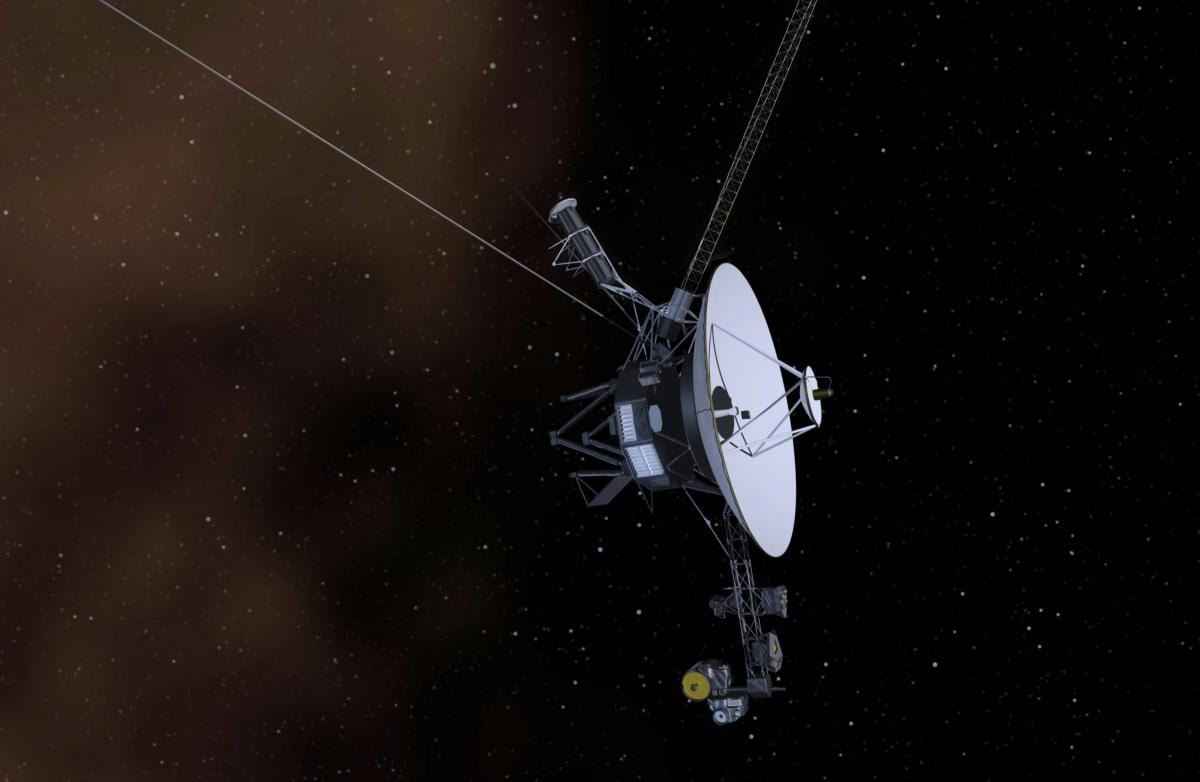
NASA spacecraft Voyager 1 has reached a distance where radio signals take more than 23 hours to reach Earth, extending round-trip communications to nearly two days.
A radio command transmitted from Earth now takes more than 23 hours to travel to the probe through space, with the spacecraft's responding signal taking roughly the same duration to return. Including transmission time in both directions, a single command and response cycle requires about two days, excluding the additional time required by mission controllers to analyze incoming data.
The long signal delay significantly complicates troubleshooting operations for National Aeronautics and Space Administration engineers. Specialists cannot react promptly to unexpected mechanical or software behavior and must plan and verify every instruction sent to the remote probe days in advance.
Voyager 1 is traveling away from the Sun at a velocity of approximately 17 kilometers per second. Scienceblog reported that the spacecraft remains the most distant human-made object from Earth, with its distance continuously expanding. By November 2026, the probe is expected to reach a distance of one light-day from Earth, meaning a radio signal moving at the speed of light will take roughly 24 hours just for a one-way trip.
Instruments and Scientific Operations
As of April 2026, Voyager 1 had two scientific instruments still operating on board: a magnetometer and a plasma wave detector. Data collected by these instruments allows astrophysicists to examine the environmental conditions beyond the heliosphere, the vast protective region of space dominated by the solar wind emitted by the Sun.
The magnetometer measures the orientation and strength of magnetic fields in deep space, while the plasma wave detector registers density oscillations in the sparse plasma surrounding the spacecraft. On April 17, 2026, NASA engineers turned off another scientific instrument, the Low-Energy Charged Particles registration system, in an effort to conserve the spacecraft's declining electrical supply.
The probe no longer transmits photographic images of space. NASA controllers turned off Voyager 1's optical cameras after the spacecraft captured its final iconic image series of the Solar System in 1990, reallocating power exclusively to instruments that measure fields and particles.
Nuclear Power Supply and Energy Decay
Voyager 1 does not use traditional batteries or solar panels, which are ineffective in deep space where sunlight is extremely faint. Instead, its electricity is generated by three radioisotope thermoelectric generators, which harvest the heat produced by the natural radioactive decay of plutonium-238 and convert it into electrical power.
When the spacecraft was launched, each of the three nuclear generators produced approximately 158 watts of power, providing an initial total output of roughly 470 watts. According to NASA figures, Voyager 1 loses about four watts of available electrical capacity each year, forcing engineers to shut down non-critical systems gradually to preserve the probe's primary functions.
NASA has not set a definitive end date for the Voyager 1 mission. The space agency noted that the Voyager probes could remain within communication range of the Deep Space Network until around 2036, depending on the remaining electrical power available for their radio transmitters. Scientific measurements may end earlier as power decreases, though the spacecraft could continue transmitting a basic carrier signal for a period after science instruments are powered down.
Interstellar Space and Historical Mission
NASA considers Voyager 1 to have crossed the heliopause in August 2012, making it the first human craft to enter interstellar space. The heliopause marks the outer boundary where the solar wind meets the interstellar medium, though the spacecraft remains bound by the gravitational pull of the Sun.
The spacecraft was launched on September 5, 1977, on a mission designed to conduct close-up studies of the outer planets. Voyager 1 completed a successful flyby of Jupiter in 1979 before exploring Saturn and its moon system in 1980, after which it was directed on a trajectory out of the ecliptic plane.
Nearly half a century after its departure from Earth, Voyager 1 continues to operate using hardware and computing technology developed in the early 1970s. It transmits data at a speed of only 160 bits per second, sending signals so faint that they must be gathered by the massive parabolic dish antennas of NASA's Deep Space Network, a global network of ground stations that supports deep space exploration.
Although Voyager 1 no longer photographs planets or carries out its original planetary exploration program, its ongoing flight provides researchers with unique, direct measurements of the interstellar environment at distances unreachable by any other active spacecraft.
Rotational Phenomenon on Saturn Moon Titan
In other space discoveries, astronomers have detailed the unusual orbital motion of Titan, Saturn's largest moon. Titan experiences tidal locking, a phenomenon that locks its rotation to its orbital period so that it continuously shows the exact same face to Saturn.
Because of this synchronous rotation, Saturn hangs fixed in the sky when viewed from one hemisphere of Titan, while remaining permanently invisible from the opposite side. Researchers explained that this dynamic is driven by gravitational tidal forces that shape the rotational behavior of many moons throughout the Solar System.