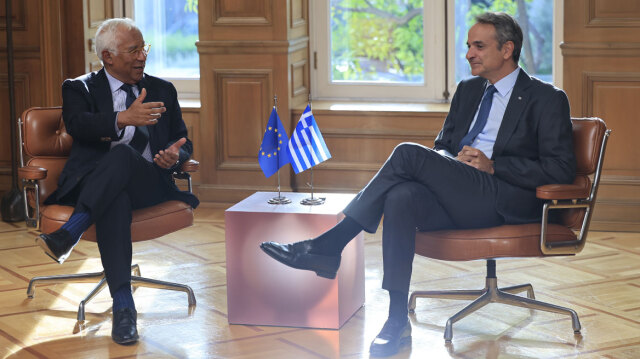
Greek Prime Minister Kyriakos Mitsotakis warned that Greece will not accept outside instructions on defense following talks with European Council President António Costa in Athens on Thursday afternoon.
Speaking at the Maximos Mansion, Mitsotakis urged the European Union to confront active threats to Greek sovereignty and raised recent Turkish provocations in the Aegean Sea directly with European leadership.
The meeting came as Costa conducted a tour of member state capitals to consult national leaders ahead of upcoming European Council summits and prepare for future EU leadership roles.
Turkey and Aegean Security
Mitsotakis informed Costa of an escalation in Turkish provocations across the Aegean Sea, emphasizing that adherence to international law and good neighborly relations remains a mandatory prerequisite for any nation seeking European integration.
The prime minister placed the active threat of war and challenges to Greek sovereignty firmly on the European agenda. He stated that Turkey's path toward Europe, which Greece supports, must align with constructive bilateral relations.
Addressing joint defense initiatives, Mitsotakis noted that third-country participation in the European SAFE defense program requires that candidate nations do not harm the security interests of existing EU member states. He reiterated that Greece poses no threat to anyone but will independently manage its defense fortification.
Costa acknowledged the security concerns, confirming that the European Union maintains a strategic interest in a stable Eastern Mediterranean. He noted that while Turkey's constructive participation is crucial for cooperation, the primary duty of the bloc will always remain the protection of member state interests.
Negotiations over the EU Long-Term Budget
The two leaders held extensive discussions regarding the complex negotiations for the next Multiannual Financial Framework covering the period from 2028 to 2034. Both agreed on the necessity of securing a formal political agreement by the end of the year.
Mitsotakis highlighted that the Cypriot presidency of the Council of the EU had established the groundwork for budget negotiations. He added that member states are awaiting detailed proposals from the upcoming Irish presidency concerning overall budget size and resource allocation.
The Greek leader called for an ambitious budget, arguing that Europe cannot achieve its strategic goals while spending less. He stressed that funding for traditional EU policies, such as Cohesion funds and the Common Agricultural Policy, must be preserved alongside new spending priorities.
Costa warned that failing to reach a timely budget consensus before the year ends could disrupt vital investments for farmers, businesses, students, researchers, and innovators. He noted that the post-2020 geopolitical environment requires a restructured budget focused on defense, competitiveness, and strategic resilience.
Climate Emergency and Revenue Generation
Rising costs and environmental threats also dominated the talks. Mitsotakis pointed to destructive wildfires that swept across multiple European countries during the summer, stating that while Greece avoided the worst outcomes this year, climate adaptation must be funded as a unified European threat.
To fund expanding EU priorities without placing excessive burdens on national budgets, Mitsotakis proposed generating new revenue streams. He suggested utilizing proceeds from future 5G and 6G spectrum auctions and considering joint European borrowing tools to fund public goods like defense.
Costa agreed that new revenue sources, known as own resources, are essential to keep national contributions within reasonable limits. He expressed confidence that member states will negotiate a balanced financial package before the end of December.
Economic Competitiveness and Energy Costs
On economic policy, Mitsotakis urged Europe to move rapidly in artificial intelligence and emerging technologies to prevent falling behind global competitors. He warned that industrial competitiveness remains compromised as long as European businesses and households pay higher energy costs than international rivals.
The prime minister called for the rapid completion of the single European energy market, pointing to high electricity prices in August and sharp price disparities between member states. He also called for finalizing the Savings and Investments Union to help European firms secure financing within the bloc.
Border Management and Migration Policy
Turning to border security, Mitsotakis cited recent incidents at Ceuta as evidence of the ongoing instrumentalization of migration. He recalled that Greece faced a hybrid migrant attack along the Evros river border in March 2020, becoming the first EU state to encounter such tactics.
Mitsotakis urged southern European nations to maintain a united front, advocate for faster returns of individuals denied asylum, and explore innovative arrangements with third countries to ensure human traffickers do not determine who enters Europe.
Costa underscored Greece's strategic geographic position overlooking the Mediterranean and Middle East. He affirmed the necessity of protecting European land and maritime borders while equipping the bloc with adequate enforcement capabilities.
Global Conflicts and Maritime Operations
Regarding international affairs, Mitsotakis reaffirmed Greece's support for Ukraine against aggression, adding that European institutions must directly represent the bloc when peace negotiations eventually take place.
Addressing maritime security, Mitsotakis emphasized that unimpeded navigation guarantees global energy and food supplies. He stated that attacks on legal shipping are unacceptable and declared that fee-free transit through the Strait of Hormuz is non-negotiable.
Mitsotakis highlighted Greece's role as one of the few nations participating in Operation Aspides, the European naval mission in the Red Sea. He noted that the operation proves Europe can act autonomously in critical regions if member states provide broader participation.
Costa noted that Middle East instability directly affects European security, migration flows, and energy supplies. He announced that the European Union will host a summit with Gulf Cooperation Council countries on October 24 and thanked Greece for fostering relations with Gulf partners.
The meeting concluded with both leaders noting that Greece is actively preparing to assume the rotating presidency of the Council of the European Union in the second half of 2027.