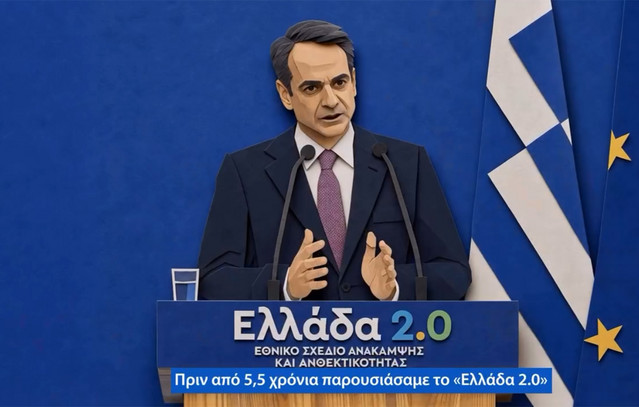
Greek Prime Minister Kyriakos Mitsotakis announced the completion of the country's Recovery and Resilience Fund on Monday, stating that national modernization has no expiration date.
In a social media post marking the conclusion of the 36 billion euro plan named Greece 2.0, Mitsotakis said the economic transformation started by the program will continue. The announcement was delivered through an artificial intelligence animation video featuring the prime minister's own voice, marking the first time a Greek political leader has released an AI-generated video on social media.
Mitsotakis leads the conservative New Democracy party and has served as prime minister of Greece since July 2019. The Recovery and Resilience Facility was established by the European Union to help member states rebuild after the COVID-19 pandemic and support digital and green transitions.
Mitsotakis recalled that he personally proposed the initiative alongside eight other European leaders in 2020 as a response to the pandemic crisis. He noted that Greece presented the Greece 2.0 plan five and a half years ago as the largest investment and reform program in Greek history, financed entirely by European funds. He added that he remembered initial resistance from frugal northern European nations against common European borrowing.
Economic growth and job creation
Reflecting on the results of the recovery program, Mitsotakis said that initial forecasts from 2021 predicted gross domestic product growth of seven percentage points. He stated that the actual increase reached 11 percentage points, driven significantly by contributions from the Recovery Fund.
Mitsotakis also highlighted employment figures, stating that the government had originally projected the creation of 180,000 new jobs during the program. Ultimately, the Recovery Fund supported the creation of 550,000 new jobs across the country.
Greece endured a severe financial crisis during the 2010s that required three international bailouts. The national economy has since stabilized and returned to growth.
Tax evasion and digital reform
The prime minister detailed structural reforms funded by the program, including the interconnection of nearly 500,000 cash registers with point-of-sale payment terminals. Mitsotakis said these resources helped Greece finally address tax evasion.
He also pointed to the launch of the digital Work Card, which was funded by the Recovery Fund. He said the system recorded millions of previously unrecorded overtime hours, bringing greater transparency and fairness to the labor market.
In addition, Recovery Fund money accelerated the digitization of the public sector. Mitsotakis stated that Greece moved from lagging behind in digital services to surpassing the European average across several critical indicators, including the gov.gr public portal and digital health systems.
Energy transition and public services
On energy policy, Mitsotakis said investments in renewable energy sources, power grids, and storage systems turned Greece from a net electricity importer into a net exporter. He added that expanding clean energy and grid connections will ultimately reduce electricity prices for consumers.
Regarding judicial reform, the prime minister noted that the time required to deliver justice in the primary courts of Athens and Thessaloniki fell by approximately 50 percent. He said the Recovery Fund also financed a new judicial map and broader legal reforms.
Athens is the capital and largest city in Greece, while Thessaloniki is the second largest city and a major administrative center in the northern region of Central Macedonia.
Infrastructure and healthcare upgrades
Mitsotakis reported that Greece established a complete national Land Registry, raising property registration coverage from 39 percent in 2019 to 99 percent today.
The recovery plan also funded the reconstruction of emergency departments in 80 hospitals and 156 health centers nationwide. Furthermore, workers installed 40,000 interactive whiteboards in schools across the country.
Mitsotakis said that while Greece had delayed in utilizing European funds for decades, the country proved it could design, implement, and complete a complex plan on schedule without losing a single euro. Looking toward 2030, he emphasized that national modernization will continue with the aim of building a stronger, safer, and fairer Greece.