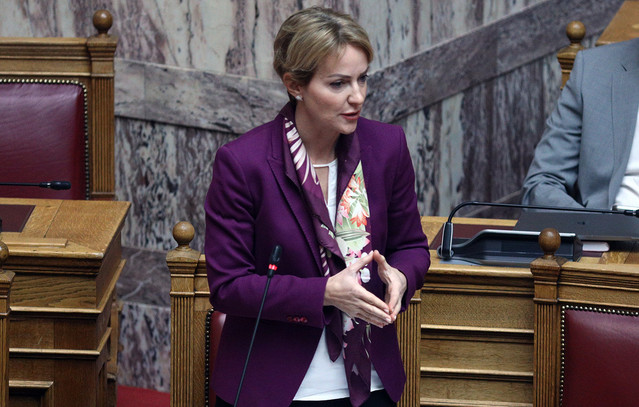
Greek ruling party spokesperson Alexandra Sdoukou said Turkey cannot gain legal rights by declaring national marine parks in waters claimed by Greece.
Speaking to ERTnews, the national public television news channel, the New Democracy press representative rejected Ankara's announcement of two new national marine reserves extending beyond Turkish territorial waters into international areas and parts of the Greek continental shelf.
Sdoukou stated that the Turkish move creates no legal effect and cannot establish accomplished facts on the ground. She emphasized that Turkey cannot grant itself maritime rights unrecognized by international law simply by issuing its own decision and publishing its own map.
Greece and Turkey, both long-standing member states of the NATO alliance in the Eastern Mediterranean, have experienced decades of diplomatic friction over territorial sea limits, continental shelf rights, exclusive economic zones, and airspace sovereignty in the Aegean region.
Sdoukou contrasted the Turkish decision with Greek maritime initiatives, noting that Greece previously tendered and designated its own marine plots in full accordance with international legal frameworks and established legal procedures.
She highlighted that Athens has consistently maintained its national lines and defended its national interests through concrete foreign policy actions, demonstrating its commitment through direct implementation in the field.
According to Sdoukou, Greek initiatives over recent years have included establishing marine parks officially endorsed by the European Union, signing international energy agreements, implementing maritime spatial planning, and ratifying Exclusive Economic Zone delimitation agreements.
She added that Greece has significantly upgraded its military capabilities through necessary and useful defense acquisitions while forging strong diplomatic and strategic alliances with multiple international partners.
Sdoukou specifically named Egypt, Israel, the United States, the United Arab Emirates, Saudi Arabia, and France as key partners supporting Greece's expanded international footprint and prestige.
She noted that Greece's heightened diplomatic presence has predictably provoked reactions from neighboring Turkey, but stressed that Greek foreign policy is not defined by external actions.
Firefighting Operations and Civil Protection
Turning to domestic issues, Sdoukou addressed summer wildfire management across Greece, stating that every outbreak and lost human life represents a tragedy for the nation.
She insisted that public discussions regarding wildland blazes require maximum seriousness, avoiding both superficial dismissals for political gain and unrealistically positive depictions of emergency conditions.
Sdoukou noted that Greece ranked sixth in total burned land area among European nations this year, placing behind Spain, France, Italy, Portugal, and Turkey.
However, she cautioned against declaring success based solely on comparative rankings. She argued that the essential debate must focus on adapting to increasingly extreme weather phenomena, evaluating past actions, and determining necessary steps to improve operational responses every year.
Citing recent wildfire outbreaks in Chalkidiki, Salamina, and Skyros, Sdoukou pointed to specific operational challenges and achievements recorded on the ground.
In Chalkidiki, she explained that emergency crews successfully contained a complex forest fire near residential settlements and dense concentrations of summer holidaymakers, minimizing overall structural and environmental damage.
In Salamina, aerial assets, floating marine vessels, and ground firefighters contained a severe blaze driven by high Beaufort wind speeds within a few hours, allowing residents to evacuate safely from threatened settlements.
Providing detailed operational timelines, Sdoukou stated that the Salamina fire was initially announced at 14:43. Within seven minutes, by 14:50, weather conditions altered rapidly to trigger swift fire expansion, yet emergency personnel were deployed immediately to tackle the shifting environment.
She emphasized that adapting to this climate reality requires upgrading prevention measures, operational readiness, and response speed. She pointed to the government's Antinero forest management program as a key structural intervention.
According to Sdoukou, the Antinero initiative has substantially assisted in clearing and organizing forest lands, establishing and maintaining firebreaks, removing dry combustible vegetation, and clarifying institutional responsibilities among public bodies despite political opposition.
She also highlighted the role of the 112 emergency warning service in saving lives, alongside a record number of private land plot clearings completed across the country this season.
Regarding Civil Protection resources, Sdoukou stated that Greece deployed expanded aerial fleets and surveillance drones for early fire detection while increasing Fire Service personnel from approximately 13,000 to more than 18,000 active firefighters.
She concluded her comments on disaster response by affirming that the government would neither claim perfection nor accept political criticism raised over ashes, maintaining that the state holds a permanent obligation to protect lives and property while preparing for extreme events.
Economic Strategy and Thessaloniki Announcements
Looking ahead to fiscal policy, Sdoukou outlined upcoming economic announcements scheduled for presentation at the Thessaloniki International Fair, Greece's premier annual commercial and political exposition held each September in the northern city of Thessaloniki.
She stated that the government address will focus on two primary pillars: permanent economic measures taking direct effect within 2027 and a comprehensive strategic roadmap guiding national development through the next four years toward 2030.
Sdoukou emphasized the growth-oriented nature of the upcoming policy package, noting that the central objective is attracting foreign and domestic investment to expand the broader economy and national wealth.
She explained that economic expansion is structured to directly benefit citizens by further reducing tax burdens, leaving higher disposable income in households while stimulating job creation.
Alongside tax relief and investment goals, Sdoukou stated that the government aims to build a modern state apparatus that operates with greater transparency and simplifies everyday administrative transactions for citizens.