Greece's Foreign Ministry declared on Sunday that Turkey's unilateral decision to establish two national marine parks in the Aegean Sea and the Eastern Mediterranean is illegal and produces no legal effect over Greek continental shelf rights or international waters.
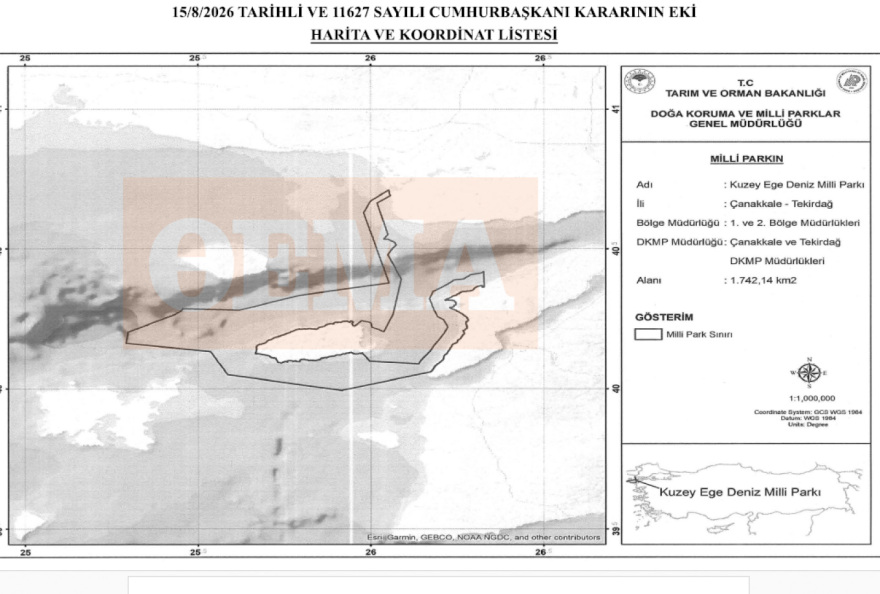
The Greek statement followed the publication of Turkish presidential decrees signed by President Recep Tayyip Erdogan on August 15, 2026, which officially appeared in the Turkish Official Gazette on August 16, 2026. The decrees establish two protected maritime zones that extend beyond Turkish territorial waters into international waters and areas claimed by Greece as part of its non-delimited continental shelf.
Greece Rejects Unilateral Maritime Declarations
In an official statement released in Athens, the Greek Foreign Ministry emphasized that under the United Nations Convention on the Law of the Sea, no state possesses the right to unilaterally establish marine protected areas outside its national jurisdiction. The ministry added that Ankara's decision cannot create a fait accompli on the ground or alter rights derived from international law.
Athens warned that unilateral steps attempting to alter the status of maritime zones in the Aegean and Eastern Mediterranean violate international law, undermine good neighborly relations, and damage efforts to maintain mutual understanding between the neighboring countries. The ministry reaffirmed that Greece will continue to act with consistency and determination to protect its sovereign rights, safeguard high seas freedoms, and preserve the marine environment in accordance with international law.
Greece recalled that its own initiative to establish National Marine Parks in the Ionian and Aegean Seas was carried out in full compliance with the Law of the Sea and strictly within Greek territorial waters. The diplomatic dispute highlights ongoing tensions between Greece and Turkey, two NATO allies that have long disagreed over maritime boundaries and continental shelf rights in the region.
Geographic Scope of Turkish Marine Parks
The first of the two newly declared Turkish marine parks is located in the North Aegean Sea, positioned directly between the Greek islands of Lemnos and Samothrace. The park covers international waters within Greece's non-delimited continental shelf and encroaches into the potential 12-nautical-mile territorial sea limit of the adjacent Greek islands.
According to Greek diplomatic analysis, the placement of the northern park aligns with Turkey's longstanding claims over the Greek continental shelf. These claims date back to the 1970s, when Ankara issued offshore research permits to state-owned energy company TPAO in the same maritime area.
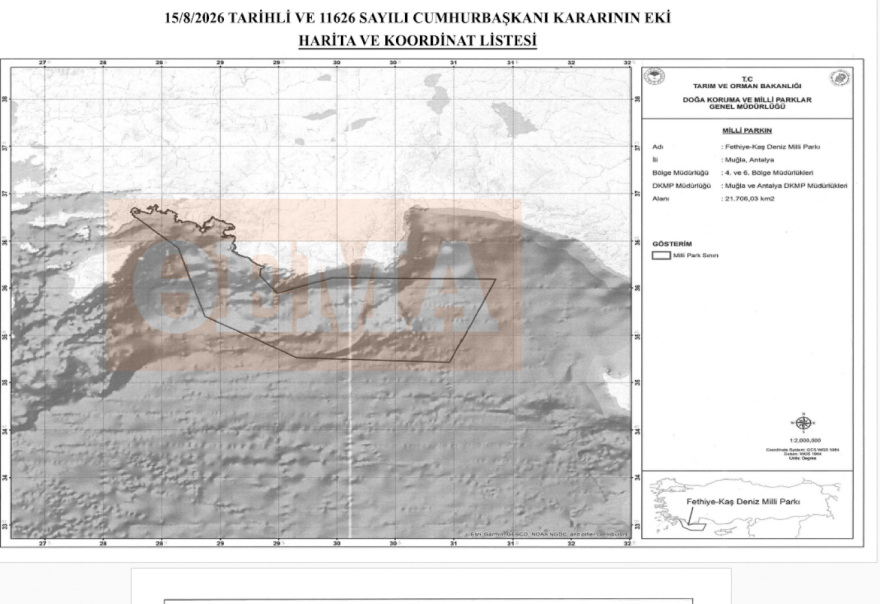
The second Turkish marine park covers an expansive area in the Eastern Mediterranean, extending across the waters east of Rhodes and encompassing the sea surrounding Kastellorizo. The designation completely isolates Kastellorizo from Rhodes, confining the island to its current six-nautical-mile territorial sea boundary.
Maps published alongside the Turkish presidential decrees display no border lines around Kastellorizo or other Greek islands, omitting even their six-nautical-mile territorial limits. Officials in Athens note that this mapping reflects Turkey's stance that no maritime borders exist between the two nations in the Aegean Sea.
Environment Claims and Border Disputes
Although Turkey officially designated the two maritime parks for environmental protection and biodiversity conservation, Greek authorities view the move as a practical attempt to enforce claims under Ankara's Blue Homeland doctrine. The newly mapped Turkish boundaries overlap entirely with Greece's Maritime Spatial Planning framework presented in 2025, which is scheduled for formal submission to the European Union.
Greece previously established two marine parks in the Ionian Sea and Southern Cyclades, keeping them strictly within six nautical miles of island shorelines. By contrast, Turkey's latest decrees adopt the position that islands generate no maritime rights beyond six nautical miles of territorial waters, asserting instead that maritime boundaries should be drawn along a median line between the mainland coasts of the two countries.
Escalating Maritime Friction
Turkish media outlets reported that the decision to enact the marine parks was made in response to Greece's 2025 Maritime Spatial Planning initiatives and its establishment of Aegean and Ionian marine parks. Greece's spatial planning framework incorporates outer limits defined under Law 4001/2011 for non-delimited exclusive economic zones, the same legal framework applied to offshore exploration blocks south of Crete leased to American energy corporation Chevron.
Ankara had previously opposed Greek maritime mapping through official Foreign Ministry statements and a formal letter submitted to the United Nations. Tensions are expected to escalate further in the autumn of 2026, when the Turkish parliament is scheduled to consider the formal adoption of Blue Homeland legislation.