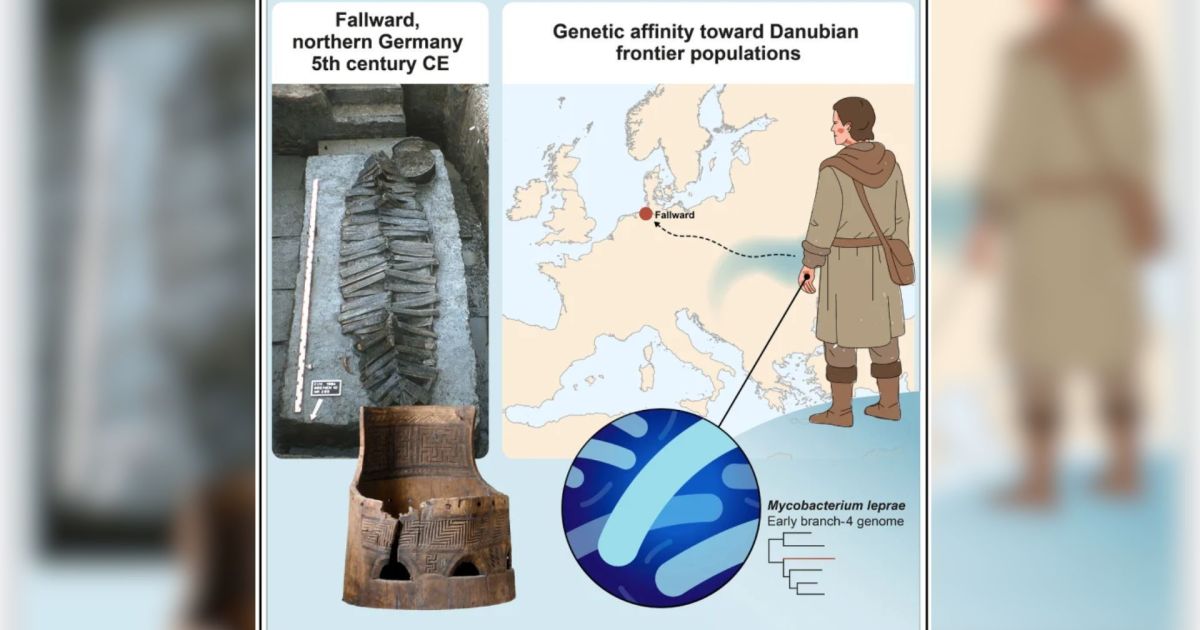
A man buried more than 1,500 years ago in an elaborate wooden boat grave in northern Germany was infected with the bacterium that causes leprosy, according to a new genetic study published in the journal iScience.
Researchers analyzed skeletal samples from 11 people buried at the Fallward archaeological site, located in the delta region of the Elbe and Weser rivers. The cemetery was used from the end of the third century to the end of the fifth century. The site is known for its unusually good preservation of organic materials, including wood, textiles and everyday objects, a result of local soil conditions that helped protect these materials for centuries.
Of the 11 individuals examined, only three yielded enough genetic material for ancestry studies. Two showed close genetic ties to northwestern European populations. The third, an adult man of about 50 years old, carried genetic traits associated with populations from the central and southern stretches of the Roman Danube frontier.
The analysis pointed to a greater likelihood of genetic affinity with a region located more than 1,400 kilometers southeast of the burial site. The researchers said this suggests the man, or his recent ancestors, may have come from that area before arriving in what is now northern Germany. They cautioned, however, that it was not possible to pin down his exact geographic origin.
A burial filled with Roman influence
The man was buried inside an oak wood boat more than four meters long. Alongside his remains, researchers found a richly decorated wooden chair, a footrest carved with a hunting scene, a gaming table, a bronze basin and a Roman military belt.
The presence of these objects points to Roman cultural influence and suggests the man held a privileged position within his community. Researchers also noted that some of the items showed signs of wear and repairs made before the burial, indicating they had likely been part of his daily life rather than purely ceremonial.
Other items found in the grave, including fish bones and a reed mat used to lay out the body, raised the possibility that the man had some connection to maritime or river activities. Based on these materials and the remains themselves, the researchers considered that he may have worked as a fisherman or as someone who piloted boats.
Although the Roman military belt could point to a link with the army, the study was not able to confirm that the man had served in Roman forces. One hypothesis raised by the researchers is that he could have been a foederatus, a term used for allied groups or fighters who provided military service to the Roman Empire. The study's authors themselves describe this possibility as speculative.
Bacterial DNA found in tooth and heel bone
The leprosy diagnosis emerged during genetic analysis of two samples taken from the man: a tooth and a bone from his heel, known as the calcaneus. Researchers detected genetic material from the bacterium Mycobacterium leprae, which causes the disease, and were able to reconstruct its genome.
The analysis showed that the microorganism belonged to phylogenetic branch 4, one of the lineages scientists use to trace the bacterium's evolution. According to the study, the sample displayed features of an ancestral lineage relative to the known diversity within that branch.
Despite identifying the infectious agent, the man's bones showed none of the lesions typically associated with leprosy. The researchers explained that this absence does not rule out infection, since the disease can progress without affecting the bones, particularly in cases where symptoms are concentrated in other tissues. The study considers it likely that the man died of another cause unrelated to the infection.
What the findings mean for the study of ancient disease
The results broaden understanding of how people and diseases moved across Europe during Late Antiquity. According to the researchers, combining genetic, archaeological and microbiological data offers new clues about the connections between northern European communities and regions tied to the former Roman Empire.
The study's authors also stressed that the findings should be interpreted with caution, since only three of the 11 individuals examined provided enough genetic material for population-level comparisons. Even so, they said the discovery shows how ancient DNA research can uncover details about human mobility and the history of diseases that do not always leave identifiable traces on skeletons.