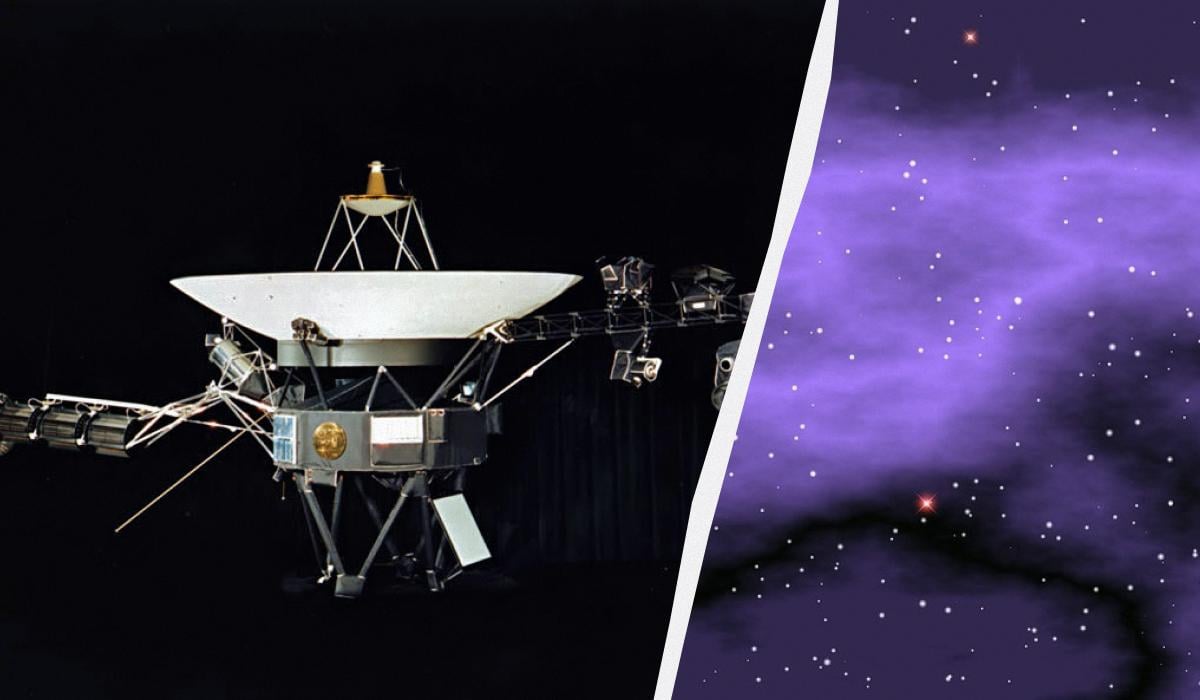
NASA's Voyager 1 and Voyager 2 probes have recorded temperatures of 30,000 to 50,000 degrees Celsius at the edge of the solar system, according to a report by Divany.
The two spacecraft have been travelling away from Earth for almost 50 years and have now reached the region where the Sun's influence fades and interstellar space begins.
What the heliopause is
The boundary of the solar system is not a sharp line that a spacecraft simply crosses, the report explained. The Sun releases a constant stream of charged particles known as the solar wind, which forms a vast bubble around the solar system called the heliosphere.
At the outer edge of that bubble, the solar wind stops dominating the surrounding environment as it meets matter from interstellar space. This transition zone is called the heliopause.
Voyager 1 crossed the heliopause in 2012, and Voyager 2 followed in 2018, making them the first human-made objects to reach interstellar space.
A wall in name only
The so-called wall is a metaphor rather than a solid barrier. It refers to a very thin plasma made up of electrically charged particles, where material from the Sun and from interstellar space interacts.
Instruments aboard Voyager 2 gathered striking data, according to the report. Researchers measured temperatures of 30,000 to 50,000 degrees Celsius in interstellar space just beyond the heliopause, far higher than earlier models had predicted, which put the figure at 15,000 to 30,000 degrees.
The report noted that despite the extreme figure, the probes did not collide with a scorching wall.
Why the probes were not damaged
Temperature reflects the energy of a system of particles, not how many of them there are. Near the heliopause, particles are so sparse that even with their high energy, they transfer almost no heat to a passing spacecraft.
As a result, Voyager passed through the "fiery barrier" unharmed, the report said.
A more complex boundary
Voyager 2's measurements showed that the area around the heliopause is more complicated than a simple boundary, according to the report. Researchers identified a transition zone 1.5 astronomical units wide just before the heliopause, where plasma slows down, heats up and doubles in density compared with earlier readings.
At the heliopause itself, changes are even sharper, with plasma density shifting significantly in less than a day, the report added.
Ongoing mission
Neither Voyager has completed its mission. Both probes continue to study the interstellar medium, collecting measurements that were previously unavailable through direct observation.
Voyager 1 continues to supply data on the density of interstellar plasma, while Voyager 2 confirmed another unexpected finding, that the direction of the interstellar magnetic field resembles the one measured in the region dominated by the Sun, according to Divany.