American physicists have detected a signal that could be the first direct evidence of dark matter, the invisible substance believed to make up nearly a third of the universe, according to the science outlet Qubit.
The finding comes from the LUX-ZEPLIN (LZ) experiment, whose results were unveiled on September 1 at a particle physics conference in Japan. Analysing data collected in 2023 and 2024, researchers recorded a flash of light consistent with what would be expected from a collision with a WIMP, or weakly interacting massive particle, one of the leading theoretical candidates for dark matter.
How the detector works
The LUX-ZEPLIN detector sits 1.6 kilometres underground at the Sanford Underground Research Facility in South Dakota. It consists of a giant tank holding 10 tonnes of liquid xenon. When a dark matter particle passes through the Earth and strikes a xenon atom, it produces a flash of light that researchers use to identify the source of the impact.
Why scientists are searching for dark matter
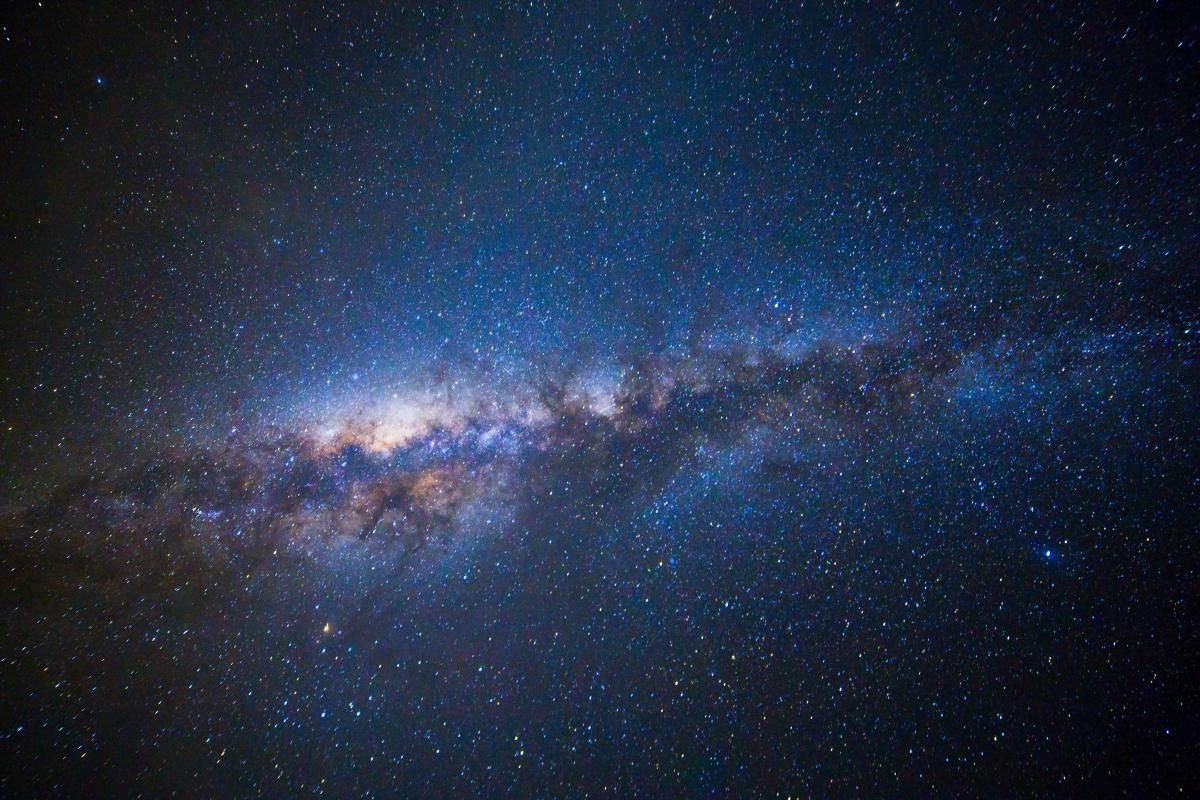
No one has ever directly observed dark matter. Its existence is inferred from gravity, which appears to hold galaxies and galaxy clusters together in ways that visible matter alone cannot explain. Study co-author Aviv Kamaha, of the University of California, Los Angeles, described dark matter as the "cosmic glue" that allowed the Milky Way and other galaxies to form.
Kamaha said that without dark matter, the universe would have developed in a completely different way, and the structures that eventually gave rise to the solar system might never have formed.
Far from a confirmed discovery
The statistical significance of the signal is 2.6 sigma. Physics requires a threshold of 5 sigma, ruling out the possibility of coincidence, before a result can be officially recognised as a discovery.
The LZ team has far more data than it has released so far. The initial findings are based on just 220 days of the detector's operation, even though it has actually been collecting data for more than 700 days. Researchers say most of those additional records remain unexamined for now, so the team does not unconsciously shape the results to fit expectations.
A separate challenge to dark matter
The announcement follows an earlier, unrelated claim from another physicist, who questioned the existence of dark matter altogether and proposed a new age for the universe. Under that researcher's model, the universe could be nearly 26.7 billion years old rather than 13.8 billion, with the accelerating expansion of space explained without invoking dark energy or dark matter, attributing it instead to physical constants that change over time and a concept known as "tired light."