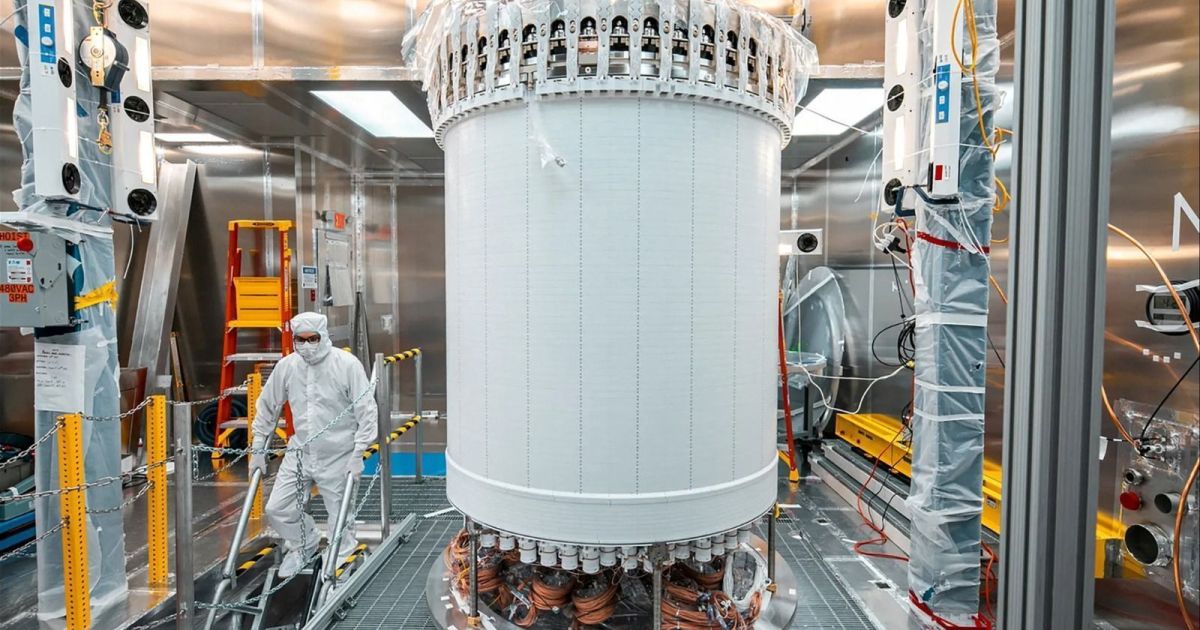
Scientists at the Sanford Underground Research Facility in South Dakota have recorded a rare particle interaction that may represent a weakly interacting massive particle, or WIMP, a leading candidate for dark matter.
The observation occurred during an ongoing experiment located about 1.5 miles underground in a converted former gold mine, where researchers registered a single collision between a subatomic particle and a liquid xenon atom.
Researchers announced the potential finding on Tuesday during a scientific conference in Japan and described their observations in a study submitted to the peer-reviewed journal Physical Review Letters. The experiment, known as LUX-ZEPLIN or LZ, is managed by the Lawrence Berkeley National Laboratory under the United States Department of Energy.
Sam Eriksen, a particle physicist at the University of Bristol in England and lead author of the study, said the interaction could mark the first hint of an observation of dark matter. However, Eriksen emphasized that because the team registered only a single event, researchers are not claiming to have definitively discovered dark matter.
The LZ experiment uses 10 metric tons of liquid xenon held within a large cylindrical detector vessel. The setup is designed to detect the extremely rare instances when dark matter particles scatter after colliding with ordinary matter.
Detection of nuclear recoil
When a particle collides with a xenon atom inside the detector, the interaction produces flashes of light whose specific properties reveal what type of particle made contact. In the registered event, what may have been a WIMP struck the nucleus of a xenon atom, transferring a small amount of energy.
This collision produced a faint flash of ultraviolet light that was picked up by the experiment's detector. The impact also propelled the nucleus of the xenon atom forward in a physical reaction known as nuclear recoil, matching the theoretical behavior expected from a WIMP collision.
Co-author Alvine Kamaha, an astrophysicist at the University of California, Los Angeles, said researchers might be looking at something extraordinary but noted that scientists must rule out alternative explanations before drawing definitive conclusions.
The Sanford Underground Research Facility operates in Lead, South Dakota, within the deep subterranean tunnels of the historic Homestake Gold Mine. Operating deep underground provides a vital shield of rock that protects sensitive particle physics experiments from cosmic rays and surface radiation noise.
The search for cosmic glue
Ordinary matter composes stars, planets, people, and everything visible in the universe, but it accounts for only about 15 percent of all cosmic matter. The remaining 85 percent is believed to be dark matter, which neither emits nor reflects light, rendering it invisible to the human eye and conventional telescopes.
Despite its invisibility, scientists are confident dark matter exists because of its gravitational effects on galactic scales. Kamaha explained that when astronomers observe galaxies and galaxy clusters, the structures behave as though they contain far more mass than can be accounted for by visible matter alone.
Kamaha described dark matter as a form of cosmic glue that enabled galaxies such as the Milky Way to form. Without its gravitational influence, the universe would have evolved differently, and structures that led to the formation of our solar system might not have taken shape in the same way.
A primary hypothesis among physicists is that dark matter consists of a type of subatomic particle created during the early moments of the universe that remains present today. Kamaha noted that millions of dark matter particles could pass through a human body every second with almost none interacting with an atom.
Underground shielding and next steps
Scientists pursue dark matter research through three complementary methods: studying its gravitational effects on galaxies, attempting to create dark matter particles in high-energy particle accelerators, and conducting direct detection experiments buried deep underground.
Direct detection facilities like LZ use liquid xenon because of the element's high atomic density, which improves the probability of capturing rare interactions. The deep rock overburden shields the 10-ton xenon container from background radiation, enabling scientists to isolate the rare events where dark matter collides with ordinary matter.
Researchers are currently working to analyze the single collision event further while continuing detector operations in South Dakota to gather more data and rule out background interference.