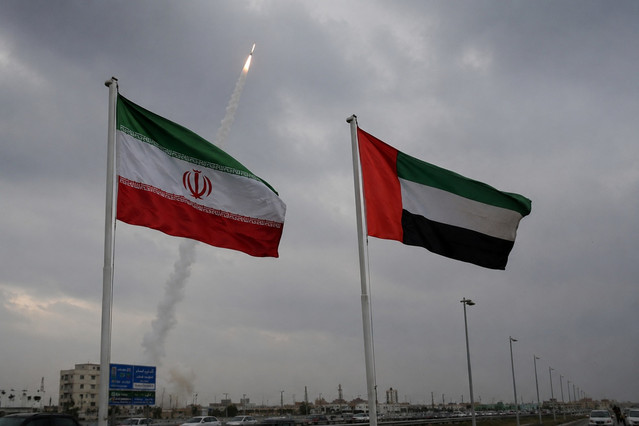
The United Arab Emirates has suspended all commercial and financial transactions with Iran following accusations that Tehran launched two ballistic missiles at Gulf maritime shipping on Tuesday.
According to the UAE Ministry of Defence, national air defence systems detected the incoming ballistic missiles, which had been fired from Iranian territory. One of the weapons fell into international waters outside Emirati jurisdiction, while the second missile landed inside UAE territorial waters off the country's coast.
Authorities in Abu Dhabi, the capital of the United Arab Emirates, asserted that the missiles specifically targeted maritime navigation passing through the crucial Gulf trade routes.
Iranian denial and warning
Tehran responded swiftly to the allegations, denying any involvement in the missile launches. Iranian Ministry of Foreign Affairs spokesman Esmaeil Baghaei said Iran categorically rejects the claim made by the United Arab Emirates that a missile was launched against the country.
Baghaei stated that such accusations damage the climate of trust among regional neighbours and undermine ongoing efforts to restore stability to the Middle East. He also warned of potential provocation operations carried out by third parties to intentionally escalate tensions between the two nations.
Suspension of economic ties
Hours after the missile incident was reported, the Emirati government announced a complete halt to bilateral economic activities. Afra al-Hameli, the director of strategic communication at the UAE Ministry of Foreign Affairs, said that in light of regional escalations, all commercial exchanges and financial transactions with Iran have been suspended until further notice.
The decision marks a major diplomatic setback after both countries had spent months attempting to ease long-standing regional rivalries and rebuild bilateral relations. According to the Financial Times, the two Persian Gulf states had recently taken concrete steps toward resuming full trade and restoring direct commercial air links, initiatives that are now threatened by the renewed dispute.
Strait of Hormuz tension
Maritime friction in the strategic Gulf shipping lanes has escalated in recent weeks. The UAE has repeatedly accused Iranian forces of targeting merchant vessels linked to Emirati interests. On August 8, the UAE Foreign Ministry condemned a missile attack on a ship associated with the state oil enterprise ADNOC as the vessel transited the Strait of Hormuz.
The renewed clash comes as security remains high in the Strait of Hormuz, a narrow sea passage that handles a substantial share of the global petroleum trade. Shipping activity through the waterway has been restricted, with officials in Tehran and Washington offering conflicting accounts regarding the operational status and security of the passage.