

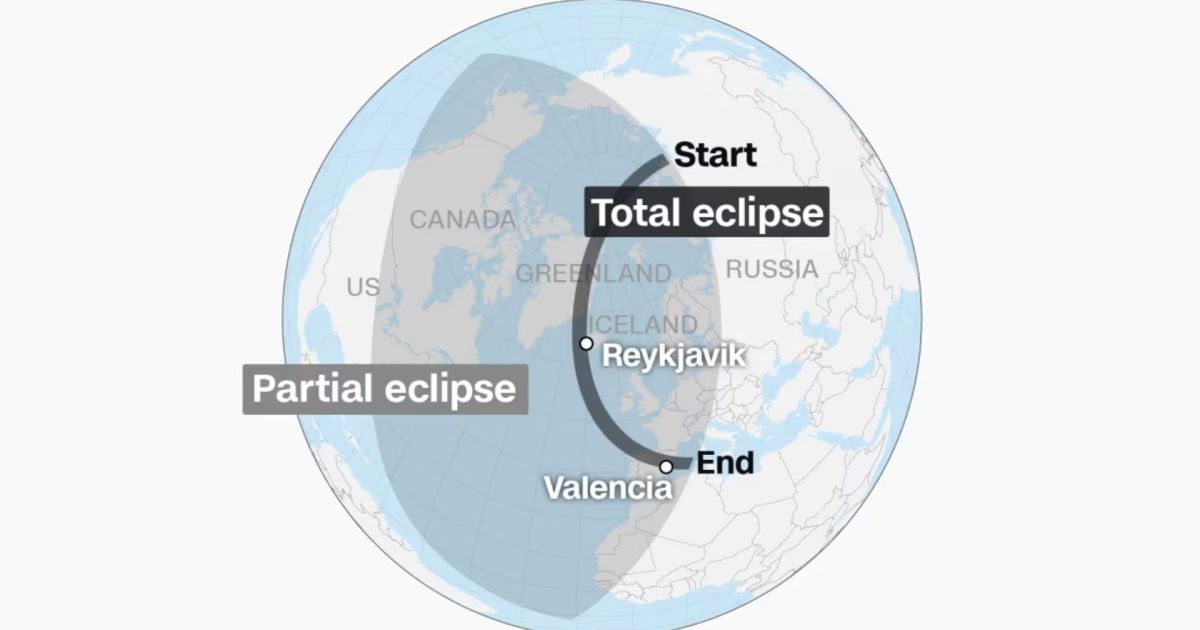
Eclipse cartographer Michael Zeiler is currently aboard the expedition ship Ocean Explorer, sailing toward the fjords of Greenland to observe the total solar eclipse taking place on Wednesday, August 12.
The veteran eclipse chaser has an ambitious goal: to make the first recorded observation of the northern lights during the totality of a solar eclipse. He also said he hopes to spot some meteors from the Perseid meteor shower, which is currently active.
Catching both spectacles at once will take some luck. The good news is that watching the total solar eclipse itself will not. Thanks to powerful computer models and precise measurements, scientists can determine an eclipse's path years, decades or even millennia in advance.
Zeiler, an eclipse cartographer and founder of the website EclipseAtlas.com, knows this better than most. He has been creating eclipse maps for more than two decades, showing the public the path of totality so others have the chance to see, and even chase, eclipses. He has been chasing them himself since he saw his first total eclipse in 1991.
Zeiler said his personal mission is to combine scientific precision with cartographic beauty, adding that for an eclipse map to truly work, it first has to be correct and accurate, but it also has to communicate the important information effectively.
His maps are built on thousands of years of astronomical observations, mathematical calculations and increasingly precise measurements of the Earth-Moon-Sun system, which let scientists predict exactly where the Moon's shadow will fall on the planet, and who will have a front-row seat to totality.
Who will be able to see this year's total solar eclipse
A total solar eclipse darkens the sky when the Moon passes between the Sun and Earth, casting a shadow over the planet and blocking sunlight in certain areas of the world, according to NASA.
Because the Moon, about 3,475 kilometers in diameter, is much smaller than Earth, its darkest central shadow, known as the umbra, is only a few hundred kilometers wide. As the Moon moves along its orbit, this narrow shadow sweeps across Earth's surface, creating what is known as the path of totality.
People within the path of totality will experience a total solar eclipse, in which the sky briefly darkens as the Sun disappears behind the Moon's shadow. During this year's eclipse, totality will be visible to observers in parts of Greenland, Iceland, northern Spain and northeastern Portugal.
Outside the path of totality, observers in the penumbra, the lighter outer shadow of the Moon, will see a partial eclipse, in which only part of the Sun's light is blocked. People in parts of Europe, Africa and North America will be able to observe a partial solar eclipse this year.
The narrow path of totality will stretch 8,300 kilometers (5,157 miles), beginning over the Arctic coast at around 1pm Brasilia time and ending near the Balearic Islands at around 2:30pm Brasilia time. Depending on location, the duration of totality will vary. In Reykjavik, Iceland, for example, totality will begin at around 1:48pm Brasilia time and last about a minute, while in Leon, Spain, it will begin at around 2:28pm Brasilia time and last about two minutes. Time and Date's website has details on when the eclipse will occur in specific regions and what it will look like there.
Eclipse maps can also help people decide where they want to be to watch an eclipse. Zeiler said some eclipse chasers prefer to observe from the edge of the path of totality to see certain phenomena that cannot be seen near the center. One such event is known as Baily's Beads, when flashes of light shine through gaps along the Moon's uneven edge.
Totality maps are mostly quite accurate, but there is always room for improvement.
Solar physicist Alex Young, associate director for science communication in the heliophysics division at NASA's Goddard Space Flight Center in Greenbelt, Maryland, said the highest accuracy currently achieved is around one to one and a half kilometers. He said scientists have not yet reached accuracy on the scale of meters, but that they may get there one day.
Young pointed to calculations from the most recent total solar eclipse, visible in Mexico, the United States and Canada in April 2024. Those calculations showed the Sun's radius was slightly different from what had previously been estimated, a small difference that shifted the predicted edges of the path of totality in some areas.
He added that many solar missions are still operating and will keep providing data that could allow for even better calculations in the future.
After Wednesday's event, the next total solar eclipse will not occur until August 2, 2027. That eclipse will be visible in North Africa and the Middle East.
How eclipse paths are determined and mapped
Total solar eclipses never repeat on exactly the same path. However, the recurring alignment of Earth, the Sun and the Moon roughly every 18 years causes eclipses to follow a cycle that sends them along similar routes. Philippe Escoubet, a space plasma scientist and spokesperson for the European Space Agency, said Earth's rotation causes a slight variation of a few degrees in the path.
This cycle, now called the Saros cycle, was first recorded by the ancient Babylonians, who used clay tablets in the late pre-Christian era to track celestial objects and planets, according to the European Space Agency.
Thanks to this cycle, astronomers can predict the path of totality well in advance. Escoubet said that anyone standing in the path of totality is certain to see something spectacular.
Escoubet said that with the models available today, scientists can predict when an eclipse will occur with a margin of error of one minute. He said the only thing that could change that would be an alteration in the orbit of the Moon or Earth, which would require a very large asteroid to collide with one of them, something he said is highly unlikely.
Over the years, predictions have become more accurate as understanding of space has advanced. Galileo, for instance, observed in 1610 that the Moon was not perfectly spherical, allowing for more precise predictions of where the Moon's shadow would fall during an eclipse.
The Saros cycle is still used today to identify patterns in future eclipses, but Young said many other factors must also be considered, including the Moon's position in its orbit, its distance from Earth, and Earth's orbit around the Sun.
Beyond this complex geometry, the rotation of Earth and other objects in space changes over time and must be accounted for. Young said the Moon will eventually move far enough from Earth, in roughly 600 million years, that the planet will no longer experience total eclipses. He explained that this movement of the Moon slows Earth's rotation, but Earth's rotation also fluctuates unpredictably from year to year. To compensate for these changes, astronomers use a correction called Delta T, which accounts for the small difference between Earth's predicted rotation and its actual rotation over time.
Young said that difference, and the uncertainty around Delta T, is why eclipse predictions can only be made reliably forward or backward across a certain span of time, with confidence typically extending about 3,000 years into the future and about 2,000 years into the past.
But even with all the sophisticated science behind eclipse predictions, Zeiler said it is not just for astronomy enthusiasts. He said it is for everyone, because during the precious moments of totality, darkness suddenly envelops observers and, in the blink of an eye, the solar corona appears around the Moon in an incredible display of light on all sides, which he said is why people like him keep coming back.


