

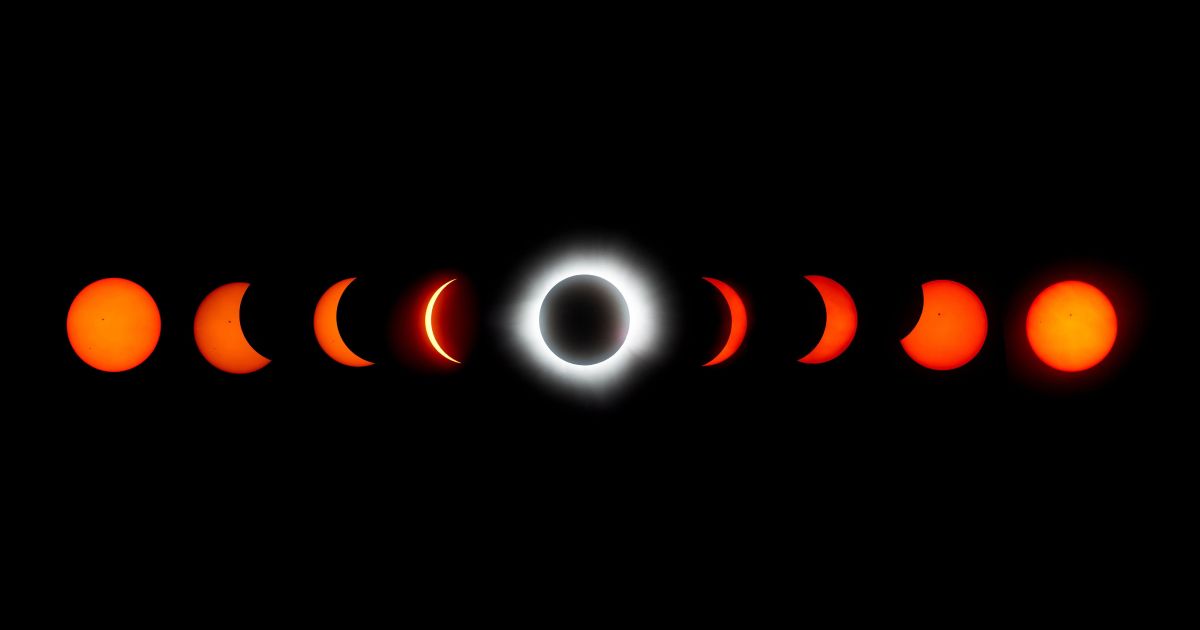
A total solar eclipse occurred on Wednesday, August 12, as the Moon passed between the Earth and the Sun, completely blocking sunlight for observers within a narrow band of the planet's surface. The phenomenon was visible in parts of Greenland, Iceland, northern Spain and a small stretch of northeastern Portugal. It could not be seen from Brazil.
The event happens when the Sun, Moon and Earth align. As the Moon positions itself between the Earth and the Sun, it casts a shadow on the planet. Depending on where an observer stands, the Sun's disk can be either fully or only partially obscured.
The lunar shadow has two parts. The umbra, its darkest region, is the area where the Sun is completely blocked and totality occurs. The penumbra, which covers a much wider area, is where only part of the Sun's disk is hidden.
Why solar eclipses don't happen every month
A solar eclipse can only occur during a new moon, when the Moon sits between the Earth and the Sun. Even so, that does not mean an eclipse happens every month.
The Moon's orbit around the Earth is tilted about 5 degrees relative to the plane of the Earth's orbit around the Sun. As a result, during most new moons the Moon's shadow passes above or below the Earth without reaching its surface.
When the alignment is right, the lunar shadow sweeps across a specific band of the planet. That is why a total solar eclipse can only be seen from a relatively small area, while a partial eclipse is visible across a much larger region.
The four types of solar eclipse
Solar eclipses fall into four categories: total, partial, annular and hybrid.
In a total eclipse, the Moon completely covers the Sun's visible disk. With the Sun's bright surface blocked, observers can see its outermost layer, the corona.
In a partial eclipse, only part of the Sun is covered by the Moon. In an annular eclipse, the Moon is farther from Earth, so its apparent size is not large enough to cover the entire solar disk, leaving a bright ring visible around it. A hybrid eclipse is rarer still, shifting between total and annular characteristics at different points along its path depending on the observer's position relative to the lunar shadow.
The path of Wednesday's eclipse
The band of totality for the August 12 eclipse began in northern Russia, near the Arctic, and continued through northeastern Greenland and western Iceland. It then crossed the North Atlantic before reaching northern Spain and a small area of northeastern Portugal.
Across most of the path, totality lasted less than two minutes. Near the center of the band, the period of complete coverage was slightly longer, with one of the longest points located in the North Atlantic near Iceland, at about 2 minutes and 18 seconds.
In Spain, the eclipse occurred late in the day with the Sun close to the horizon. In cities such as Leon, totality began at 8:28 p.m. local time and lasted about two minutes. In other parts of the country, the eclipse took place shortly before sunset, producing a sudden darkening of the sky.
The global maximum of the eclipse occurred at around 2:46 p.m. Brasilia time. That moment does not correspond to peak coverage in any single city, since the eclipse travels through different regions of the planet along its path.
Outside the band of totality, parts of Europe, northern and western Africa, and North America had the chance to see a partial eclipse, with varying levels of coverage of the Sun's disk.
What happens during totality
When the Moon fully covers the Sun, brightness drops sharply and the sky can take on an appearance similar to early evening. Temperatures can also fall, and some of the brightest stars and planets may become visible. In the moments around totality, other effects can appear.
One is the so-called diamond ring, formed by the last point of sunlight visible before the Sun's disk is completely covered. Baily's beads can also appear, small points of light produced as sunlight passes through valleys and irregularities on the Moon's surface.
Another phenomenon linked to total eclipses is shadow bands, light and dark stripes that can move rapidly across nearby surfaces in the moments just before and after totality. The most widely accepted explanation ties the effect to the way sunlight, reduced to a thin crescent, passes through the Earth's atmosphere and is disturbed by turbulence.
Why looking directly at the Sun is dangerous
Looking directly at the Sun during a partial eclipse, or during the partial phases of a total eclipse, can cause serious and permanent damage to the retina. The danger is that this kind of injury can occur without pain and is not always noticed right away.
Regular sunglasses do not provide enough protection. Viewing the eclipse safely requires proper solar filters, such as eclipse glasses that meet the ISO 12312-2 standard. Optical equipment including cameras, binoculars and telescopes also needs specific solar filters.
The only exception is during totality, when the Moon fully covers the Sun's bright disk. In that brief window, it is safe to look at the eclipse without eye protection. As soon as any part of the Sun reappears, filters must be used again.
How to follow the eclipse from Brazil
Because the eclipse was not visible from Brazil, people in the country were able to follow the event through live broadcasts from space agencies and observatories.
NASA broadcast images from different points along the eclipse's path, while the European Space Agency also provided coverage from Europe. The broadcasts allowed viewers to watch totality even from places where the event could not be seen directly.
A second eclipse in August, this one visible from Brazil
The August 12 solar eclipse is not the only such event this month. In the early hours of August 28, a partial lunar eclipse will be visible from all of Brazil.
During that event, the Moon will pass through the shadow cast by the Earth and may take on a reddish tone. At its peak, about 93% of the Moon's disk will lie within the umbra, the darkest part of the Earth's shadow.
Unlike a solar eclipse, watching a lunar eclipse requires no special eye protection. It can be observed directly, weather permitting.
The next total lunar eclipse that will be visible across all of Brazil in this way is expected on the night of June 25 into June 26, 2029.
Next total solar eclipse due in 2027
The next major total solar eclipse will take place on August 2, 2027, with a path crossing southern Europe, North Africa and the Middle East.
The event will be especially long. At its point of greatest duration, totality will reach 6 minutes and 23 seconds, making the 2027 eclipse one of the most striking of the coming decades. On land, it will be the longest total solar eclipse since 1991.
The exceptional duration is tied to the relative positions of the Earth, Moon and Sun. At the time, the Moon will be near perigee, the closest point in its orbit to Earth, while the Earth will be near aphelion, its farthest point from the Sun. With the Moon appearing larger in the sky and the Sun appearing smaller, the period of totality can stretch longer.
The 2027 band of totality will pass through regions including Spain, North Africa, Egypt and the Middle East. Like the eclipse of August 12, 2026, it will not be visible from Brazil.


