

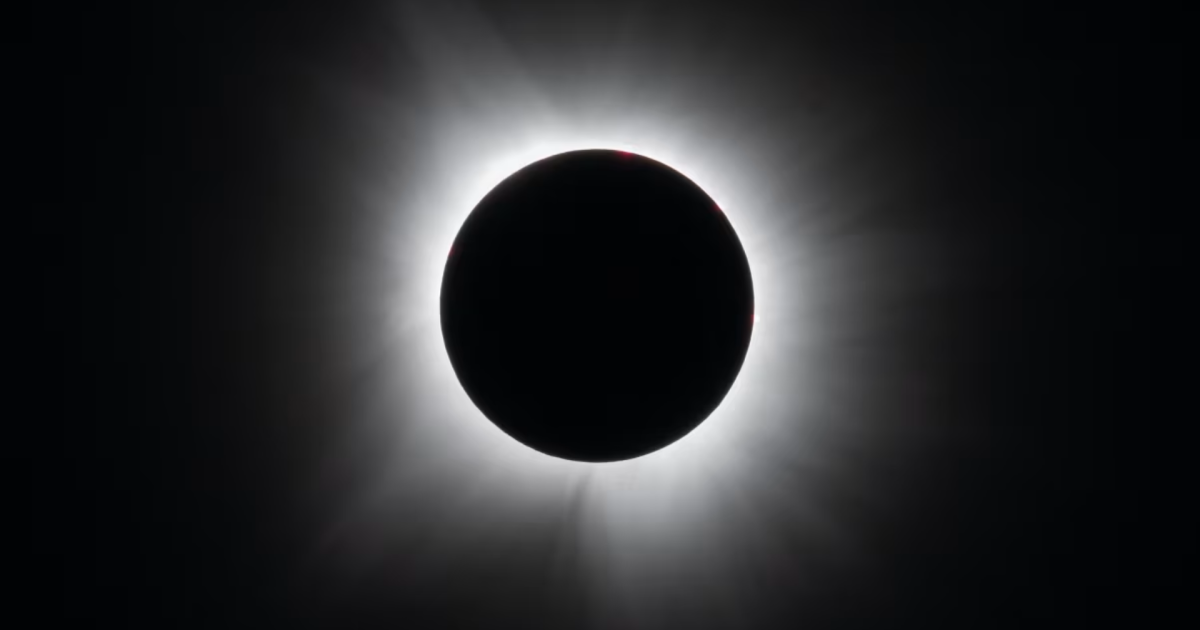
A total solar eclipse swept across parts of Greenland, Iceland, Portugal and Spain on Wednesday, August 12, 2026, as the Moon passed between the Earth and the Sun and completely blocked sunlight along a narrow band of the planet.
The path of totality measured about 8,300 kilometers. It began over the Arctic coastal region at around 1pm Brasilia time, then passed close to the North Pole before advancing toward Greenland, Iceland, Portugal and northern Spain.
During totality, the sky darkened in the middle of the day as the Moon fully covered the solar disk. The effect lasted just over two minutes in parts of Greenland, while in northern Spain it lasted only about 20 seconds.
Where the Eclipse Was Visible
Totality was confined to a narrow strip of the planet. The best viewing points were in Greenland, Iceland, northern Spain and northeastern Portugal, weather permitting. In Spain, the eclipse crossed Galicia and later the Balearic Islands. In some locations the phenomenon occurred near the end of the day, making the shift from daylight to darkness even more abrupt.
Beyond the path of totality, a partial solar eclipse was visible across other parts of Europe, Africa and North America, where the Moon covered only part of the Sun. In Brazil, the eclipse could not be seen with the naked eye, since the country fell outside the zones of visibility.
What Happens During an Eclipse
A solar eclipse occurs when the Sun, Moon and Earth align. The Moon passes in front of the Sun as seen from Earth and casts its shadow on the planet's surface. In the area struck by the darkest part of that shadow, known as the umbra, totality occurs, the solar disk is fully covered and light levels drop sharply.
The sudden change in lighting can also affect animal behavior. According to astronomer Alberto Silva Betzler, birds such as chickens can display behavior associated with nighttime, including returning to the spots where they usually roost.
How to Watch the Eclipse
For those outside the path of totality, one option was to follow the event online. The European Space Agency broadcast totality live from the Javalambre Astrophysical Observatory in Teruel, Spain. The stream ran on YouTube, allowing viewers to watch the moment of the eclipse even in regions where it was not visible in the sky.
Specialized platforms such as Time and Date could also be checked for the exact time, duration and type of eclipse visible at a given location.
When the Next Total Solar Eclipse Will Happen
The next total solar eclipse is expected on August 2, 2027. Its path of totality will cross southern Spain, northern Africa, Saudi Arabia and Yemen.
Wednesday's eclipse was the first total solar eclipse in more than two years and forms part of a sequence of astronomical events that will be observable across different regions of the planet in the coming years.


