

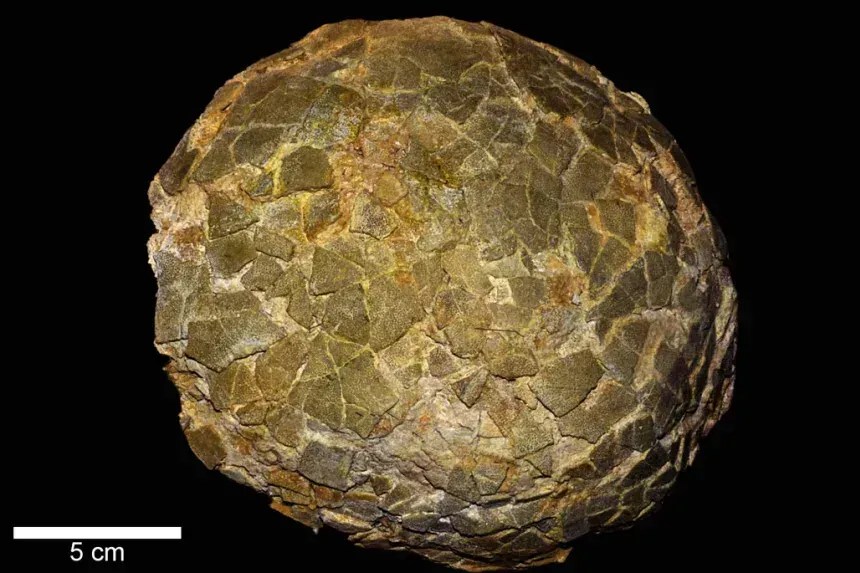
The largest dinosaurs that ever lived were able to reproduce at high latitudes, far from the equator, and developed a clever strategy to keep their eggs warm, according to a study of titanosaur eggs discovered in Argentina.
Most titanosaur eggs and eggshells, like those of other dinosaurs, have been found at lower latitudes closer to the equator, where warmer temperatures would have made incubation easier.
Scientists believe these long-necked, small-brained herbivorous giants, known as sauropods, lived in herds and may have migrated long distances, nesting at the same site for thousands of years.
Their bones have been found as far south as Antarctica and southern Argentina, and as far north as Mongolia and Texas, said Darla Zelenitsky, a paleontologist and associate professor at the University of Calgary in Alberta and one of the lead authors of the new research, published Tuesday in the journal Royal Society Open Science.
Zelenitsky said it was clear the animals spent time in higher-latitude areas, but until now it was not known whether they were also nesting there.
Unlike some smaller dinosaur species and modern birds, paleontologists are fairly certain titanosaurs did not sit on their own eggs. Zelenitsky said their enormous size would have turned the nest into a giant omelette.
As a result, titanosaurs were probably not attentive parents. Like most reptiles, they likely laid their eggs and left the hatchlings to fend for themselves.

Eggs still need warmth to develop and hatch, and sunlight is scarcer at higher latitudes. The study suggests titanosaurs found a way to cope with cooler temperatures in the more southerly regions of the planet, even though the climate at those latitudes during the late Cretaceous was not as cold as it is today.
Zelenitsky said the most likely scenario was that the titanosaurs laid their eggs in mound-shaped nests made of vegetation and soil, where the heat for incubation came mainly from decomposing plant matter. She said the eggshells were very porous, meaning that if the eggs were left exposed, they would lose water, dry out and the embryos would die. Buried in sand, soil or vegetation, she said, the nest would stay moist enough for the eggs to survive.
Nests the size of picnic tables
Researchers uncovered 255 eggshell fragments at the Chorrillo Formation in southern Argentina, 322 kilometres (200 miles) north of the Strait of Magellan, the sea route at the southern tip of South America, during digs in 2020 and 2024. The eggs date back 68 million years, when the site would have sat between 55 and 60 degrees south latitude. According to the study, the clutches represent the highest-latitude nesting environment known for sauropods anywhere in the world, and the southernmost confirmed evidence of dinosaur eggs.
Steve Brusatte, a professor of paleontology and evolution at the University of Edinburgh who was not involved in the research, said what makes the discovery particularly important is that the eggs belonged to titanosaurs, giant long-necked dinosaurs with prominent bellies.

Brusatte said some of the largest animals in Earth's history laid eggs and gave birth to their young at high latitudes during the Cretaceous, a new fact about dinosaur biology and behaviour that allows scientists to better appreciate their adaptability and resilience.
Paul Upchurch, a professor of paleobiology at University College London who also was not part of the research team, said sauropod remains are rare at high latitudes and that it had been thought the giants migrated to these areas during warm summers before returning closer to the equator. He said that now that eggs have been found at a high latitude, it suggests the animals may have stayed there year-round, or at least were able to complete their reproductive cycle during the warm season at these higher latitudes.
Titanosaurs include the largest known dinosaurs, with some individuals estimated at up to about 75,000 kilograms, more than eight times the size of a Tyrannosaurus rex. Dinosaur eggs are rare in the fossil record because the shell is relatively thin and fragile, breaking quickly into small pieces and making preservation difficult.

Mystery species
It is not clear which titanosaur species the eggs belonged to, but teeth found at the same site came from colossosaurs, among the largest titanosaurs, though not the biggest.
Zelenitsky said that if the eggshells do belong to colossosaurs, the hatchlings must have had access to plenty of nutritious food resources in that environment to begin packing on tons of weight and eventually reach their colossal body sizes.
Although these dinosaurs were enormous, their eggs were tiny, about 1/18,000th the size of an adult dinosaur, holding roughly 4 litres of fluid, with hatchlings weighing around 4 kilograms (about 9 pounds).
Even so, titanosaur nests would have been large enough to leave a noticeable mark on the landscape, especially if the dinosaurs nested in colonies. Zelenitsky said she imagines the nest as a mound of earth and vegetation the size of a picnic table, with the eggs buried inside, so it probably was not a discreet structure.



