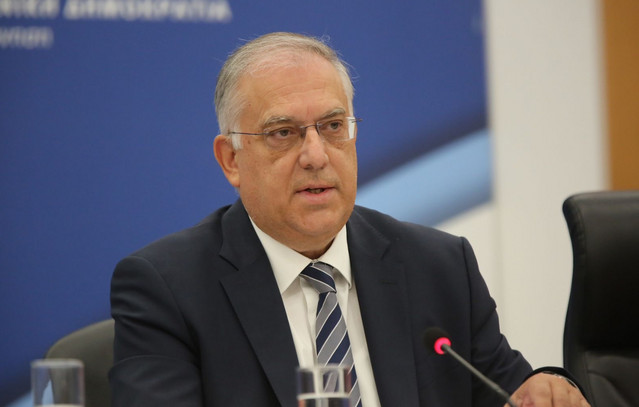
Greek Development Minister Takis Theodorikakos has announced that around 1,500 supermarket products will have their prices reduced starting on Monday under a national initiative.
Speaking on the main evening news broadcast of Greek public television channel ERT3, Theodorikakos outlined measures aimed at lowering the cost of living while detailing major state funding for infrastructure and industrial projects across northern Greece.
The price reduction scheme, officially titled the National Price Reduction Initiative, takes effect on August 31 and will run for four months to assist households facing financial pressure.
Supermarket price cuts and food inflation
Under the initiative, participating supermarkets will offer discounts of at least five per cent on a significant selection of essential food and basic living items over a four month period.
Theodorikakos explained that addressing cost of living challenges requires a combined strategy of increasing household incomes while simultaneously working to curb or lower retail prices.
Citing official figures from Eurostat, the statistical office of the European Union, the minister noted that food prices in Greece fell by 2.3 per cent from June to July, bringing annual food inflation to minus 0.4 per cent.
However, he clarified that the administration does not view the problem of high prices as resolved, adding that government officials are neither celebrating nor resting on their laurels.
Diesel fuel subsidy extension
The minister also addressed government support for diesel fuel prices at the pump, a temporary relief measure currently set to expire on August 31.
Theodorikakos stated that he had discussed extending the pump subsidy with Prime Minister Kyriakos Mitsotakis, adding that a continuation of the relief measure was likely.
He noted that the ultimate duration of any extension would depend on developments across international fuel markets.
Industrial investments in Macedonia
Turning to economic development in northern Greece, Theodorikakos revealed that the Ministry of Development is currently financing 282 separate investment projects across the region of Macedonia.
The funding package totals approximately 1 billion euros and is projected to create more than 5,000 new jobs, with a substantial portion focused on manufacturing and industrial operations.
He emphasized that strengthening the industrial sector is central to establishing a more productive, competitive and resilient national economy.
Infrastructure projects in Thessaloniki
The minister highlighted several flagship infrastructure projects underway in Thessaloniki, the second-largest city in Greece and the administrative capital of Central Macedonia.
Major initiatives currently in progress or planning include the further extension of the Thessaloniki Metro system, the comprehensive redevelopment of the Thessaloniki International Fair site, and the creation of a new Metropolitan Park.
Theodorikakos singled out the construction of a new Pediatric Hospital and the Flyover elevated expressway as key developments that will significantly transform the city's transport capacity and economic prospects.
He stated that Thessaloniki is entering a new era of growth aimed at securing an even stronger economic and geopolitical role across the wider Balkan region.
Describing the city as a protagonist in Greece's long-term strategic plan heading toward 2030, the minister affirmed the government's focus on sustainable regional expansion.
Border region incentives and demographic policy
Addressing regional growth disparities, Theodorikakos detailed a specialized development framework tailored specifically for border prefectures in northern Greece.
He directly linked regional economic incentives to tackling Greece's broader demographic challenges, including rural depopulation in frontier counties.
The targeted scheme aims to enable young people born and raised in border areas to remain in their home regions by providing expanded career opportunities and improved living standards.
Electoral goals and foreign policy
Asked about upcoming national elections, Theodorikakos declared that the governing New Democracy party aims to secure an outright parliamentary majority once again.
He said the party will approach the polls by presenting its legislative accomplishments and its strategic vision for Greece through 2030.
Concluding his broadcast interview with remarks on foreign policy, the minister addressed relations between Greece and Turkey, affirming that the government will not allow any challenge to the country's sovereign rights.
Theodorikakos concluded by stating that the administration's primary goal remains building a strong, productive and safe Greece.