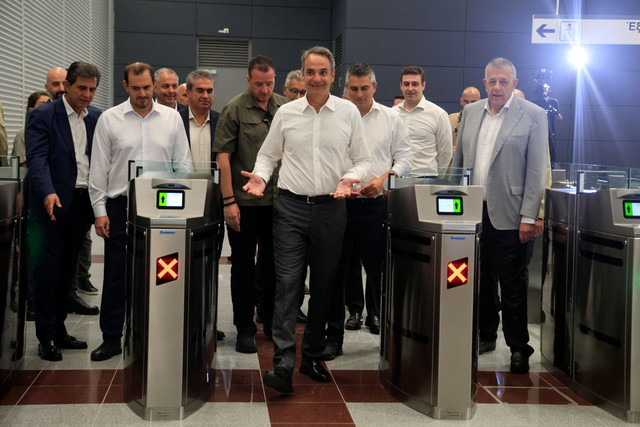
Greek Prime Minister Kyriakos Mitsotakis inaugurated the Thessaloniki Metro extension to Kalamaria on Thursday, August 27, opening five new stations along a 4.5-kilometre line.
The new branch expands the city's urban rail network to 18 stations across 15 kilometres, connecting the southern municipality of Kalamaria directly to the Thessaloniki city centre.
Thessaloniki is Greece's second-largest city and the principal economic centre of the northern region of Macedonia, while Kalamaria is a major coastal municipality located southeast of the urban core.
Inauguration ceremony at Mikra station
The official opening ceremony took place at Mikra station, situated at the junction of A. Papandreou and Pontou streets in Kalamaria. Mikra is the largest station on the extension and was selected to accommodate the invited guests.
Mitsotakis arrived at the ceremony by travelling on the new metro line. He boarded a train at Merarchias station and reached Mikra station within a few minutes for the official proceedings.
Speaking at the event, Mitsotakis recalled pressing the button at the depot in November 2024 to take the inaugural trip on the main line. He noted that it took 40 years of waiting, during which the Thessaloniki Metro was viewed as a long-running joke marked by parody inaugurations, to complete the basic network.
Mitsotakis said the city now boasts one of the most beautiful and modern metro systems in Europe, featuring some of the lowest ticket prices. He added that the government fulfilled its difficult commitment, saying we said it and we did it, despite years of objections, protests, and legal appeals that had delayed construction, increased costs, and left metal sheet hoardings lining city streets.
The prime minister said the government fought major battles against forces of denial and stagnation, taking on the political cost. He emphasised that it was a conscious political choice to return long-overdue infrastructure to Macedonia, adding that solid relationships of trust are built through consistency between words and deeds in an environment where cheap promises cost nothing.
European funding and regional transport links
European Commissioner for Sustainable Transport and Tourism Apostolos Tzitzikostas also addressed the ceremony, stating that history recorded the Thessaloniki Metro being completed and expanded under the leadership of Mitsotakis.
Tzitzikostas previously served as the Regional Governor of Central Macedonia, the regional authority encompassing the Thessaloniki metropolitan area, before taking up his executive role at the European Commission in Brussels.
Tzitzikostas said the metro is evolving from a single line into a true network, adding five stations and nearly five kilometres of track that put the city centre about 15 minutes away from Mikra. He projected that the extension will initially carry 63,000 passengers daily and remove 12,000 vehicles from local roads.
The commissioner noted that the metro was built for residents who commute, work, study, and raise families, as well as for visitors supporting year-round quality tourism in a city with 23 centuries of history. He added that Thessaloniki is changing how it views itself, moving from discussing missing infrastructure to expanding what it has acquired.
Acknowledging past hardship for local residents and pressure on local businesses during years of delays and mockery, Tzitzikostas praised the determination of the prime minister to complete the project. He thanked the leadership of the Ministry of Infrastructure and Transport, project contractors, and metro workers for their cooperation.
Tzitzikostas highlighted the project's strong European backing, noting that more than one billion euros in European Union funds supported its construction. He stated that EU resources have also funded new electric buses currently operating in Thessaloniki, urban green space at Pavlos Melas Metropolitan Park, and major transport links.
The commissioner highlighted the strategic Aegean to Black Sea road and rail corridor connecting Thessaloniki with Alexandroupoli, and continuing to Bucharest through Bulgaria. He described the corridor as a top priority in Brussels, vital for trade, exports, tourism, and military mobility as geopolitical, energy, and economic shifts alter the European centre of gravity.
Network operations and station details
The new branch operates as an integrated network with the existing main line running between Neos Sidirodromikos Stathmos (New Railway Station), Nea Elvetia, and the Pylaia Depot, completing the urban rail system as designed.
The extension diverges after 25is Martiou station, adding five new stations: Nomarchia, Kalamaria, Aretsou, Nea Krini, and Mikra. Trains will alternate destinations between Mikra and Nea Elvetia at a two-to-one ratio, operating under a single automated control system.
Train frequency on the shared central section between Neos Sidirodromikos Stathmos and 25is Martiou will start at approximately three minutes. On the Kalamaria extension, average wait times between trains will be about 4.5 minutes.
Travel time from Mikra to Neos Sidirodromikos Stathmos will take between 24 and 26 minutes, depending on train rotation, bringing travel from Kalamaria to central Thessaloniki to under 20 minutes.
Future infrastructure and western expansion
Looking ahead to future developments, Mitsotakis announced that planning and implementation for extending the metro to the northwestern districts of Thessaloniki will begin at a fast pace. He stressed that residents in those working-class areas deserve modern infrastructure and are not children of a lesser God.
Mitsotakis outlined additional government infrastructure commitments for the city, including the Flyover elevated highway scheduled for completion in the first half of 2027, a three-line western suburban railway, the expansion of Pier 6 at the port of Thessaloniki, and the redevelopment of the Thessaloniki International Fair site.
Tzitzikostas pledged that in his role as EU transport commissioner he will help secure all available European funding for the western metro expansion, which will serve hundreds of thousands of residents, families, healthcare facilities, and business hubs. He urged rapid project preparation so no time is lost, expressing hope that officials will soon gather again to announce the start of construction in western Thessaloniki.