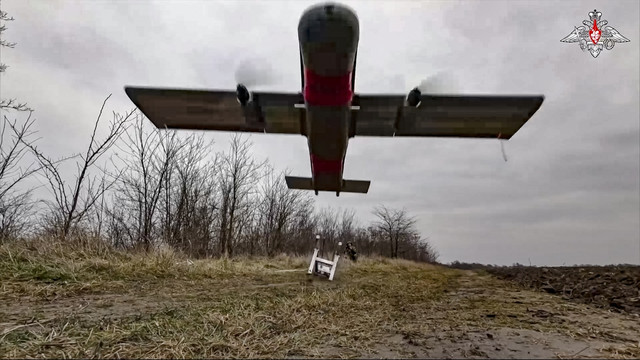
A Russian drone attack in Zaporizhzhia, Ukraine, killed three civilians in July using an experimental artificial intelligence system that appeared to select its own target without direct intervention from a human operator, according to a report by The New York Times.
Among the victims was 19-year-old student Tetiana Bubinets. The strike hit a fuel station in Zaporizhzhia, where the drone had been programmed to head toward the facility. As it approached, its onboard AI system reportedly took over the final recognition and selection of the impact point, most likely the site's propane tanks.
Military officials and experts who reviewed the evidence believe the system was trained on image-based object recognition, allowing it to identify on its own what it judged to be a suitable target.
Concern over autonomous weapons
The case has caused significant alarm, as it may be one of the first documented incidents in which a Russian drone with autonomous target-selection capability caused civilian deaths.
Colonel Serhii Minaiev, commander of Ukraine's air defense in Zaporizhzhia, warned that the development concerns not just the Ukrainian front but the future of warfare as a whole. He said it represents a danger for the entire world, adding that decision-making by machines without direct human intervention creates an entirely different level of threat.
The concern is not theoretical. A recent analysis by the Center for Strategic and International Studies found that Russia has invested systematically in developing unmanned AI systems and is moving gradually toward greater autonomy in navigation, reconnaissance and target selection.
Nvidia computing components found
Wreckage collected at the fuel station and at other attack sites in Zaporizhzhia contained Nvidia microcomputers, which are used for artificial intelligence applications.
Nvidia confirmed that the component recovered was a Jetson Orin computer, a system widely used for machine learning and image-processing applications.
Similar components have been found in other Russian unmanned systems. The Center for Strategic and International Studies has documented the use of Nvidia Jetson Orin units in Russian drones and notes that these systems can support autonomous recognition and target-selection functions through optical sensors.
Nvidia has clarified that these computers are general-purpose commercial products designed for students, developers, startups and a wide range of other applications. The company said it does not sell the products directly to Russia, though they can be obtained through resellers and international distribution chains.
From remote control to autonomous targeting
The difference between a conventional drone and a more autonomous system is substantial. With a conventional drone, an operator watches the video feed and personally decides when and where to strike. A more autonomous system can use cameras, sensors and machine-learning algorithms to recognize objects and continue its mission even without ongoing communication with a human.
According to an analysis by Kateryna Bondar, a senior fellow at the Center for Strategic and International Studies, Russia has developed systems that use artificial intelligence to recognize vehicles, infrastructure and human activity through imagery. She noted that this technology does not amount to full autonomy at every stage of an operation, but it does grant the weapon system greater independence on the battlefield.
Possibly the first recorded case with civilian deaths
Bondar said the July 6 attack in Zaporizhzhia may represent the first documented case in which a Russian drone with autonomous target-selection capability caused civilian deaths.
She also said the presence of components capable of supporting advanced AI processing is strong evidence that Moscow is actively experimenting with increasingly autonomous weapons systems.
Experts caution, however, that the presence of a powerful computing system on a drone does not by itself prove that every critical decision was made without human involvement. It does show, they said, that the technological infrastructure for such functions is already present on the battlefield.
The development is intensifying international debate over the limits of artificial intelligence use in weapons systems and over whether the final decision to carry out a lethal strike should remain mandatorily under human control.