

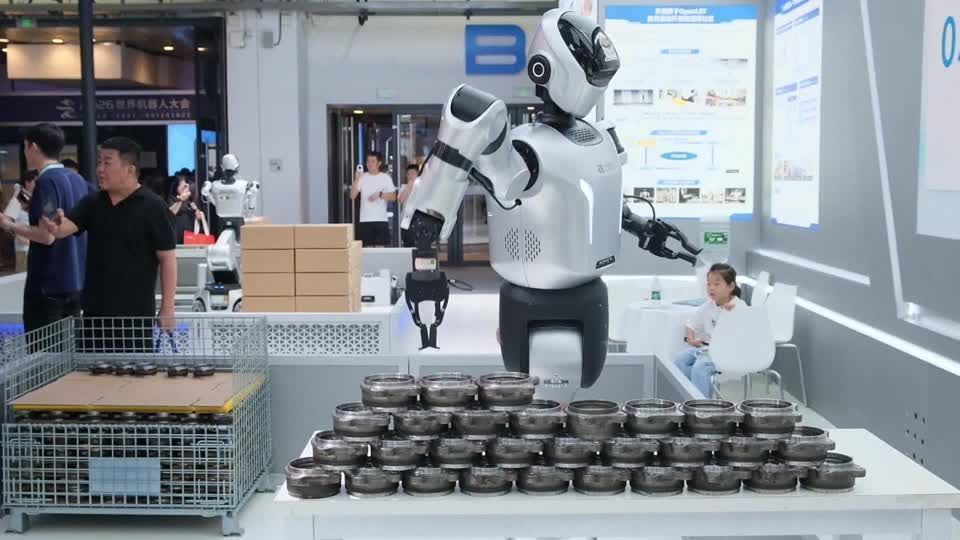
Chinese humanoid robot makers showed off machines sorting packages, packaging phones and helping with household chores at a crowded conference in Beijing on Wednesday, staging entertainment-focused demonstrations aimed at a broader commercial audience.
More than 300 companies, most of them Chinese, are taking part in the World Robot Conference, which runs in the Chinese capital until Sunday. Organizers said more than 2,000 items are on display and more than 150 products are being launched at the event.
The conference comes amid a surge in investor interest in humanoid robots, a potential new source of industrial growth for China and a field of technological competition with the United States.
Shares in Unitree, China's best-known humanoid robot maker, soared almost six-fold on their Shanghai stock exchange debut this week, after retail investor demand for the offering was oversubscribed more than 8,000 times.
Nvidia Executive's Surprise Visit
Madison Huang, a senior Nvidia executive and daughter of the US chipmaker's chief executive, Jensen Huang, made an unannounced visit to the event. She watched robots perform flying kicks and dance choreography before stopping at a company booth to ask about its sensors.
Huang, who drew onlookers much as her father has on previous trips to Beijing, oversees marketing for Nvidia's Omniverse and robotics platforms, software used to simulate and test physical AI, systems capable of perceiving and acting in the real world.
Despite geopolitical tensions and US restrictions on exporting Nvidia's most advanced AI chips to China, her visit underscored the role foreign suppliers play in China's push to develop robots for businesses and homes.
RealSense, a US maker of vision systems for robots and one of the few foreign exhibitors at the conference, said it is building sales partnerships in China as the sector develops. Mike Nielsen, the company's marketing director, said China is a very strategic market for the company and is becoming the center of humanoid technology.
Robotics Called an "Important Force"
At the opening ceremony, Xin Guobin, China's vice minister of industry and information technology, said robotics had become an important force in the country's economic and social development, according to local media reports.
Chinese robots are increasingly being tested in logistics, manufacturing and service settings. Zhang Dapeng, deputy vice president of Leju, a maker of industrial humanoid robots, said the company's most common applications were in logistics, as it demonstrated robots moving and sorting boxes and small objects. Zhang said European factories and Chinese automakers were using Leju robots to move boxes and carry components.
At Robotera's booth, a humanoid torso mounted on a wheeled tripod base sorted parcels. A company representative said the robot had been used at China's postal logistics facilities since last year, running on Robotera's own AI software. A sales representative said Robotera had more than 100 package-sorting robots deployed across 15 warehouses nationwide.
From Demonstrations to Deployment
Nearby, DexForce demonstrated humanoid robots packaging mobile phones into boxes on an assembly line. The robots have been operating since early this year at a factory run by Lens Technology, a Chinese supplier of touchscreens and other components for Apple and Huawei, said Nicole Yang, a DexForce representative.
Yang said the machines have operational precision on the order of millimeters and can detect and correct errors, such as a phone placed at an angle. She said humans are in theory the most skilled workers, but many factory employees are unwilling to do that kind of monotonous work.
Lumos Robotics is already using robots to automate the assembly of key modules at its factory and plans to introduce them to final assembly, said chief executive Yu Chao.
X Square Robot, known for its focus on household tasks, is trying to move beyond short trials of home services. Its longest deployment so far has lasted a month, and the company is testing robots in hundreds of homes this year ahead of a gradual commercial rollout next year, said co-founder Yang Qian.
Nielsen of RealSense said the companies most likely to succeed would be those able to put robots into active production environments, adding that China's fast development cycle is pushing suppliers to move more quickly. He said product cycles for robots are now closer to six to eight months, rather than three to four years.


