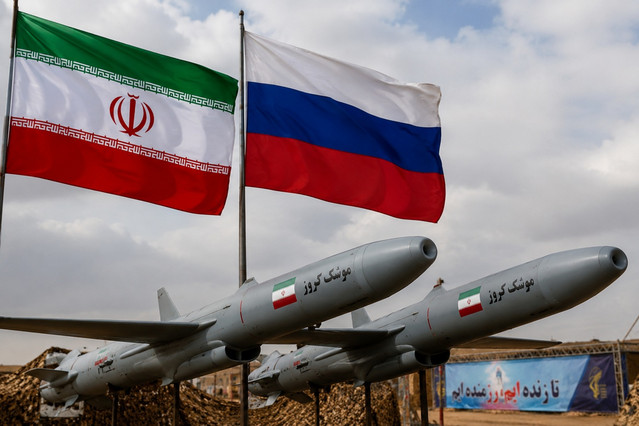
Russia has been providing secret technological support to Iran for nearly three years to help Tehran develop advanced hypersonic cruise missiles, according to an investigation by the Financial Times. The multi-year joint effort could significantly enhance Iranian military capabilities directed against American warships deployed in the Middle East.
The collaboration reportedly began in 2023 under a covert project codenamed C430L. According to the investigation by the Financial Times, a major British daily business newspaper based in London, the project involves Russian state arms exporter Rosoboronexport and technical specialists from NPO Mashinostroyenia. Rosoboronexport operates as Russia's sole state agency for defense exports, while NPO Mashinostroyenia is a leading Russian aerospace and missile design bureau headquartered in Reutov.
The newspaper's investigation drew upon leaked Russian correspondence, travel records, and military patent filings. Those documents indicated that Russian officials and missile specialists made repeated trips to Iran prior to the formal signing of an agreement with the Iranian Ministry of Defence and Armed Forces Logistics in November 2023, the executive body that oversees military procurement and defense manufacturing in Iran.
Ramjet engine propulsion technology
The central objective of project C430L is to supply Tehran with technical expertise to build a ramjet propulsion system. A ramjet is an air-breathing jet engine that uses the vehicle's forward speed to compress incoming air without a rotary compressor, allowing a cruise missile to sustain flight at speeds several times the speed of sound. Hypersonic weapons travel at velocities of Mach 5 or higher, representing speeds five times faster than sound, where extreme atmospheric friction demands specialized aerodynamic design.
Russian engineers reportedly gained direct access to Iranian technical data and analyzed flight test results from the propulsion system. Following those evaluations, the Russian specialists provided ongoing technical guidance to their Iranian counterparts to refine the propulsion design.
The ramjet propulsion technology is considered vital for developing both anti-ship cruise missiles and land-attack missiles. Combining hypersonic flight speed with a low-altitude flight profile drastically cuts down the reaction time available to air defense systems, making interception of incoming missiles significantly more difficult for naval and land defenses.
Threat to United States naval vessels
The development carries particular significance for United States naval forces operating in the Persian Gulf, a strategic waterway located between Iran and the Arabian Peninsula, as well as across the wider Middle East region. Iran has already demonstrated an extensive arsenal of ballistic missiles and unmanned aerial vehicles capable of targeting American military installations in the area.
However, striking moving and heavily defended naval units presents a distinct operational challenge compared to stationary ground installations. A fully developed hypersonic cruise missile powered by a ramjet engine would provide Tehran with a far more formidable weapon to target warships, including American aircraft carriers operating in regional waters.
Iranian engineers have reportedly already constructed and flight-tested the ramjet propulsion system. However, the Financial Times noted that it found no evidence showing that a finished hypersonic cruise missile developed with Russian assistance has been added to Iran's active military arsenal or deployed operationally.
Status and duration of the partnership
Records reviewed by the newspaper showed that the bilateral cooperation remained active until at least June 2026. Discussions were also taking place regarding the next phase of the joint project, though it remains unclear whether that subsequent stage has officially commenced.
If the full scope of the cooperation is confirmed, project C430L would represent one of the most significant known transfers of strategic military technology from Moscow to Tehran. The arrangement comes during a period in which defense relations between Russia and Iran have strengthened substantially across multiple military sectors.