Physicists at Ben-Gurion University of the Negev dropped cooled rubidium atoms inside a quantum interferometer to confirm that Einstein's theory of general relativity holds at microscopic scales.
The research team, comprising scientists from Ben-Gurion University in Israel, Ulm University in Germany, and the University of Oxford in the United Kingdom, published their study in the journal Science Advances.
Lead author Or Dobkowski and his colleagues demonstrated that quantum matter in free fall experiences gravitational phase shifts that align precisely with predictions from general relativity.
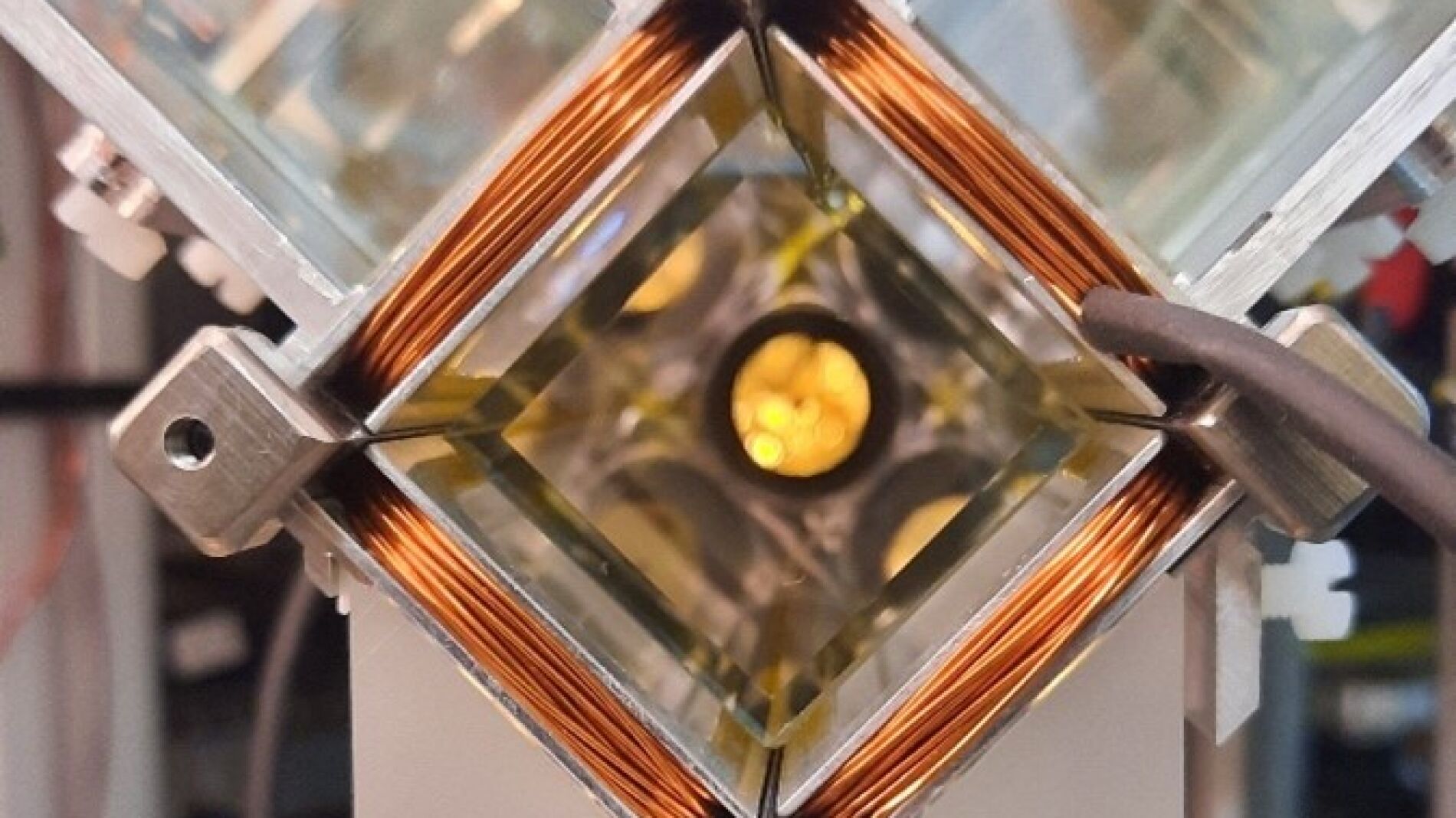
The experiment builds upon earlier atomic gravity tests, such as a 2014 study published in Physical Review Letters.
That earlier research dropped potassium atoms alongside rubidium atoms, which are more than twice as heavy as potassium, to verify Galileo Galilei's 1590 Tower of Pisa experiment at the atomic scale.
While the 2014 experiment proved that light and heavy atoms fall at identical rates, the new study tested whether general relativity and the equivalence principle apply to quantum particles undergoing free fall.
Testing gravity at atomic scales
Classical mechanics formulated by Sir Isaac Newton accurately describes the gravitational movement of everyday objects like cannonballs, humans, and falling raindrops.
Newtonian equations break down when applied to extremely massive celestial bodies or objects traveling close to the speed of light, where Albert Einstein's general relativity takes over.
General relativity defines gravity not as a direct mechanical force, but as the physical warping of space and time caused by mass.
At the opposite extreme, quantum mechanics governs subatomic particles and atoms, which exhibit wave-particle duality and behave like ripples in water.
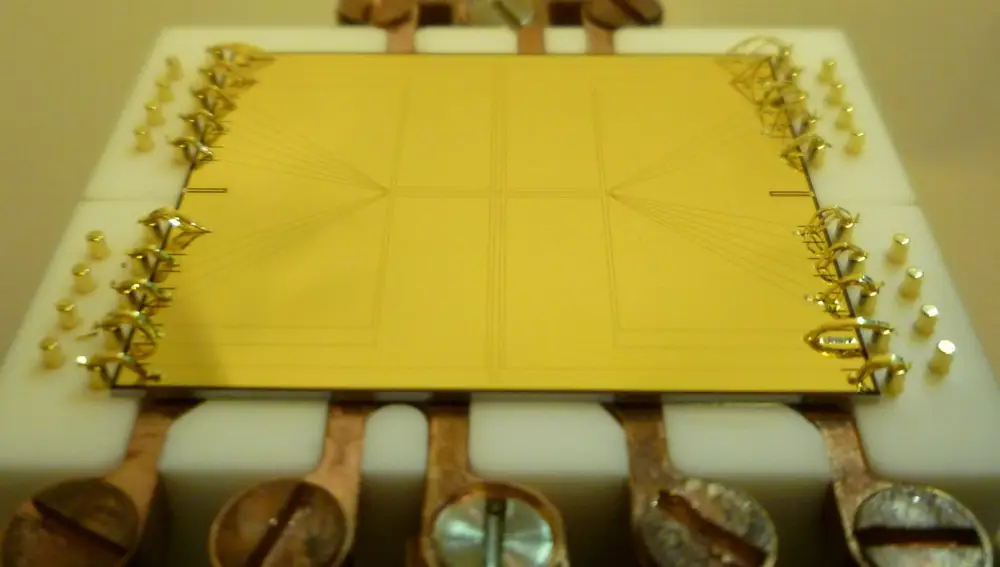
Einstein's theory predicts that an object undergoing free fall ceases to feel the effects of gravity.
This phenomenon occurs aboard the International Space Station, where astronauts float because the station falls toward Earth at 27,600 kilometers per hour while maintaining orbital velocity, even though gravity at that altitude remains roughly 80 percent of sea-level gravity.
Physicists sought to determine whether this cancellation of perceived gravity during free fall also holds true in the quantum realm.
The Galileo quantum interferometer
To measure gravitational effects on quantum waves, the research team engineered a specialized device called the Galileo quantum interferometer.
An interferometer splits a wave into separate paths and recombines them to measure any mismatch or phase shift between their crests and troughs.
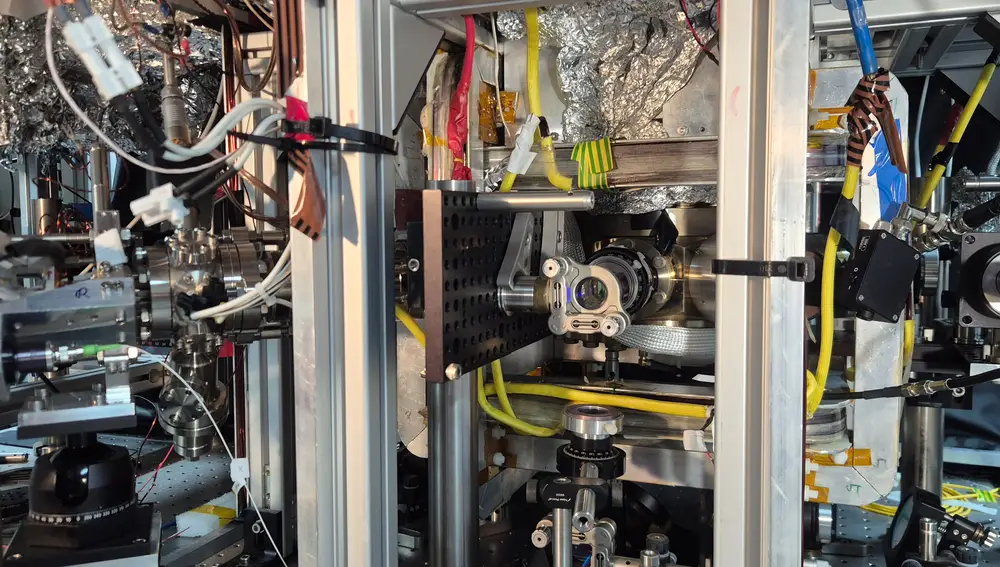
The experimental design incorporates a central vacuum chamber that mimics space-like conditions to shield atoms from external noise and environmental interference.
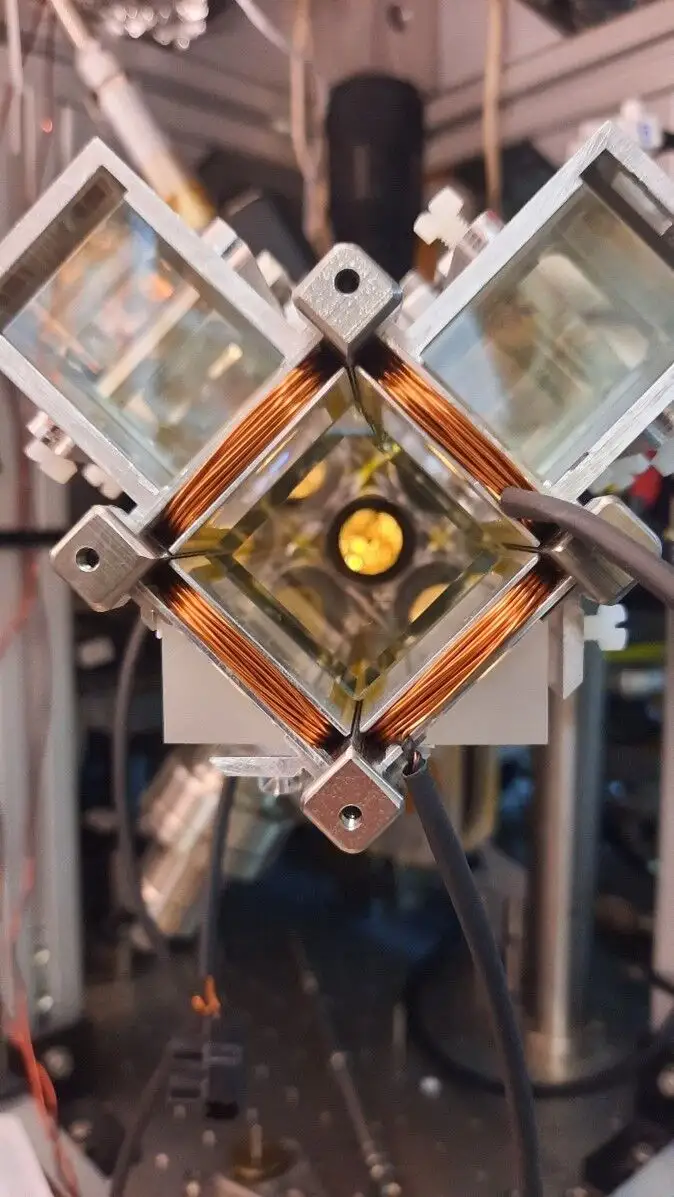
A two-dimensional magneto-optical trap (2D MOT) feeds cold atoms into the main chamber through a tiny aperture located in the center of a yellow surface.
Surrounding the chamber, a network of magnetic coils, antennas, and optical fibers traps, cools, and splits the atoms along two distinct pathways.
Cooling rubidium atoms on microchips
During the trial, scientists cooled rubidium atoms to minus 273 degrees Celsius, approaching absolute zero, which is the lowest temperature permitted by nature.
The ultra-cold atoms were placed onto a quantum atom chip, which was positioned upside down during the experiment to manipulate rubidium atoms from below.
Treating the atoms as wave packets, researchers used magnetic fields to hold one wave component stationary while projecting the second wave component upward.
The launched wave component fell back down under gravity, entering free fall until returning to its original location on the chip.
Researchers then measured the degree of phase shift between the wave crests of the dropped component and the stationary reference wave.
Implications for quantum unification
Results showed that the resulting phase shift matched calculations derived from Einstein's general relativity, confirming that gravity affects quantum wave packets as predicted.
Professor Ron Foldman of Ben-Gurion University of the Negev stated in a press release that while relativity and quantum mechanics have evaded attempts at a unified theoretical framework, this complex experiment provides additional clues toward achieving unification.
The researchers noted that unifying quantum mechanics and general relativity remains an exceptionally difficult challenge, cautioning that the findings represent an incremental step forward rather than an immediate theoretical breakthrough.