

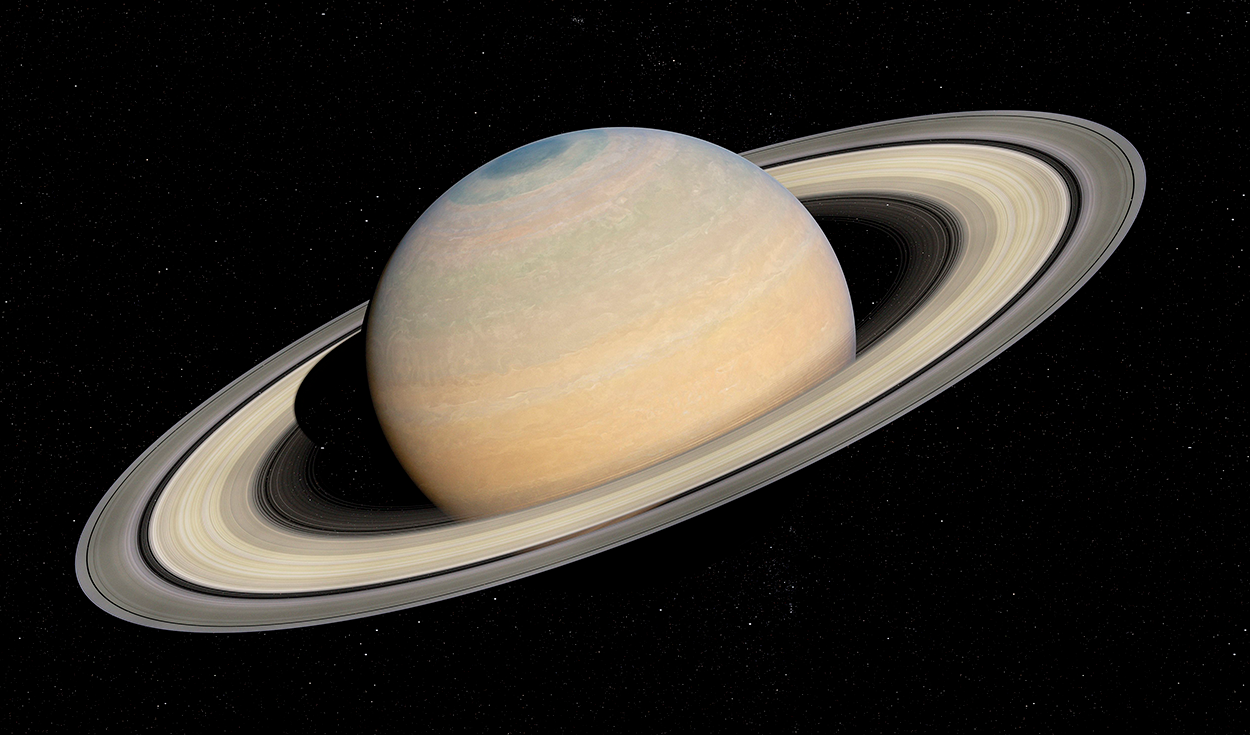
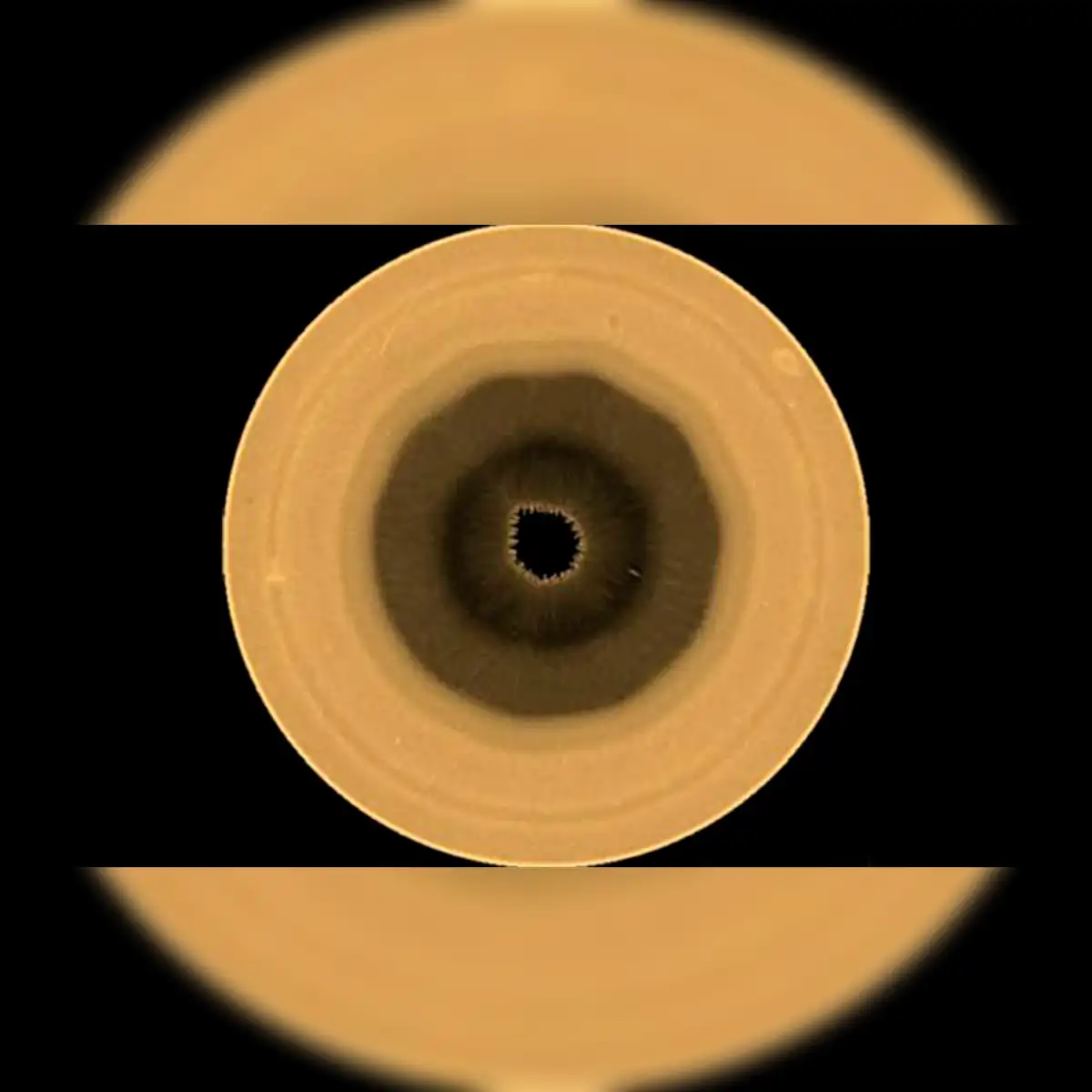
Astronomers using the Hubble Space Telescope have confirmed a giant ten-sided geometric structure spinning around the south pole of Saturn. The atmospheric decagon drifts eastward at approximately 10 kilometres per hour.
The pattern sits in the hemispherically opposite region to Saturn's famous northern polar hexagon. One of its ten sides measures more than 16,700 kilometres across, making it one of the largest structured atmospheric features observed in the solar system.
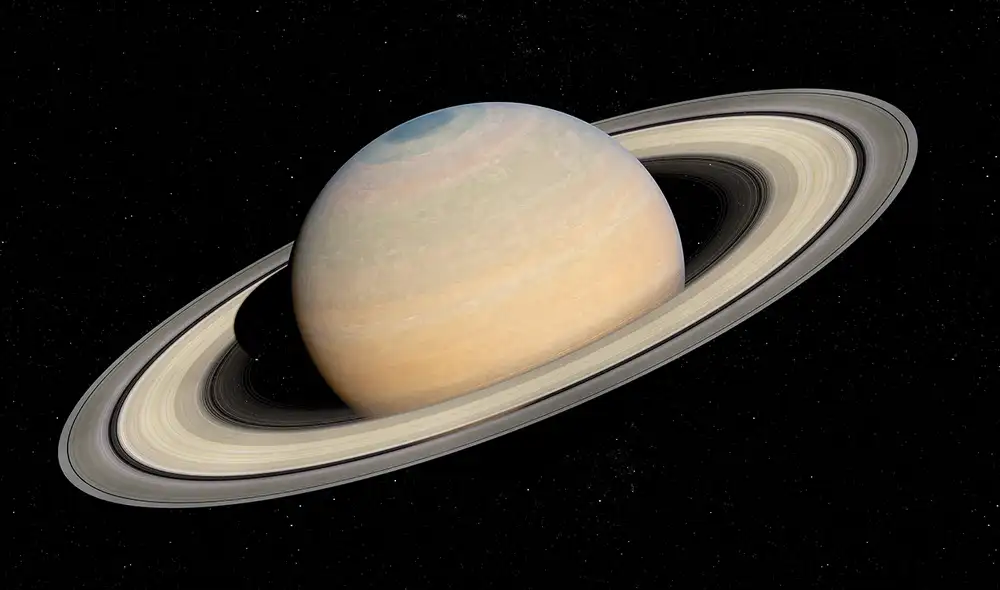
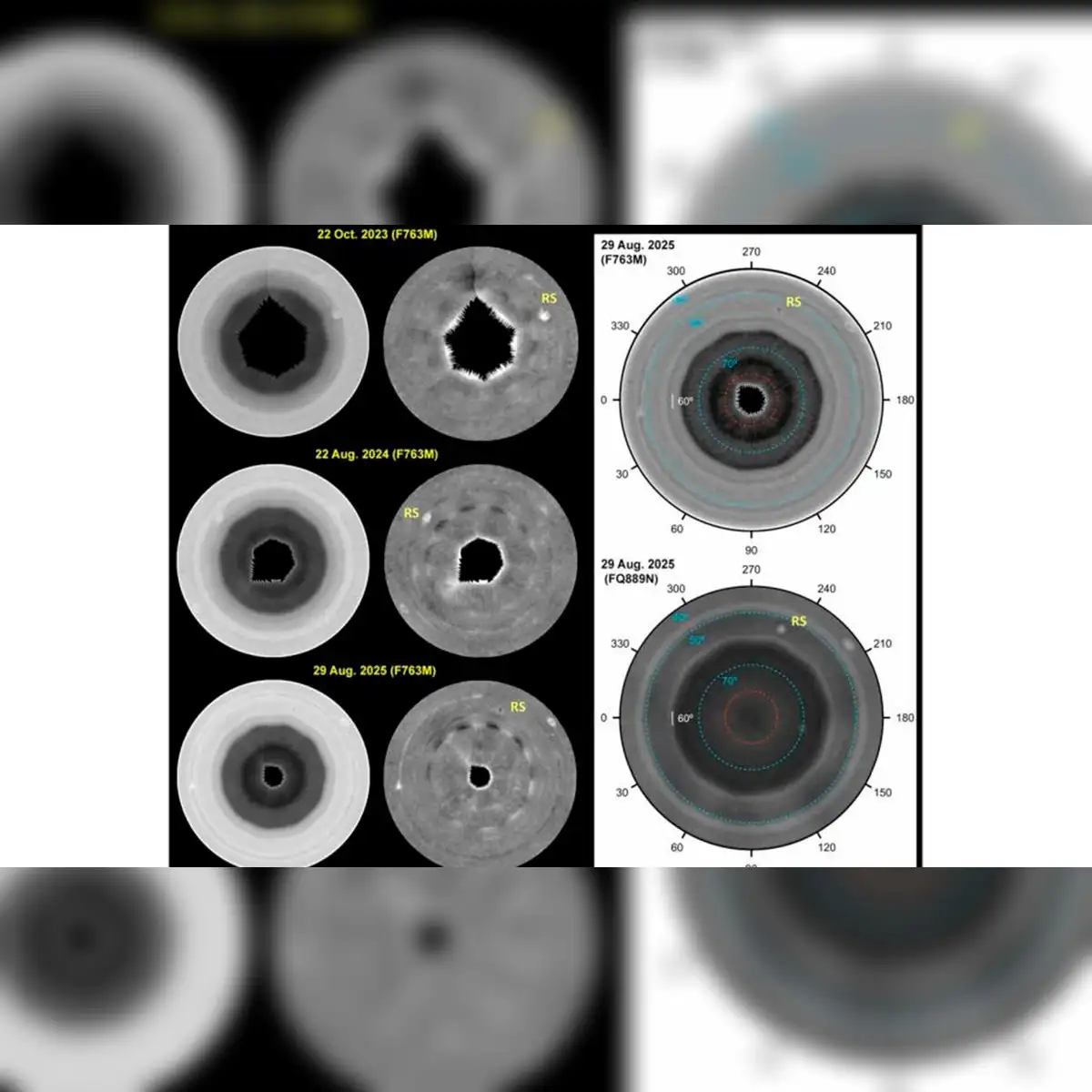
Researchers published their findings in the scientific journal Science Advances. The team confirmed that the structure was already visible in Hubble Space Telescope images captured in 2023, suggesting it likely formed between 2017 and 2023. However, the exact date of its origin remains undetermined.
The decagonal formation was formally identified after the changing axial tilt of Saturn brought its southern polar region back into view from Earth. Astronomers combined orbital data from Hubble with ground-based observations taken between 2023 and 2025 to clearly trace its ten distinct vertices.
Saturn is the second-largest planet in the solar system and is classified as a gas giant, composed primarily of hydrogen and helium. Because the planet lacks a solid surface, its upper atmosphere experiences extreme weather phenomena driven by internal heat and rapid planetary rotation. The Hubble Space Telescope, operated jointly by NASA and the European Space Agency, has monitored planetary atmospheres across the solar system since its launch into Earth orbit in 1990.
Atmospheric wave dynamics and origin
Scientists do not classify the decagon as a standard planetary storm. Instead, the feature acts as a massive atmospheric wave connected directly to a high-speed jet stream traversing multiple atmospheric layers.
Unlike typical weather systems, the decagon exhibits unusual physical motion. Its ten vertices constantly shift position over time, causing the overall outline of the structure to alter as it moves across the planet.
Computer simulations based on fluid dynamics suggest two main potential explanations for how the wave formed. The pattern may stem from a periodic disturbance within the surrounding jet stream, or it could be shaped by the influence of an atmospheric vortex located further north. Neither hypothesis has been confirmed.
Atmospheric jet streams are fast-flowing currents of gas that dominate weather patterns on giant planets. Fluid dynamics models allow researchers to simulate how narrow wind channels interact with planetary rotation. On gas giant planets like Saturn, these jet streams interact with large-scale atmospheric waves to produce geometric cloud formations that can persist across vast distances.
Comparison with the northern polar hexagon
The discovery presents a stark contrast to Saturn's northern hemisphere, home to the well-known hexagonal wave. NASA's Voyager space probes first detected the northern hexagon in the early 1980s, and the joint Cassini spacecraft studied the structure in detail during its orbital mission.
NASA's Voyager 1 and Voyager 2 space probes conducted flybys of Saturn in 1980 and 1981, capturing the first images of the northern hexagon. Decades later, the Cassini spacecraft, a joint mission by NASA, the European Space Agency, and the Italian Space Agency, orbited Saturn from 2004 to 2017 to study its ring system, atmosphere, and diverse moons in detail.
The northern hexagon has remained nearly stationary and stable for more than four decades. By contrast, the southern decagon shows significant dynamic variability, with shifting corners and a changing form.
Leigh Fletcher, an astronomer at the University of Leicester, measured wind speeds surrounding the southern structure using the Very Large Telescope operated by the European Southern Observatory in Chile. Fletcher noted that Saturn still retains the ability to surprise planetary scientists.
The Very Large Telescope is an astronomical observatory located on Cerro Paranal in the Atacama Desert of northern Chile. Its instruments enable astronomers to measure atmospheric conditions and wind velocity on outer solar system worlds.
Agustín Sánchez-Lavega, a researcher at the University of the Basque Country and lead author of the study, explained that contrasting the northern and southern polar regions will improve understanding of climate dynamics on gas giant planets.
The University of Leicester in the United Kingdom and the University of the Basque Country in Spain both host planetary science research groups that specialize in analyzing outer solar system atmospheres.
Sánchez-Lavega said the research team wants to determine why this apparently unique atmospheric phenomenon forms such a precise geometric shape. Scientists expect ongoing monitoring from space telescopes and ground observatories to track how long the decagon persists.



