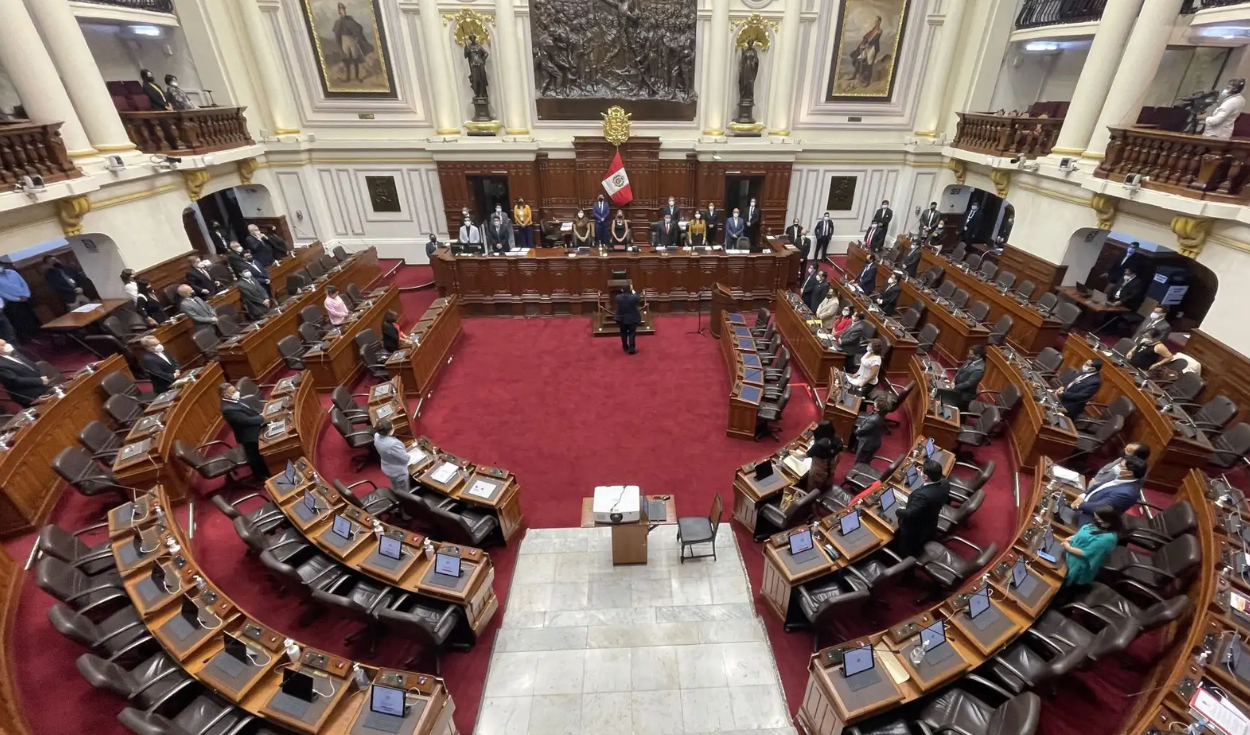
Peru's newly reconvened bicameral Congress is facing a contradiction just as it gets underway, according to legal scholar Pedro Grández Castro. He argues that the reform which restored the Senate was presented as a way to strengthen legislative deliberation, add a second review of laws and raise the quality of parliamentary decisions. But he writes that the government's request to delegate legislative powers, which bundles together an unspecified number of topics and matters that put oversight of regulatory quality at risk, contradicts the arguments used to justify bringing back the Senate.
Delegation of powers is not inherently unconstitutional, he notes, since Article 104 of Peru's Constitution expressly allows it. The issue he raises is different: on one hand, there is a constitutional requirement for a law that transfers competencies belonging to Congress under the separation of powers; on the other, there is the legitimacy of a government that held significant weight in the previous Congress and could act with the speed of a single-chamber legislature. Now, he writes, that government wants to govern without Congress if lawmakers give up their role in debating the crucial matters being delegated.
The constitutional parameter
The Constitution calls for a defined period and a specific subject matter, he explains. The bill circulating in Congress proposes four months, but in crucial areas it resembles a blank request, according to Grández Castro. He cites a Constitutional Tribunal ruling (Exp. N.º 00007-2020-PI, f.j. 13), which established that the authorizing law serves as the benchmark for reviewing the constitutionality, not just the formal validity, of any legislative decree that follows.
For that reason, he argues, the delegated matter must be specific enough to answer a basic question: what can and cannot the Executive do under the delegation? A law that grants an open-ended delegation introduces a substantive unconstitutionality into the benchmark itself, he writes, because if the matter is not specified, constitutional review becomes impossible. He notes the Tribunal has added that the intent expressed in the authorizing law must be as clear, precise and coherent as possible, and that determining its content requires looking not just at the delegated power itself but also its purpose (Exp. N.º 00017-2019-AI, ff.jj. 45-50).
Barring "structural delegation"
This is where the bill deserves closer scrutiny, Grández Castro writes. He proposes the term structural delegation for authorizations that do not assign the Executive a delimited task but instead hand it broad power to reconfigure entire sectors of state activity. A specific delegation lets the authorizing law define the boundaries of the delegated power, he explains, while a structural delegation shifts part of the decision about those boundaries onto the Executive itself, turning the delegation law into a license without controls.
He points to the public security bundle as an example, which covers military and police, criminal, criminal procedure and criminal enforcement matters. The issue is not that criminal legislation cannot be delegated, he writes, but the breadth of the wording: if criminal law as a whole is delegated, what reform of the Criminal Code could ever count as overreach? He calls it a structural delegation that shuts Congress out of matters of major public interest, such as criminal policy or changes to the Criminal Code.
The productive development bundle takes the problem to its extreme, he argues, covering agriculture, water resources, fishing, mining, tourism, hydrocarbons, electricity, the financial system, the environment, infrastructure and public-private partnerships, a scope so wide the category risks no longer functioning as a limit at all. He notes the paradox that the bill shows it could have been written differently: when it identifies a concrete decision, such as reducing certain public holidays or repealing a specific law, the authorization becomes far easier to define. The problem, he concludes, is not technical but reflects a political choice.
Explicit constitutional limits
Grández Castro also flags areas where the debate turns into a question of firm limits. The Constitution bars delegating matters tied to constitutional reform, treaty approval, organic laws, and the Budget and General Account of the Republic, under Articles 101.4 and 104 and a Constitutional Tribunal ruling (Exp. N.º 00047-2004-AI, f.j. 25). He argues that authorizations allowing the creation, merger or dissolution of public agencies, and the reassignment of competencies, functions and resources, deserve special scrutiny wherever they touch matters reserved for organic law. Even clearer, he writes, is the problem of authorizing mechanisms for institutional participation in constitutional proceedings, which could alter the constitutional review system itself.
On tax matters, he notes that delegation is possible but not unlimited: Article 74 allows delegating tax powers, while Article 79 sets specific requirements for certain tax benefits. A generic authorization to modify and optimize tax regimes cannot become a way around those constitutional reserves, he writes.
A procedural dispute
The delegation will also raise questions about the procedure for approving legislative initiatives that fall under the exclusive competence of the Chamber of Deputies, which appears to be the case for a delegation law, Grández Castro writes. Article 108 of the Chamber of Deputies' regulations places delegation of powers, an exclusive presidential competence, within the Chamber of Deputies' domain. He asks whether this means the Senate is excluded from deliberating on it, and whether that would directly conflict with Article 104 of the Constitution, which grants this power to Congress as a whole rather than to a single chamber.
The debate over the first delegation-of-powers law, he concludes, will also raise a deeper question: whether a two-chamber Congress can function under a government seeking to centralize power.