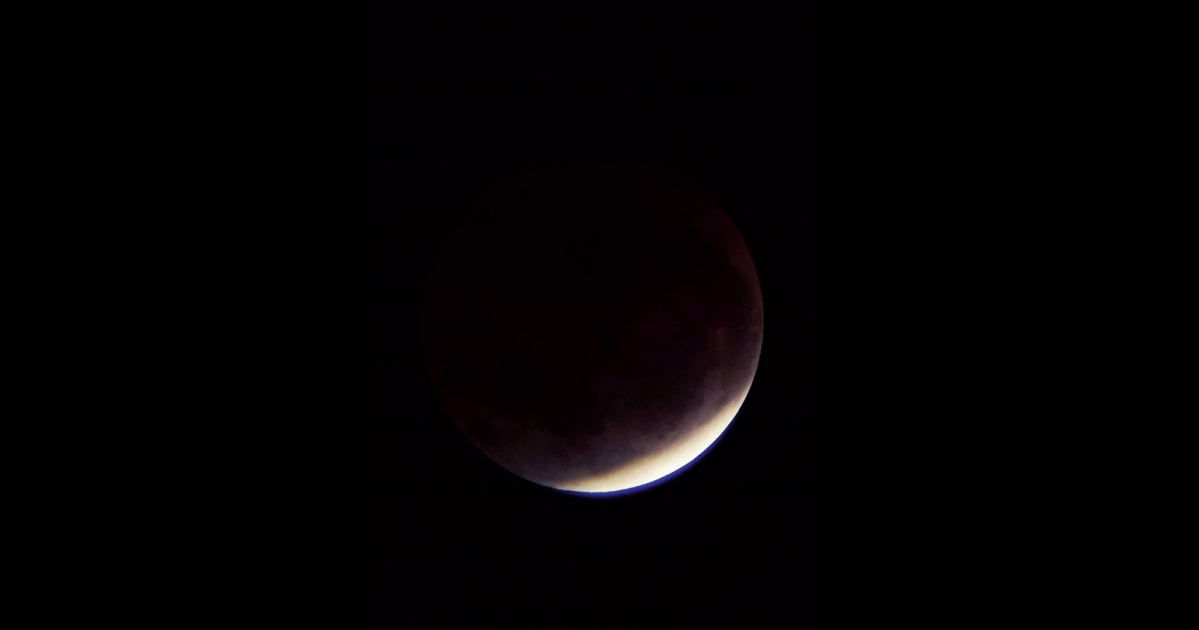
A partial lunar eclipse turned the Moon a reddish color across Brazil overnight on Friday, as Earth blocked out sun rays for more than three hours.
The celestial event, popularly known as a Blood Moon, began shortly after 11:33 p.m. on Thursday when Earth began blocking sunlight. The eclipse reached its maximum point at 1:12 a.m. on Friday before concluding at 2:51 a.m.
Earth's shadow obscured roughly 93 percent of the lunar disk, leaving about seven percent illuminated. Despite being classified as partial, the eclipse exhibited visual features typical of a total eclipse due to its pronounced red hue.
Skywatchers and astronomy enthusiasts across the country stayed awake into the early hours of Friday morning to watch the phenomenon. Astronomer Emerson Roberto Perez was among those who recorded images of the event.
Perez, who is based in São Thomé das Letras in the state of Minas Gerais, discussed the mechanics of the event in an interview on Friday with Live CNN. The town is widely known for its distinctive rock formations and a strong tradition of stargazing and sky observation.
How atmospheric refraction creates a Blood Moon
During a lunar eclipse, Earth moves directly between the Sun and the Moon, casting a long shadow cone into space. Perez explained that as solar rays pass through the atmosphere of Earth, they bend and refract inward toward the shadow cone.
Perez said red light experiences the least scattering when traveling through the atmospheric layer. Consequently, those surviving red rays continue onward to illuminate the Moon, causing the surface of the natural satellite to take on a reddish shade.
Atmospheric refraction occurs because short wavelengths of light scatter more easily when colliding with gases in Earth's atmosphere. This phenomenon, known in physics as Rayleigh scattering, is the same process responsible for making daytime skies appear blue and sunsets appear red.
Historical weight and eclipse durations
Perez highlighted the historical and cultural significance attached to the Blood Moon phenomenon over centuries. He noted that total lunar eclipses carry deep cultural weight, mentioning that ancient wars were even halted when the Moon turned red.
Addressing the timeframe of celestial events, Perez pointed out that lunar eclipses typically last much longer than solar eclipses. He stated that it is normal for a lunar eclipse to span more than three hours from start to finish.
In contrast, Perez cited an upcoming solar eclipse expected next year that will be visible from Egypt. Although described by Perez as one of the century's longest solar eclipses, its total phase will last only about six minutes and 23 seconds.
Solar eclipses occur when the Moon passes between Earth and the Sun, temporarily casting a shadow across small regions of Earth's surface. Because the shadow of the Moon is relatively small compared to Earth's shadow, solar totality lasts only a few minutes for viewers along the central path.