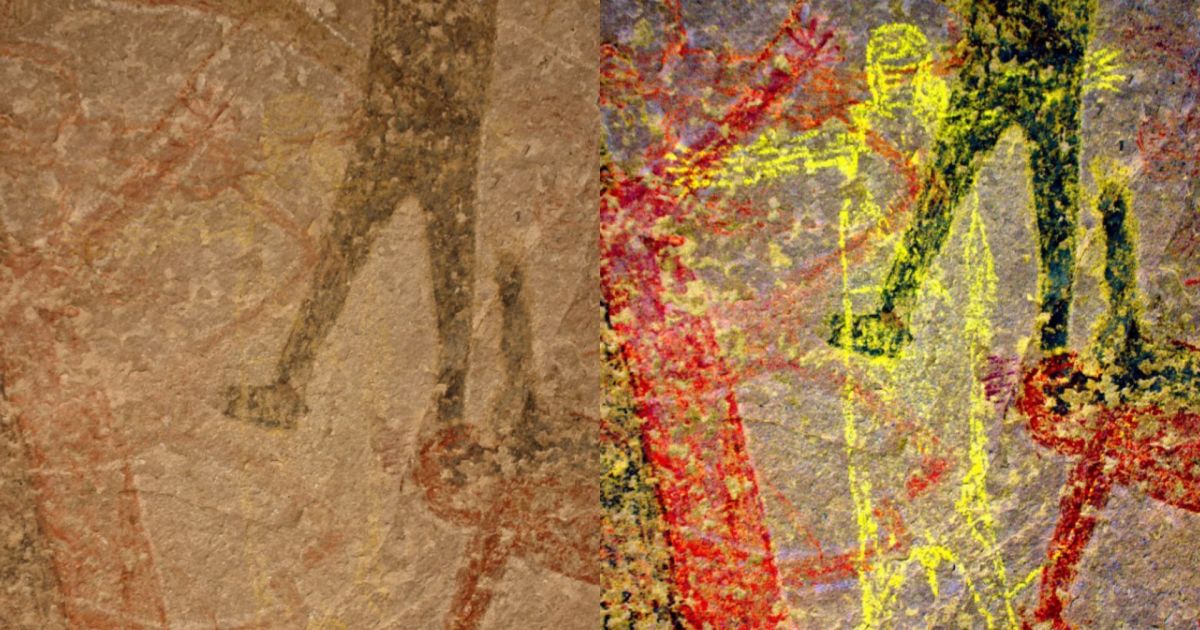
An image processing technique developed by NASA has revealed previously unseen ancient structures and rock art in satellite photographs and digital imagery, according to a comparison released by the space agency on Tuesday, September 8.
The method, known as DStretch, uses decorrelation stretching to intensify color contrast in digital photos. NASA demonstrated the technology using images of the San Borjitas Cave in Baja California, Mexico, where faded details on historic rock surfaces became visible after the algorithm was applied.
Decorrelation stretch is an image processing algorithm originally used in planetary science and satellite remote sensing. The technique enhances subtle differences in color channels by reducing spectral correlation, allowing fine details that are nearly invisible to the human eye to stand out sharply.
In archaeological applications, the software magnifies minute variations in natural paint pigments and mineral dyes. Over centuries, exposed rock art at ancient sites often fades due to weathering, sunlight, and atmospheric erosion, making digital contrast enhancement vital for historical preservation.
Discoveries at Angkor Wat temple
The NASA technology has previously enabled major archaeological breakthroughs at world heritage sites. High in the central tower of the ancient temple of Angkor Wat in Cambodia, paintings depicting horsemen and a traditional musical ensemble had remained unnoticed by thousands of visitors for decades because the images had severely faded.
Between 2010 and 2012, an archaeologist using the contrast enhancement method developed at NASA's Jet Propulsion Laboratory in Southern California uncovered the tower paintings. The investigation ultimately identified approximately 200 distinct ancient paintings hidden across the walls of the temple complex.
Angkor Wat, located in northern Cambodia, was constructed during the 12th century under the Khmer Empire. Originally built as a Hindu temple dedicated to Vishnu, it eventually evolved into a Buddhist site. While the monument is famous for its extensive stone reliefs, many of its painted interior murals had faded into obscurity until revealed by digital processing.
The Jet Propulsion Laboratory, managed by the California Institute of Technology for NASA, routinely develops advanced digital image processing tools to analyze satellite data and space probe photographs from across the solar system.
Creation of the DStretch tool
The adaptation of NASA's decorrelation technique for widespread use in archaeology was spearheaded by Jon Harman, a rock art enthusiast and retired professional with experience in medical imaging.

Harman first encountered the image processing method in 2005 after viewing NASA images that showed the surface of the planet Mars with and without decorrelation stretching applied. Seeing the dramatic contrast improvement on Martian soil, Harman recognized that the space agency's technique could be applied to study ancient and faded rock art on Earth.
Harman said he conducted a search on Google and located a technical paper published by NASA that explained how to write the decorrelation algorithm. He noted that his prior professional experience working with medical images gave him confidence that he could program the tool himself.
Harman built a custom plug-in designed to run on ImageJ, an open-source image processing program created by the National Institutes of Health in the United States. ImageJ is widely distributed in scientific fields to assist researchers in analyzing complex digital imaging data.
Harman said he now responds to approximately 200 requests per year from researchers seeking DStretch processing, helping archaeologists around the world detect and document faint rock art that would otherwise remain hidden.