

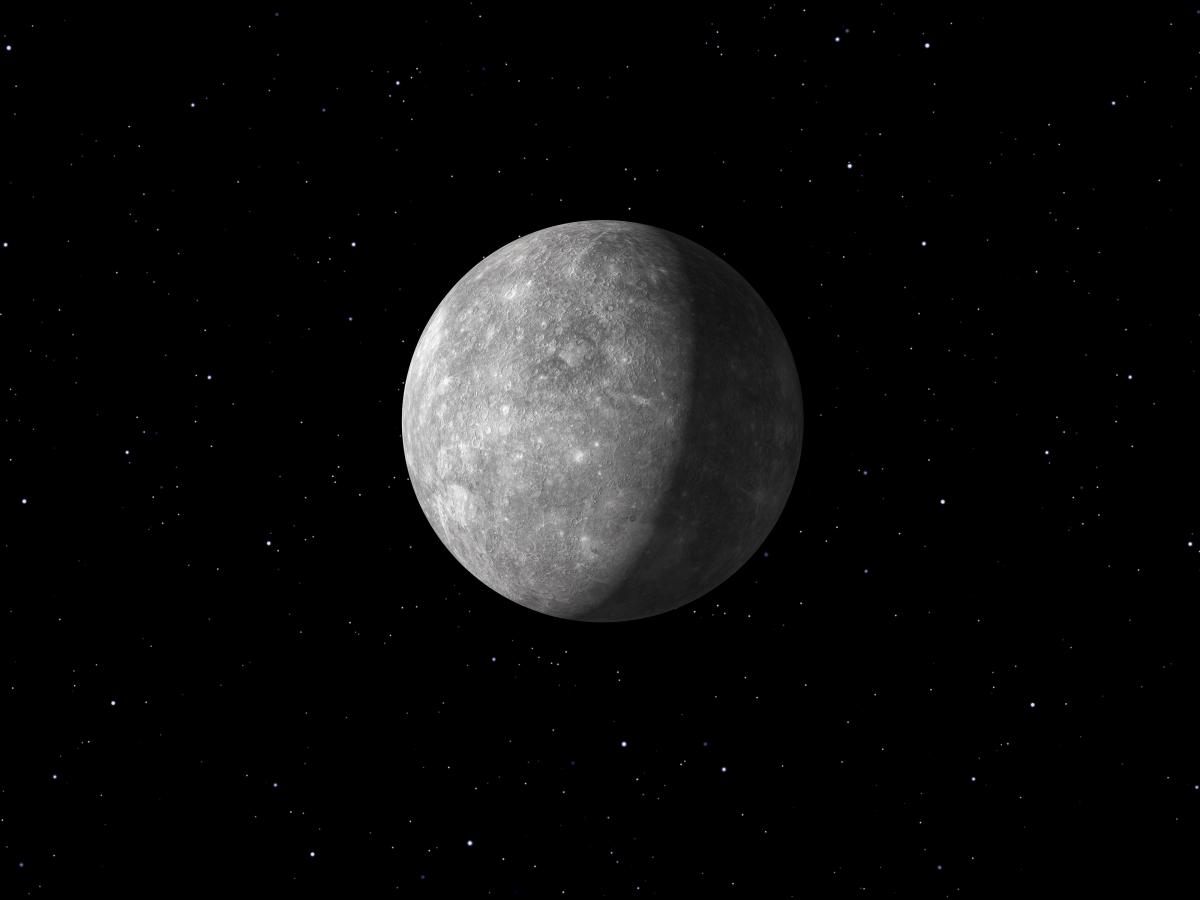
Mercury has shrunk by up to 30 percent more than previous scientific estimates suggested, according to a new study led by planetary scientist Gaku Nishiyama.
The updated analysis indicates that the solar system's smallest planet has lost roughly 19 kilometres from its total diameter since it formed approximately 4.5 billion years ago.
Writing in a study reported by science news publication Gizmodo, Nishiyama, a researcher at the Institute of Planetary Research within the German Aerospace Center, explained that earlier assessments had underestimated the planet's radial contraction because they failed to account for recent geological processes.
Nishiyama explained that these recent processes include geologically young impact craters and the blanket of ejected debris surrounding them, which can physically cover and conceal visible signs of planetary shrinkage across the surface.
Cooling History and Surface Wrinkles
Before the planets of the solar system took shape, the Sun was surrounded by a flat, spinning protoplanetary disk composed of gas and dust. Over time, gravitational forces caused this material to clump together into dense clusters, eventually forming the eight planets recognized today.
Mercury, a rocky planet located closest to the Sun, was formed through repeated, high energy asteroid collisions. The kinetic energy generated by these violent impacts was converted into heat, leaving the newly formed planet to cool gradually over billions of years.
As Mercury cools, its interior volume contracts. Because the planet cools uniformly throughout its internal volume, scientists long assumed that its surface wrinkles, created as the solid outer crust contracted over the shrinking interior, were distributed evenly across its exterior.
However, Nishiyama and his research team discovered that this assumption was incorrect after comparing a global map of Mercury's surface roughness, which serves as a key indicator of geological youth, against earlier maps tracking the planet's surface folds.
Their comparison revealed that the roughest regions on Mercury contained the fewest visible surface wrinkles, confirming the team's hypothesis. Nishiyama stated that while he had anticipated finding some level of correlation, the clear pattern uncovered by the analysis far exceeded his expectations.
Revised Estimates of Shrinkage
To determine the true magnitude of the planet's contraction, the research team measured the amount of compression required to form surface folds in less bumpy areas and used those values to estimate total planetary shrinkage.
By accounting for the previously overlooked rough regions, the scientists discovered that Mercury's overall radial shrinkage across its existence was 10 to 30 percent greater than previous studies had recorded.
These updated numbers provide researchers with a clearer framework for understanding the geological processes occurring beneath Mercury's surface. Nishiyama remarked that although deciphering the internal parameters of the planet is difficult, the findings suggest the planet began evolving at a significantly higher initial temperature.
The research team's results also indicate that Mercury's core originally contained a lower concentration of light elements than previously assumed, which allowed for the formation of a larger metallic core.
Implications for the Moon and Mars
Nishiyama explained that the team's analytical technique could also help refine estimates regarding the historical shrinkage of Earth's Moon. Previous estimates placed total lunar radial contraction at less than one kilometre, a figure that does not align with established models of planetary thermal evolution.
Because the Moon exhibits a higher overall surface roughness than Mercury, Nishiyama noted that scientists have likely missed an even larger proportion of structural shortening features on the lunar surface.
The findings regarding Mercury come amid ongoing efforts by international space agencies to examine geological evidence across the solar system, including NASA's exploration of Mars.
A year ago, NASA highlighted findings from its Perseverance rover, which collected a sample from an ancient dried riverbed in Jezero Crater that may contain evidence of past microbial life on the Red Planet.
However, transmitting data and returning physical samples back to Earth remains a complex technical challenge. A joint retrieval mission planned by NASA and the European Space Agency is currently listed on NASA's website as a future mission, with no estimated timeline provided for its launch.



