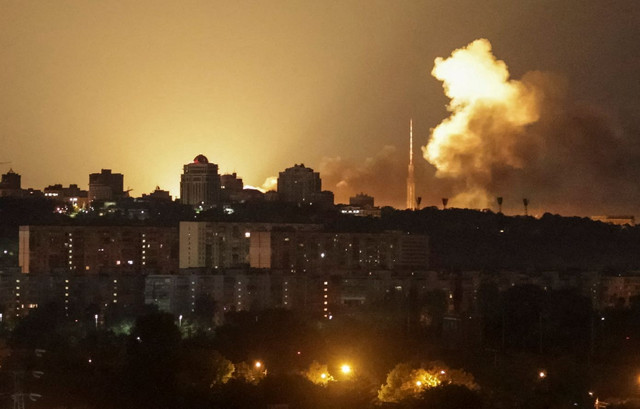
Powerful explosions rocked the Ukrainian capital of Kyiv early Tuesday morning as the city came under a renewed Russian aerial threat.
Journalists from the international news agencies Reuters and Agence France-Presse who are stationed in the city reported hearing heavy explosions across the capital area.
Before the blasts occurred, the Ukrainian Air Force sounded an initial air alert warning of an approaching high-speed target. In a subsequent update published on Telegram, military authorities warned that multiple targets were heading directly toward the capital.
In military air defense terminology, a high-speed target refers to fast-flying aerial threats such as ballistic or supersonic missiles, which move rapidly and reduce defense reaction times.
Consecutive Russian Air Attacks
Kyiv municipal authorities instructed all citizens to move immediately to safe areas and remain inside protective shelters for the entire duration of the aerial threat.
The early morning incident comes as Kyiv has faced consecutive Russian strikes and near-continuous air sirens over recent days.
Kyiv is the capital and largest municipality of Ukraine, located along the Dnieper River in the north-central part of the nation. International wire services including Reuters, headquartered in London, and Agence France-Presse, headquartered in Paris, maintain active press bureaus in the city to cover national developments.
Civil Defense Infrastructure
Emergency advisories in Ukraine are routinely issued through Telegram, a cloud-based instant messaging service used by government ministries, emergency responders, and military services to broadcast public safety alerts.
The Ukrainian Air Force is the military branch responsible for monitoring national airspace, tracking radar targets, and activating regional siren systems when incoming aerial attacks are detected.
To protect the civilian population during aerial strikes, municipal authorities rely on designated bomb shelters across Kyiv. These facilities include deep underground railway stations on the Kyiv Metro system, reinforced basement levels of residential and commercial structures, and purpose-built concrete bunkers.