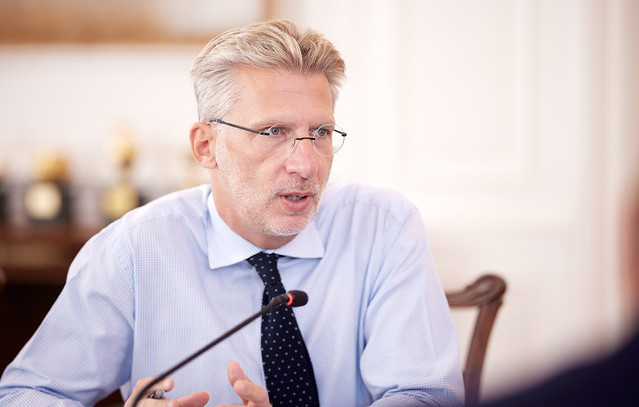
Greek Minister of State Akis Skertsos highlighted a new international study showing Greece has outperformed comparison eurozone nations in economic growth, employment, and investment following the pandemic. Skertsos shared the analysis online, urging critics to read it carefully because it was not a government press release.
The research was published on VoxEU by the Centre for Economic Policy Research and authored by Dino Pinelli, a special research advisor at the European Commission Directorate-General for Economic and Financial Affairs. The study examined Italy, Spain, and Greece, comparing their post-pandemic economic paths against eurozone countries that received funding from the Recovery and Resilience Facility.
According to the figures cited by Skertsos, Greece recorded a 10.8 percent increase in real gross domestic product from 2019 to 2025. By comparison, real GDP in the benchmark group of countries grew by 5.4 percent during the same period.
Economic figures and investment trends
The analysis showed that total hours worked in Greece grew by 7.5 percent between 2019 and 2025, compared to 2.6 percent in the comparison group. Additionally, the total investment rate in Greece rose by 5.9 percentage points of GDP, whereas investment in comparison countries fell by about two percentage points of GDP.
Skertsos noted that the study found evidence that public investments from the Recovery Fund mobilized private investment rather than crowding it out. The authors described Greece as experiencing a broader convergence process, with GDP above pre-pandemic trends, investments rising significantly from a low base, and total factor productivity making a strong positive contribution.
The researchers cautioned that their work is a preliminary descriptive analysis and that further econometric research is needed to isolate the precise causal effect of the fund. Skertsos acknowledged this limitation but argued that domestic political debate must start from these objective figures rather than slogans claiming the fund had failed. He added sarcastically that opposition critics had only stopped short of expecting the fund to cure baldness.
Reforms and governance
Skertsos explained that the main objective of the Recovery Fund was not merely to boost GDP temporarily, but to transform the country's productive base through structural reforms. He cited ongoing progress in state digitization, the energy transition, the labor market, and the healthcare system as evidence of convergence with core European economies.
Skertsos stated that he is working with government colleagues Nikos Papathanasis, Orestis Kavalakis, and Evi Dramalioti to complete the final requirements of the ninth payment request. This request marks the final stage of the reform and investment program.
He added that Greece managed a Greek-owned European plan tailored to its own reform and investment needs for the first time. The goal was not simply absorbing EU funds on schedule, which he affirmed would be achieved without delay, but transforming the economy and state administration.
Skertsos concluded that the foundations for economic transformation have been laid. He urged the government to complete reforms, sustain investment momentum, and convert economic acceleration into permanent gains in productivity, household income, and employment.