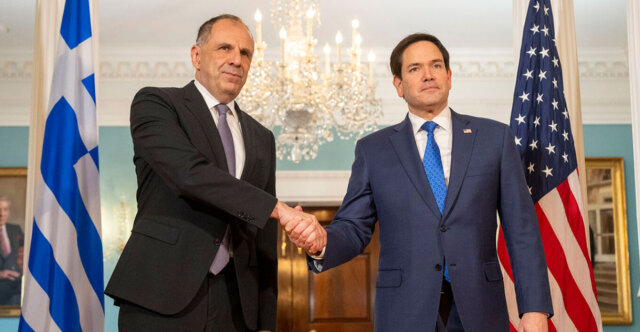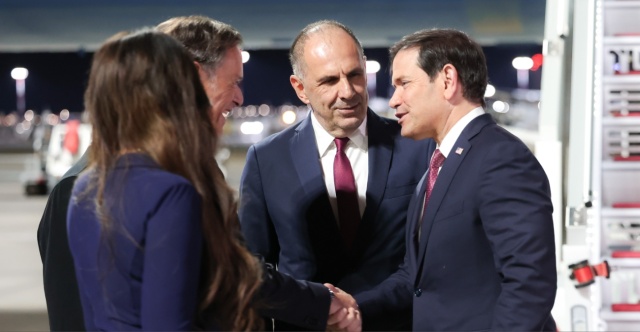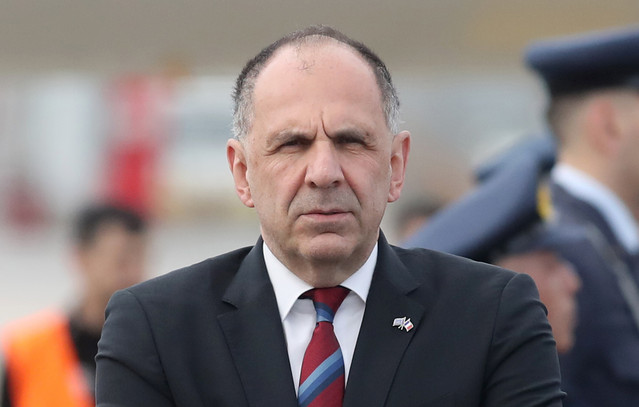
Greek Foreign Minister Giorgos Gerapetritis has declared that any arbitrary action or aggression by Turkey will be met with a response from the Greek state. Speaking in an interview with Greek radio station Parapolitika, the foreign minister emphasised that Athens remains fully prepared to handle any escalation along its borders while maintaining active diplomatic channels with Ankara.
Gerapetritis also confirmed that the planned electrical interconnection between Greece and Cyprus will proceed according to schedule in the coming months. The laying of the subsea power cable is expected to begin within 2026, marking a significant step in regional energy infrastructure.
The minister clarified that international law governs the subsea cable project and does not require permission from Turkey. He stated that Greece will not seek authorization from Turkish authorities to carry out the installation across the Mediterranean seabed.
Athens Declaration and Dialogue Mechanism
Addressing bilateral relations, Gerapetritis recalled that the Athens Declaration signed between Greece and Turkey established a structured dialogue framework. The primary goal of this mechanism is to prevent daily friction from escalating into major regional crises while allowing both nations to manage differences constructively.
The Athens Declaration on Friendly Relations and Good-Neighbourliness was signed in December 2023 during a summit in the Greek capital, aiming to normalize ties between the two NATO allies after years of heightened tension in the Aegean Sea and Eastern Mediterranean.
The minister acknowledged that neither side has abandoned its fundamental positions during discussions. He noted that Athens never expected Turkey to abandon claims built over decades, such as the Blue Homeland maritime doctrine, the concept of grey zones regarding island sovereignty, or demands for the demilitarisation of Aegean islands.
Despite those continuing disagreements, Gerapetritis pointed out tangible benefits from the dialogue. He highlighted a dramatic reduction in Turkish airspace and maritime violations, effective cooperation on migration management, and the successful prevention of major military standoffs.
He stressed that the structured dialogue mechanism remains essential precisely because the two countries disagree. In his view, refusing to talk during periods of disagreement makes a major crisis mathematically certain, whereas past Greek administrations of all political backgrounds maintained communication channels with Ankara without compromising national sovereignty.
Strengthening Armed Forces and Regional Alliances
Comparing the current diplomatic landscape to 2023, Gerapetritis asserted that Greece now operates from a far stronger position. He attributed this shift to expanded international alliances, a prominent footprint within international organisations, and a decisive reinforcement of the Greek Armed Forces.
The minister noted that recent acquisitions have established air and sea superiority for Greece, allowing the nation to negotiate on different terms. He added that the recovery of the Greek economy following past financial turmoil has provided the financial latitude needed to sustain robust national defense capabilities.
On the Greece-Cyprus power project, Gerapetritis stated that Greece, Cyprus, and France share a complete mutual understanding regarding the importance and deployment of the cable. He explained that notifications under international law serve solely to protect mariners and prevent maritime accidents, rather than to request operational approval from coastal states.
He added that Greek forces remain prepared for any contingency, ranging from mild diplomatic disputes to intense field operational scenarios. As part of efforts to broaden defense capabilities, Gerapetritis announced that Greece will sign an expanded defense security agreement with Israel on Monday, August 31, 2026.
Greek Initiatives and Turkish Responses
Regarding reports that Turkey intends to introduce legislation related to its Blue Homeland doctrine, Gerapetritis stated that no clear timetable or draft text has been presented. He noted that Greece has already alerted relevant European Union and international bodies to the potential move.
The foreign minister emphasized that any internal Turkish law on maritime jurisdiction carries no external legal effect or international validity. He contrasted such prospective Turkish legislation with Greece's official maritime spatial planning, which carries the legal force of the EU acquis, the binding body of European law.
Gerapetritis argued that Greece has taken the absolute initiative in regional maritime policy for the first time. He pointed out that Turkish actions, including proposed jurisdiction laws, marine environmental parks, and requests for inclusion in European defense programs, are direct reactions to prior Greek policy announcements.
He rejected claims that Athens should refrain from proactive steps out of fear of provocative responses. He asserted that the government evaluates every Turkish reaction carefully and responds with documented evidence in international forums and on the ground.
Response to Political Opposition and Former Prime Minister
Gerapetritis strongly criticized domestic political opposition parties, calling their stance hypocritical. He noted that while opposition politicians agree that dialogue with Turkey is necessary, they routinely demand sanctions whenever Ankara reacts to Greek diplomatic initiatives.
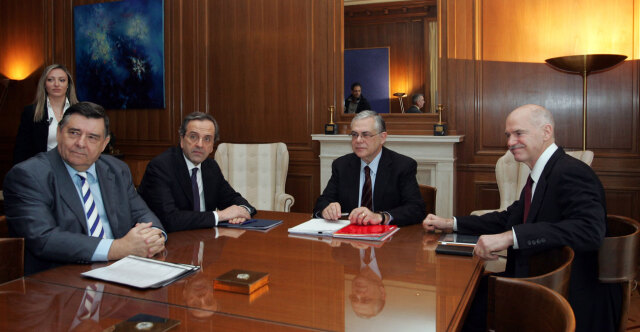
The minister addressed recent public criticism from former Prime Minister Antonis Samaras and his associates. Samaras, who served as prime minister from 2012 to 2015 and previously led the ruling centre-right New Democracy party, has voiced opposition to the government's foreign policy direction.
Gerapetritis stated that while the views of a former prime minister are respected, anyone engaging in public political debate must accept scrutiny. He argued that foreign policy outcomes must be evaluated using objective data rather than personal ideology or political narrative.
Responding to accusations by Samaras that New Democracy has suffered ideological dilution, Gerapetritis pointed out that Samaras governed in a coalition with the centre-left PASOK party. He also noted that under the Samaras administration, Greece conducted six rounds of exploratory talks with Turkey regarding maritime boundary delimitations.
The minister highlighted that Samaras traveled to Ankara to meet Turkish President Recep Tayyip Erdogan and signed multiple bilateral agreements, even as Greek airspace recorded approximately 2,500 Turkish violations in 2014 alone.
Gerapetritis concluded by stating that Greece's national standing, military readiness, and economic strength in 2026 are vastly superior to the 2012 to 2015 period. He added that political figures seeking to lead new political movements must exercise ten times greater responsibility when discussing national defense and foreign relations.