
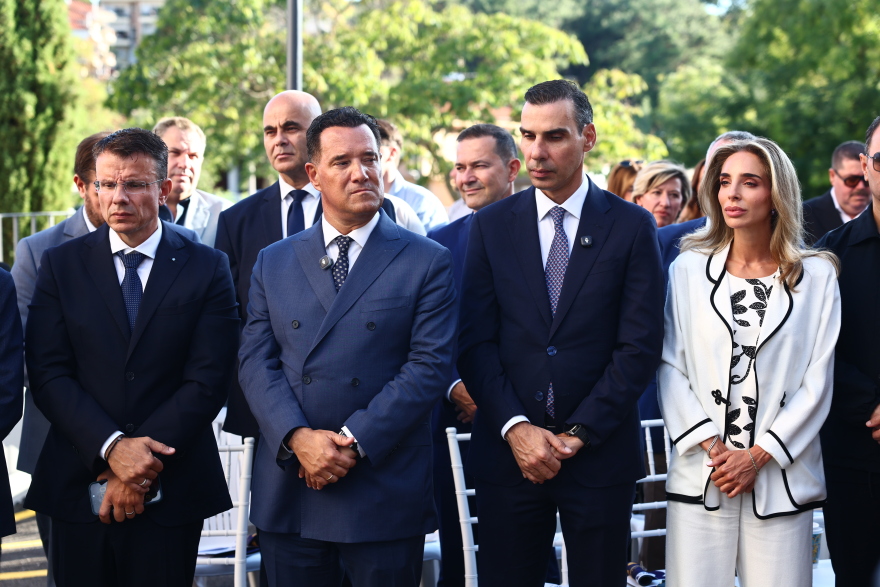
Greek Health Minister Adonis Georgiadis said Greece was beginning a new chapter in advanced cancer treatment and research at a pan-European level, as he opened a new Cell and Gene Therapy building and laboratories at the Hematology Clinic of Papanikolaou General Hospital in Thessaloniki.

Georgiadis said the project had been included in Greece's Recovery and Resilience Fund, the European Union financing programme set up to support national reforms and investment, but had risked being dropped because of delays in completing the required procedures. He said that after taking office in early 2024, he pushed through a special legislative measure, passed under an urgent procedure, which kept the project in the fund and allowed construction to begin.
The minister said the new building strengthens the country's capacity for cellular and gene therapies. He said a recent legislative change now allows cellular therapies to be transferred from one public hospital to another, meaning doses of treatment produced at Papanikolaou could be used to increase capacity across Greece's National Health System.
Georgiadis also referred to plans for a National Cancer Action Plan, saying the goal is to have it formally established before the next national elections. He praised the scientific staff of Papanikolaou Hospital and its Hematology Clinic, saying he was proud, as health minister, of the standard of staff at public hospitals across the National Health System.
Closing his remarks, Georgiadis said the aim was to use the new facilities to provide more and increasingly advanced treatments to patients, adding that no one would ever be left behind and that the ministry would keep doing as much as possible to provide care to the last person who needs help.
New unit adds 12 rooms and research space
Secretary General of Health Services Lilian Vildiridi said the new building was not simply another renovation but infrastructure that fundamentally changes what Papanikolaou Hospital can offer in hematology. She said the new Hematopoietic Stem Cell Transplant and Cell Therapies Unit has 12 single-occupancy rooms along with space for critical laboratories and research facilities, creating the conditions for further development of CAR-T and other advanced cell therapies. Vildiridi said the project is part of a wider 15 million euro programme to strengthen the hospital through the Recovery Fund, and referred to new hiring of medical and other staff to reinforce Papanikolaou.
Deputy Health Minister Marios Themistokleous said the new building marks something new and pioneering for the whole National Health System, since Papanikolaou is the first centre in Greece with the capacity to produce CAR-T cells in-house. CAR-T therapy involves modifying a patient's own immune cells to fight cancer. He said domestic production could mean faster patient access to treatment and significantly lower costs for the health system, while also creating opportunities to move research from the laboratory into clinical medicine. He said it was the ministry's duty to make this happen, and expressed hope that patients would come out as winners in what he called a very difficult battle.
Clinic has carried out 2,700 transplants since 1985
Ioanna Sakellari, coordinating director of the Hematology Clinic at Papanikolaou, described the clinic's long history, noting it has spent 42 years diagnosing and treating blood disorders and has carried out about 2,700 hematopoietic stem cell transplants and 113 advanced cell and gene therapies since 1985. She highlighted the clinic's in-house production of CAR-T lymphocytes, which began in 2024, and said the first therapies under a clinical trial were due to be administered soon.
Sakellari said the new infrastructure would strengthen the clinic's ability to deliver advanced cell and gene therapies, support clinical research and help develop new therapeutic products. She said adding 11 beds to the Cell Therapies Unit is expected to increase capacity by 30 to 50 percent. She added that the clinic handles about 25,000 outpatient visits a year, and said the new building creates a complete framework for diagnosis, treatment, research and training in hematology.
Idea for the unit dates back to 2008
Achilleas Anagnostopoulos, the former director of the Hematology Clinic, traced the project's origins back to 2008, saying that funding of 1.5 million euros was approved through the National Strategic Reference Framework in 2009 but the project ultimately did not go ahead. He said he delivered a completed preliminary study to the ministry in 2012, and in 2019 presented the case for the new facility to the prime minister, who he said committed to supporting it. The project was finally included in the Recovery and Resilience Fund in 2022 and completed with input from both previous and current leadership at the Health Ministry.
Anagnostopoulos said the new infrastructure is expected to strengthen Greece's capacity for hospital care, research and training in cell and gene therapies, adding that the project belongs to the patients who will need these treatments.