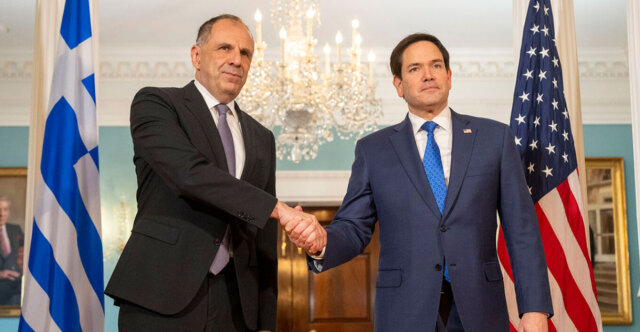
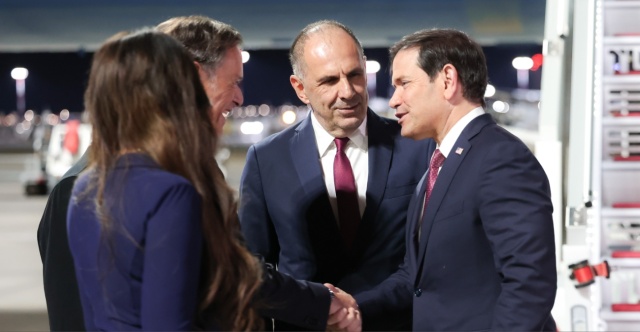
Greek Foreign Minister George Gerapetritis said his country will not negotiate sovereignty claims with Turkey, insisting the delimitation of maritime borders remains the only dispute open to international arbitration.
Speaking to the National Herald newspaper ahead of Greece assuming the presidency of the United Nations Security Council in October, Gerapetritis outlined Athens' diplomatic strategy. He detailed priorities including UN reform, navigating regional crises and strengthening ties with Greeks living abroad.
The United Nations Security Council is the international body responsible for maintaining global peace and security. Greece is currently serving a term as a non-permanent member and its October presidency, the second in its current term, will coincide with the selection process for a new UN Secretary-General.
Gerapetritis said in a highly unstable and rapidly changing geopolitical landscape where power often attempts to substitute rules, Greece remains committed to international law, the UN Charter and effective multilateralism.
United Nations presidency
The foreign minister said the Greek pursuit is to use the presidency to enhance consultation, broaden consensus and produce concrete results on issues dividing the council.
He noted Greece maintains open channels with countries from different political groups and aspires to act as a bridge between the global north and south, and east and west. Greece is already systematically cooperating with other member states to reach broader convergences, he added.
Success at the end of the month would be measured by tangible contributions to consensual decisions, bridging differences within the council, and a secretary-general selection process that enhances the organisation's credibility, Gerapetritis said.
Security Council reform
The discussion on reforming the UN is absolutely necessary to address modern challenges, Gerapetritis said, adding that Greece supports the UN80 plan to reform the decision-making process.
He said the Security Council's current composition does not reflect the 21st century because geographical regions are underrepresented, while shifts in global power necessitate a fairer and more representative international security architecture.
Greece is open to reforming the decision-making process and expanding both permanent and non-permanent membership, prioritising proportional representation for Africa, Asia, Latin America and the Caribbean. Specifically regarding India, Gerapetritis said Greece supports its permanent representation on the council.
The veto system has often become an abusive tool hindering critical and obvious decisions, Gerapetritis said. He argued the veto should be used exceptionally and carries special responsibility, especially in cases concerning the protection of people, war crimes or crimes against humanity.
Global crises and Cyprus
Gerapetritis and the Greek prime minister are travelling to the UN General Assembly in New York to convey a message of consistency, credibility and international prestige. He said preserving multilateralism and shielding international legality constitute the core of Greek international policy.
During their contacts, the Cyprus issue will be discussed with the aim of maintaining current mobility under the secretary-general's auspices and creating conditions to restart talks within the agreed UN framework.
They will also discuss major crises testing international security, from Ukraine and the Middle East to developments in the broader neighbourhood, seeking de-escalation, the protection of civilians and a return to diplomacy. Gerapetritis said they want to use their position so Greece can act as a bridge of understanding and a reliable partner.
Relations with Turkey
On Greek-Turkish relations, Gerapetritis reiterated that the delimitation of the continental shelf and the Exclusive Economic Zone is the only difference that can be taken to international jurisdiction.
He said claims touching on Greek sovereignty, such as the demilitarisation of islands or so-called grey zones, are arbitrary, unfounded and not up for discussion. This position is based on international law and does not change depending on circumstances, he added.
Gerapetritis said an escalation from the Turkish side has been observed, which he attributed partly as a reaction to Greece's initiatives to defend its rights and interests. He said Greece has regained real power based on its defensive shielding, economic recovery and international position.
Despite this, he said dialogue with Turkey must continue, even though conditions for a substantive discussion on delimitation are not yet met. Greece will continue to seek peace and good neighbourliness in the Eastern Mediterranean without compromising its sovereign rights, he said.
Greek diaspora
Addressing the Greek diaspora in Canada, Gerapetritis said the state aims to build a modern, two-way relationship with younger generations based on their needs and real opportunities for participation, rather than just memory and origin. The goal is for Greece to be a homeland constantly present and accessible in their daily lives, he said.
Following his attendance at the enthronement of the new Archbishop of Canada, he said the Greek government looks forward to close cooperation with the Archdiocese, focusing on the diaspora.
He said networks of young expatriates are being created, alongside hosting, education and exchange programmes, in cooperation with the Church, academic institutions, Greek schools and businesses.
Gerapetritis noted that lifting restrictions on the voting rights of Greeks living abroad abolished practical obstacles to a fundamental political right. Initiatives for postal voting in national elections and enhanced parliamentary representation of the diaspora are moving in the same direction, he said.
The diaspora possesses important human capital in science, entrepreneurship, culture, technology and public life, Gerapetritis said. He concluded that Greece must shape institutions allowing this potential to connect with the country and acquire a more stable role in its international presence, respecting the autonomy of diaspora communities.