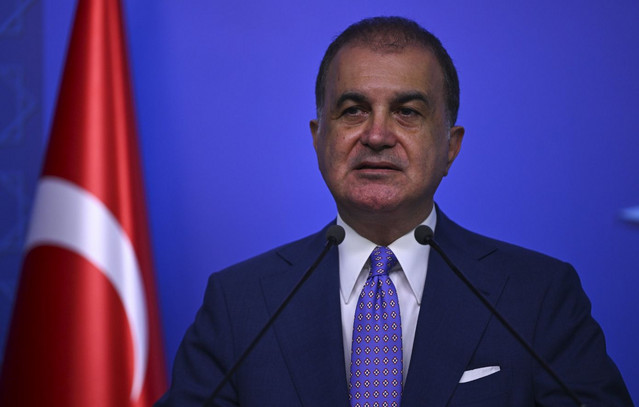
Ömer Çelik, spokesman for Turkey's ruling Justice and Development Party (AKP), warned against what he called "provocative approaches" in the Aegean Sea and the Eastern Mediterranean, saying Turkey was aware of its strength "at the table and in the field."
Without naming Greece directly, Çelik referred to "images that have appeared recently" and called on "everyone" to act with caution. He said that in the midst of current global turmoil, the last thing anyone should want was the appearance of provocative approaches in the Aegean and the Eastern Mediterranean, and he called for prudence regarding the recent images.
Diplomacy is not weakness
Çelik said Turkey's focus on diplomacy and on resolving problems at the negotiating table should never be seen as a sign of weakness. He said that, being aware of Turkey's strength both at the table and in the field, Ankara was highlighting this sensitivity so that no new problems would be added in the Aegean and the Eastern Mediterranean at a difficult time for the world, and so that no unnecessary costs would arise for anyone.
He added that no one could send Turkey a message through a show of force. Çelik said there was no message that could be delivered to Turkey through a display of power or through provocative approaches, and stated plainly that if anyone tried to send Turkey a message in that way, Turkey would not receive it and would not accept it.
According to Çelik, all sides have the diplomatic capacity needed to resolve their disputes. He said the importance Turkey attaches to diplomacy, negotiation and the resolution of international problems through a rules-based order was an opportunity for everyone, and that this was not weakness but a recognition of Turkey's own strength at the table and in the field.
Aegean should stay out of domestic politics
Çelik also said the disputes in the Aegean and the Eastern Mediterranean should not be used for domestic political purposes. He said no one should adopt a stance that turns problems in the Aegean, the Eastern Mediterranean and other regions into part of domestic politics, warning that this creates a vicious cycle that confronts the rules-based international order with even more toxic structures.
Criticism of US decision on Cyprus
Çelik criticised a decision by the United States to renew, for another year, the suspension of restrictions on defence exports to the Republic of Cyprus. Using Turkey's standard designation for the island, he said news had arrived that the US decision to lift the arms embargo on what he called the "Greek Cypriot Administration of Southern Cyprus" had been renewed for a further year, and he called it the wrong decision.
He said Turkey had made the same objection when the embargo was first lifted, describing it as a protective measure meant to stop anyone on the island from escalating the crisis, disturbing the balance, or shifting negotiations onto different ground. Çelik said the US move could further erode trust between the two sides in Cyprus.
Support for the north Cyprus authorities
Çelik repeated Turkey's support for the administration in the Turkish-occupied northern part of Cyprus, known internationally as the Republic of Cyprus but administered in the north by an entity recognised only by Ankara. He said Turkey's firm stance on the sovereignty of the "Turkish Republic of Northern Cyprus" and on the principles of the Turkish Cypriot cause would continue, and grow stronger. As the motherland and guarantor state, he said, Turkey would keep up its struggle to protect the legitimate rights and interests of the Turkish Cypriot people, adding that this included the security of the northern administration.
Condemnation of attacks on Saudi Arabia
Turning to developments around the Strait of Hormuz and the Bab el-Mandeb strait, Çelik said the situation remained a major international problem. He said that after the Islamabad Agreement it had not been possible to achieve a lasting ceasefire and peace, and that larger problems had since emerged around Bab el-Mandeb.
Çelik condemned attacks launched from Iraqi territory against Saudi Arabia and expressed Turkey's solidarity with Riyadh. He said Turkey did not consider correct the attacks carried out from Iraqi soil against Saudi Arabia's territorial integrity, and that Turkey rejected and condemned them. He also praised the Iraqi government's move to condemn the drone attacks and to work toward identifying those responsible.
"No one outside the state should have weapons"
Discussing the goal of a "Turkey free of terrorism," Çelik said all armed organisations and forces operating outside state structures should be brought under state authority. He cited a statement by the Iraqi prime minister that no one outside state structures should possess weapons, and voiced support for the principle of a single national army, the protection of states' territorial integrity, and the strengthening of state institutions.
He said Turkey did not want weak states among its neighbours in any circumstance, but wanted neighbours whose territorial integrity is protected, whose state sovereignty is established, whose armed forces operate under a single command, and whose political institutions are strong.
No early election planned
Asked whether recent remarks by President Recep Tayyip Erdoğan about preparing for the next election signalled an early vote, Çelik rejected the idea. He said that anyone familiar with how the president operates would know that his statements about preparing for the next electoral contest had nothing to do with an early election.
Çelik said Erdoğan routinely asks party officials to prepare for the next election, even immediately after one has just concluded. He said this was not a signal of an early vote and made clear that there was currently no election on Turkey's agenda.
Call for a new constitution
Çelik also referred to the anniversary of the 12 September 1980 military coup, describing coups as politically and morally illegitimate. He said one of the greatest damages the coup left behind in Turkey was its constitution.
He said politics still faces the task of drafting a new constitution, calling it a duty owed to future generations. He added that the issue was not limited to revising individual articles but involved writing a constitution with the nation as its direct subject, free of the shadow of past coups.
Warning on artificial intelligence
Finally, Çelik addressed discussions about the risks of artificial intelligence. He said warnings had recently been raised about AI systems organising among themselves, creating other AI agents, and developing activities independent of the humans who control them.
He named the production of biological weapons, intelligence operations and the loss of human control as possible dangers. He said Turkey would not stay out of the artificial intelligence race, and that Ankara would seek to take initiatives to help shape principles and rules so that AI is not used in ways that threaten humanity.