
Dominican historian Frank Moya Pons has launched his latest book, Lecturas históricas dominicanas, during a public presentation held at the National Museum of History and Geography in Santo Domingo.
The publication, which has been officially incorporated into the editorial collection of the Dominican Academy of History, gathers a curated selection of prologues, book presentations, introductions, and academic reviews written by Moya Pons over several decades.
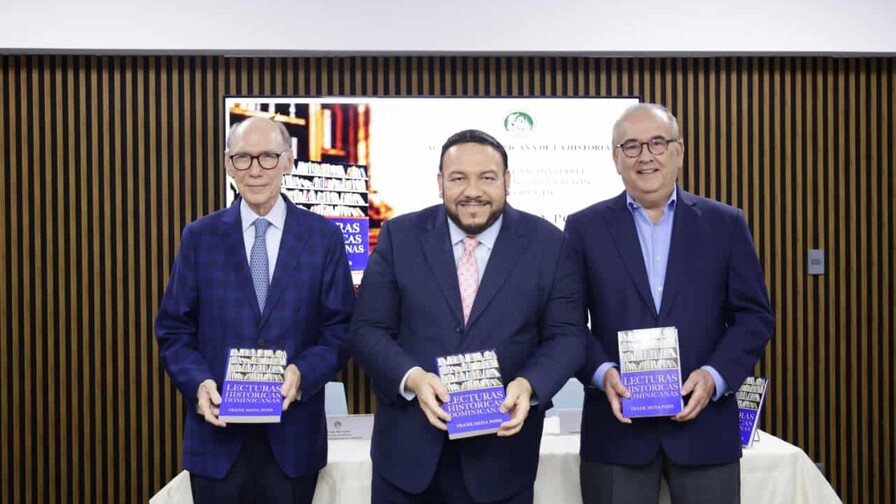
Moya Pons, a full member of the Dominican Academy of History, brings together in the volume a critical evaluation of works written by 63 different historians and scholars. The collection offers a specialized perspective on how the history of the Caribbean nation has been researched, interpreted, and recorded across various generations.
The Dominican Academy of History, established in Santo Domingo in 1931, serves as the primary national institution dedicated to historical research, document preservation, and scholarly publishing. The National Museum of History and Geography, located in the capital city's Plaza de la Cultura complex, regularly hosts major cultural and academic gatherings.
Origin and structure of the compilation
Addressing attendees at the launch event, Moya Pons explained that the initiative to assemble his collected reviews into a single published volume did not originate from himself. For many years, colleagues, fellow authors, and personal friends had repeatedly urged him to compile his scattered writings, though he initially resisted the idea.
In the introduction to the book, Moya Pons wrote that he eventually yielded to the persistent encouragement of several friends, overcoming his long-standing reluctance to publish an anthology of the prologues, introductions, and reviews he had written regarding Dominican historical literature.
The author noted that for a considerable period he believed the inherent diversity of the texts posed a major obstacle to creating a unified book. Because the pieces had been composed under widely varying circumstances and focused on diverse historical topics, he struggled to identify a single narrative thread capable of binding them into an organic whole.
Moya Pons acknowledged that he had never envisioned publishing a standalone volume composed of book reviews. To resolve the structural challenge, he ultimately decided to arrange the collected material according to thematic closeness rather than chronological order.
The historian described the volume as an anthology of accessible academic essays examining a representative sample of works submitted to him for review by 63 authors over the course of his career.
Role of academic criticism in history
During his remarks, Moya Pons emphasized the educational value of historiographical analysis, pointing out that the compiled essays could serve as a practical reference for students and researchers beginning their work in Dominican history.
He advocated incorporating the writing of book reviews into the formal training of early-career historians. Moya Pons stated that emerging scholars would benefit greatly from dedicating a few hours each month to analyzing historical publications and crafting written reviews.
He stressed that such reviews should always be written with impartiality, objectivity, equanimity, and generosity. He urged younger historians to practice academic evaluation, assuring them that they would not regret making it a regular part of their professional development.
Moya Pons delivered a defense of scholarly criticism as an essential mechanism for enriching historical knowledge, arguing that critique should function to expand understanding rather than serve as a tool for personal or professional disqualification. He noted that effective academic criticism does not need to be negative or destructive to be valuable.
Concluding his address, Moya Pons expressed formal appreciation to the team involved in assembling the volume. He extended special recognition to José Chez Checo for carrying out the initial organization of the manuscripts, Aimara Vera for managing the editorial process, and Janet Canals for executing the graphic design and layout.
A broad survey of Dominican history
Miguel Reyes Sánchez, the president of the Dominican Academy of History, also spoke at the launch, praising the scholarly significance of the new publication and characterizing it as a volume born out of Moya Pons's ongoing intellectual dialogue with other authors and their books.
Reyes Sánchez observed that the work is neither a conventional single-subject monograph nor a linear general history of the country. Instead, he explained that Moya Pons operates within its pages as an active reader, critical reviewer, and intellectual mediator connecting the original works with the broader academic community.
The essays included in the compilation cover a wide historical spectrum, spanning from the early Spanish colonial period and the initial formation of Dominican society through the political struggles of the 19th century, major economic transformations, and the 31-year dictatorship of Rafael Trujillo.
The texts also examine the clandestine and public anti-Trujillo resistance movement, as well as the political crises that affected Dominican democracy following the fall of the regime in 1961. Beyond political events, the book addresses themes related to economic growth, national geography, environmental issues, collective memory, urban development, cultural identity, and social change.
Reyes Sánchez stated that this thematic breadth demonstrates that national history cannot be understood through any single analytical framework. According to the Dominican Academy of History, the compilation highlights the depth, diversity, and continuity of historical scholarship in the Dominican Republic.
Distinguished guests at the Santo Domingo launch
The presentation ceremony concluded with the distribution of complimentary copies of Lecturas históricas dominicanas to all attendees at the National Museum of History and Geography.
The event brought together prominent figures from the Dominican Republic's academic, legal, media, and political spheres. Among those present alongside Moya Pons and Reyes Sánchez was Eduardo Tejera, the vice president of the Dominican Academy of History.
Other notable attendees included journalist Aníbal de Castro, author José Báez Guerrero, economist Andrés Dahuajre, business leader Manuel Estrella, and former Foreign Minister Roberto Álvarez.
The gathering was also attended by former Constitutional Court President Milton Ray Guevara, legal scholars Eduardo Jorge Prats and Alejandro Moscoso, movement leader Ángela de Jorge, architect José Enrique Delmonte, historian José Guillermo Guerrero, and former Culture Minister Manuel García Arévalo.