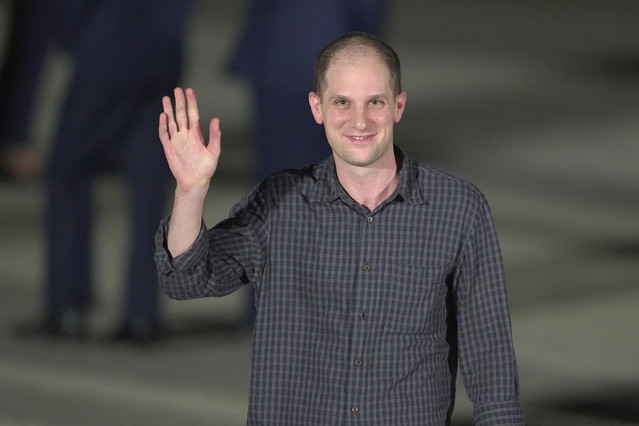
American journalist Evan Gershkovich has said he knew Russia was framing him for espionage the moment he was arrested by federal agents in 2023, telling British media that he realized he was being used as a pawn in a larger geopolitical game.
The 34-year-old reporter spoke to the BBC from Berlin in his first interview with a British outlet since his release from a Russian prison. He described his arrest by the Federal Security Service, or FSB, and his subsequent 16 months in detention before he was freed in a high-profile prisoner exchange.
Gershkovich said he was neither interrogated nor tortured, despite being accused of espionage. He described a feeling of relief, saying the Russian authorities had set him up and fabricated the case so that he could serve as a valuable hostage in a larger game.
Gershkovich had lived in Russia since 2017 and was working as a Moscow correspondent for the Wall Street Journal when he was arrested. Both he and his employer consistently maintained that the espionage charges against him were entirely false. He was eventually sentenced to 16 years in prison before being released.
Arrest in Yekaterinburg
Gershkovich detailed the day of his arrest in Yekaterinburg, a city situated about 1,600 kilometres east of Moscow. He was meeting with a man he believed to be a source for a news story.
The two men were sitting in a half-empty restaurant dining room when a group of about six masked men entered the establishment.
Gershkovich recalled that the men approached and said they thought they had booked that table. He described the remark as strange, but noted in retrospect that it was a clever tactic to freeze a person in place.
As the two men stood up, Gershkovich was informed that he was being arrested by the FSB, Russia's powerful internal security agency.
Gershkovich said that was the moment he realized the situation was genuinely serious, adding that an operation by the FSB is always planned.
During the commotion, the man Gershkovich had been meeting with vanished into the crowd.
A valuable commodity
Following his arrest, Gershkovich said he quickly noticed that he was not being subjected to interrogation or torture. He pointed out that Russian security services frequently use such practices in actual espionage cases, leading him to conclude that he was being treated as a commodity rather than a genuine enemy of the state.
He said a strange feeling of relief washed over him as he realized he was not being treated like an actual spy. He said he understood that the case had been fabricated to make him a valuable hostage, which meant his ordeal would take time but would not result in him serving his full sentence.
This understanding helped Gershkovich remain steady and disciplined during his incarceration, providing him with a framework to anticipate what would happen next. He correctly predicted that his arrest would lead to a prisoner swap.
He said he assumed his arrest would cause global outrage because he was a foreign correspondent for the Wall Street Journal.
His assessment proved accurate. News outlets around the world covered his detention, his face was displayed on a billboard in New York's Times Square, and United States President Joe Biden stated that he had no higher priority than securing the reporter's return.
Gershkovich said he believed the international uproar was precisely what Moscow intended, giving the Russian government a high-profile prisoner to exchange for one of its own operatives. In this case, the operative was Vadim Krasikov, a Russian hitman who was serving a life sentence in Germany.
Gershkovich said the Russian government got away with the operation without facing sanctions, calling it a cynical but smart play.
Lefortovo isolation
Gershkovich spent his detention in Moscow's Lefortovo prison. The notorious facility has a long history of housing Russia's most prominent political prisoners and dissidents, and was a site where torture and executions were common during Joseph Stalin's Great Terror in the 1930s.
He described his time in the small cell as an isolating experience that breaks a person down psychologically. However, he added that his basic treatment was acceptable, as he was allowed to sleep and the food was adequate.
Throughout his detention, images of a smiling Gershkovich standing in glass cages during Moscow court appearances were broadcast globally. He explained that his demeanour was deliberate, intended to signal to the world that he was coping well.
He said he wanted to show people resistance, reasoning that since the case was a fabricated theatrical game, he would not let Moscow play it the way they wanted.
He stressed that his relatively benign treatment is not the norm for everyone held in the Russian penal system. He said some prisoners are tortured and crushed as human beings, deprived of food and hot water, and told they will never see their families again, while he was treated completely differently.
Gershkovich contrasted his situation with that of Viktoria Roshchyna, a 27-year-old Ukrainian journalist who died in Russian custody in 2024. When her body was eventually returned months later, reports indicated it showed signs of torture and that her organs had been removed.
Return to normal life
Gershkovich was informed that a prisoner exchange had been scheduled three weeks before it took place. He described the wait as torturous, saying every day felt painfully long.
The swap finally occurred on August 1, 2024. He called it a moment of absolute joy, but noted that the feeling soon fades, the adrenaline subsides, and a person is forced to face the reality of returning to normal life.
He admitted that the readjustment period has been difficult and sometimes overwhelming. He has struggled with insomnia, experienced panic attacks in large crowds, and found himself with a short temper as he tried to manage his emotions.
Gershkovich has sought help from therapists who specialize in post-traumatic stress disorder, and said the process of writing a book about his experiences has also aided his recovery.
Despite his ordeal, the reporter maintains a deep connection to Russia. His parents emigrated to the United States from the Soviet Union in the 1970s, and he grew up in a Russian-speaking household with a Russian name. He moved to the country when he was 25 and built a life there, making many friends and meeting his Russian partner.
Gershkovich said he would like to return to Russia someday, but acknowledged he would have to wait to see what follows Russian President Vladimir Putin, adding that it is not guaranteed the next government will be any better.