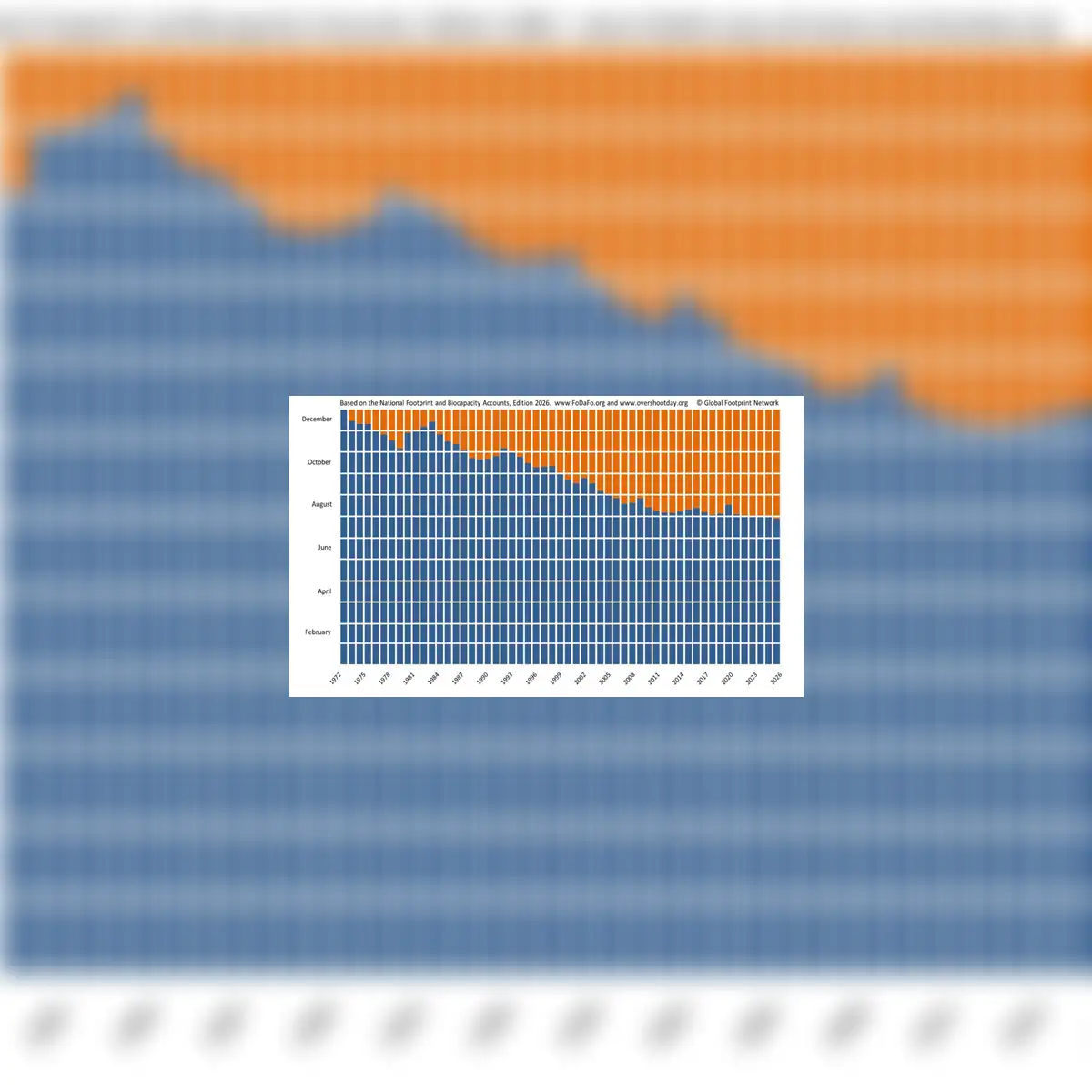
Humanity crossed Earth Overshoot Day for 2026 on July 30, exhausting the planet's annual biological capacity in the earliest month ever recorded, according to research by the Global Footprint Network and Greenings.
The environmental research groups reported that global demand for natural resources is currently running 73 percent faster than Earth's ecosystems can regenerate. That consumption rate requires the resource equivalent of 1.73 Earths to sustain human activity each year.
Data tracking the global ecological deficit since 1972 shows that the first recorded overshoot occurred in December 1973. Two decades later, the threshold advanced to October, before shifting into August and reaching July for the first time in 2026.
National Deficits and Planetary Boundaries
The Global Footprint Network, an international sustainability think tank founded in 2003, computes national overshoot dates by measuring when global resource depletion would occur if humanity consumed at the per-capita rate of a specific country.
In the 2026 country breakdown, Qatar recorded the earliest national overshoot date on February 4, followed by Luxembourg on February 17, Singapore on February 23, and Kuwait on March 3. The figures highlight how high-income economies consume renewable resources months ahead of the global average.
Conversely, nations with lower ecological footprints marked their overshoot dates much later in the year, led by Honduras on November 27, Cambodia on November 25, Ecuador on November 12, Nicaragua on November 6, and Tunisia on November 5. In Peru, a South American nation with diverse ecosystems spanning the Pacific coast and Amazon basin, Earth Overshoot Day occurred on August 12.
The report coincides with broader environmental metrics showing that seven of nine planetary boundaries have now been breached. Developed by scientists to outline safe operating limits for Earth systems, the surpassed thresholds include climate change, biosphere integrity, biogeochemical flows, land-system change, freshwater use, ocean acidification, and the accumulation of novel entities such as synthetic chemicals and plastics.
Extreme Heat and Public Health Toll
The findings follow extreme weather events reported by former Peruvian environment official José De Echave C., who described experiencing a full week of temperatures exceeding 40 degrees Celsius with peaks reaching 45 degrees. Writing in the Peruvian newspaper La República under the title Economy at 40 Degrees and More in the Shade, Echave noted that prolonged heatwaves have caused widespread disruption across Europe, North America, and Asia.
The severe heatwaves have resulted in widespread droughts, multiplying forest fires, damage to livestock and agriculture, and localized population confinements. Citing data published in The Lancet, a peer-reviewed medical journal based in the United Kingdom, Echave noted that extreme heatwaves now kill 490,000 people globally each year, making heat the most lethal climate event above hurricanes and floods.
Climate scientists, previously dismissed as alarmist environmentalists by mainstream media outlets and political power groups, had warned of these conditions decades ago in reports presented at international climate summits. Despite these warnings, political leaders, including a former president of the United States who claimed global warming was a concept created by China to undermine American manufacturing and labeled the climate narrative the greatest scam in history, continued to dismiss the crisis alongside executive figures in the hydrocarbon, mining, and automotive sectors.
Rising Global Temperatures and Atmospheric Chemistry
Carlo Buontempo, director of the European Union's Copernicus Climate Change Service, stated that current global temperatures are the warmest recorded in the last 100,000 years, pushing human society into unknown territory.
Scientific projections indicate warming could reach 2 degrees Celsius by 2035 and 3 degrees Celsius by 2050, potentially generating localized temperatures of 50 degrees Celsius in 2035 and 60 degrees Celsius in 2050, which would leave 60 percent of the planet uninhabitable for humans.
Addressing the persistence of global warming, French energy expert and carbon accounting pioneer Jean-Marc Jancovici noted that carbon dioxide, the primary greenhouse gas, remains chemically stable once released into the atmosphere and does not easily dissipate. He added that the cumulative warming effect is further exacerbated by concurrent emissions of methane and nitrous oxide.
Energy Sector Emissions and Policy Challenges
Efforts to halt global warming remain stalled as global greenhouse gas emissions reached record highs last year. Data from the International Energy Agency, an autonomous intergovernmental organization based in Paris, indicates that the energy sector accounts for 73 percent of all emissions through the burning of fossil fuels for industrial production and transport.
Transportation activity reached a historical peak on July 23, when 153,359 commercial flights took off worldwide in a single day. Global aviation volume is projected to double by 2050, showing no immediate signs of emission reduction.
Research from Global Footprint Network and Greenings highlighted that almost no national government treats resource security as a core component of economic planning, despite ecological overconsumption driving stagflation, food insecurity, health crises, and conflict.
Pointing to severe weather events in Nepal and recurring El Niño climate patterns, analysts emphasized that recent weather disasters are not random natural phenomena but human-driven extreme climate events, warning that economic policy must recognize nature as its essential foundation, noting that humanity has driven the climate out of control.