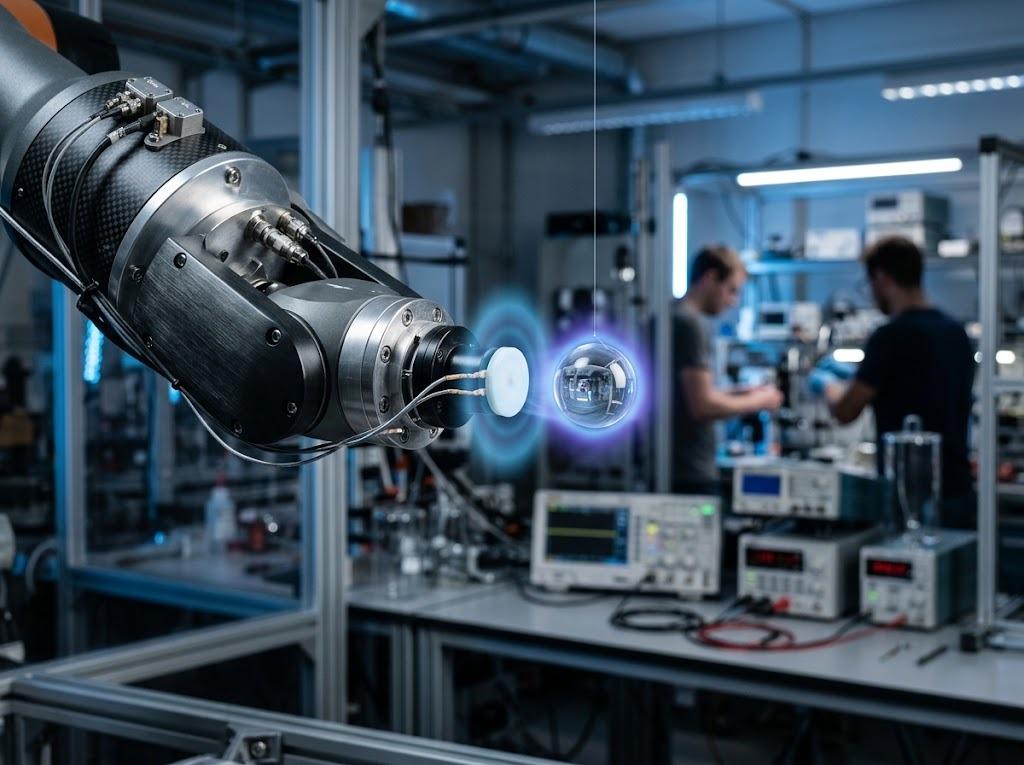
Engineers at Xidian University in China have developed a non-contact sensor that enables robots to detect surrounding objects by mimicking the natural sensing mechanism of electric eels.
The new device relies on a charged fluoropolymer surface that functions as a miniature static battery with long-lasting charge retention. This surface creates a predictable electric field around the sensor, allowing it to detect objects by analyzing distortions in the field's electrical conductivity, dielectric properties, and physical geometry.
Eel-inspired technology
Electric eels, which are freshwater fish native to South America, generate weak electric fields in murky river waters to navigate and sense nearby objects without relying on sight. Xidian University, located in Xi'an in Shaanxi province, is a leading Chinese research institution known for its work in electronics and technology.
When an object moves close to the sensor, it alters the surrounding field in specific ways based on the object's physical characteristics. Large flat surfaces distort the field differently than small spherical items, enabling the system to evaluate both object geometry and distance.
Detecting clear materials
Professor Zhang Weiqiang said the research team aimed to give machines the ability to feel an approaching target and identify its material and surface condition before physical contact takes place. He noted that metal objects produce strong changes in the electric field, whereas non-conductive materials like plastic, glass, and wood still polarise and leave identifiable marks within the field.
This approach offers major advantages over conventional camera systems in manufacturing settings. For example, transparent glass used in optical manufacturing is difficult for visual cameras to detect, but its dielectric properties remain clearly distinguishable inside an electric field.
Future industrial applications
The technology could be applied to delicate robotic manipulation, medical prosthetics, industrial automation, and tasks performed in dark, smoky, or dusty environments where vision systems are unusable. Fluoropolymers, synthetic materials prized for their high electrical resistance and stability, allow the sensor to maintain its charge during extended operation.
The researchers noted that key technical questions remain to be answered, including the sensor's ultimate precision, maximum range, and performance under varying humidity and temperature conditions.