China is constructing a 320-meter aircraft carrier equipped with potential nuclear propulsion at the Dalian shipyard, according to recent satellite imagery.
The vessel, identified as the Type 004, has reached a hull length of approximately 320 meters and a beam of 46 meters, marking a major advancement in the expansion of the People's Liberation Army Navy.
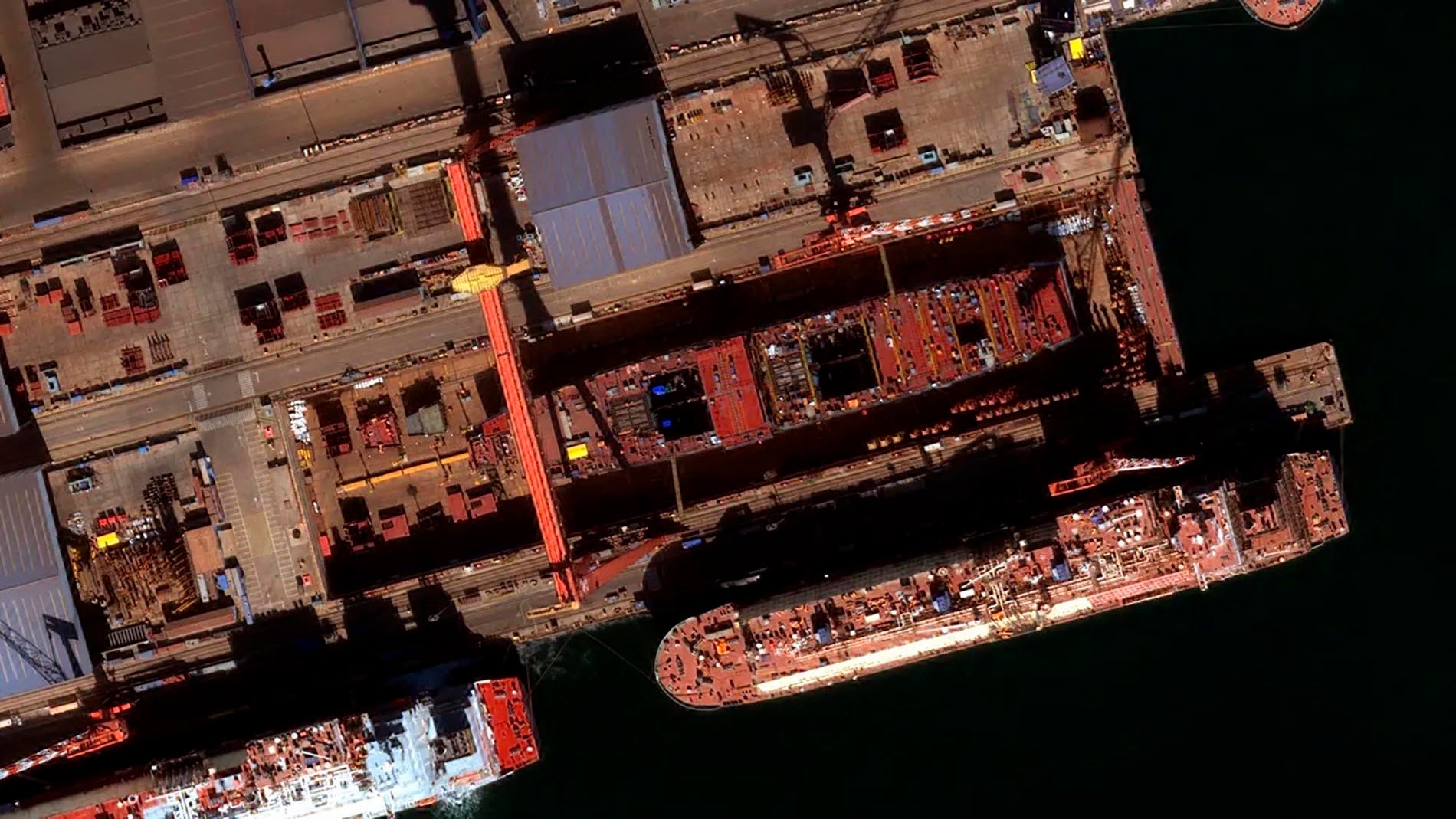
Satellite photographs captured on August 21 show that the bow section of the fourth Chinese aircraft carrier is significantly more advanced than in previous months. Beneath the flight deck, naval analysts have identified two reinforced internal compartments measuring approximately 15 meters by 15 meters each, which are consistent with layout requirements for housing twin marine nuclear reactors.
Beijing has not officially confirmed that the Type 004 will utilize nuclear power. The findings remain based on structural analysis of the incomplete hull at the Dalian shipyard in northeastern China's Liaoning province.
Nuclear Propulsion and Electromagnetic Catapults
If the nuclear propulsion indicators are verified, the Type 004 will become the first Chinese aircraft carrier powered by nuclear reactors rather than conventional fuel. Nuclear power provides virtually unlimited operational range without the need for frequent fuel replenishment, while also generating massive electrical output for advanced shipboard systems.
The expanded power capacity would support electromagnetic aircraft launch systems, similar to the catapult technology introduced on China's third carrier, the Fujian. Electromagnetic catapults allow a carrier to launch heavier fixed-wing aircraft carrying larger fuel payloads and weapons compared to the angled ski-jump ramps used on earlier Chinese carriers.
The Fujian, which was launched in Shanghai as China's first catapult-equipped carrier, also introduced specialized defensive features, including an advanced anti-torpedo system capable of intercepting incoming torpedoes before they impact the hull.
Air Wing Operations and Fleet Expansion
The Type 004 is designed to operate a next-generation carrier air wing, including the J-35 fifth-generation stealth fighter, naval variants of the J-15 multirole fighter, and the KJ-600 airborne early warning and control aircraft. The flight deck is also expected to accommodate uncrewed aerial vehicles and specialized electronic warfare aircraft.
Fixed-wing surveillance planes like the KJ-600 require the high launch speeds provided by electromagnetic catapults, as they cannot take off from traditional ski-jump ramps. The integration of stealth fighters and early warning platforms gives naval task groups organic radar coverage and battle management capabilities far beyond coastal radar range.
Challenging United States Supercarriers
China's carrier program began with the Liaoning, a refurbished Soviet-built hull commissioned in 2012, followed by the Shandong, China's first domestically constructed carrier built at Dalian. Both early vessels relied on conventional engines and ski-jump launch ramps.
With an assembled hull length already approaching 320 meters, the Type 004 nears the scale of United States Navy Gerald R. Ford-class supercarriers, which measure 333 meters in length. Military analysts note that China is developing its fourth carrier specifically to close the capability gap with American supercarrier strike groups in the Indo-Pacific region.
Construction work continues at the Dalian shipyard, where final hull shaping and catapult installation will determine the ultimate size and operational role of the vessel. Confirmation of nuclear propulsion would mark the most significant technological leap in the history of Chinese naval aviation.