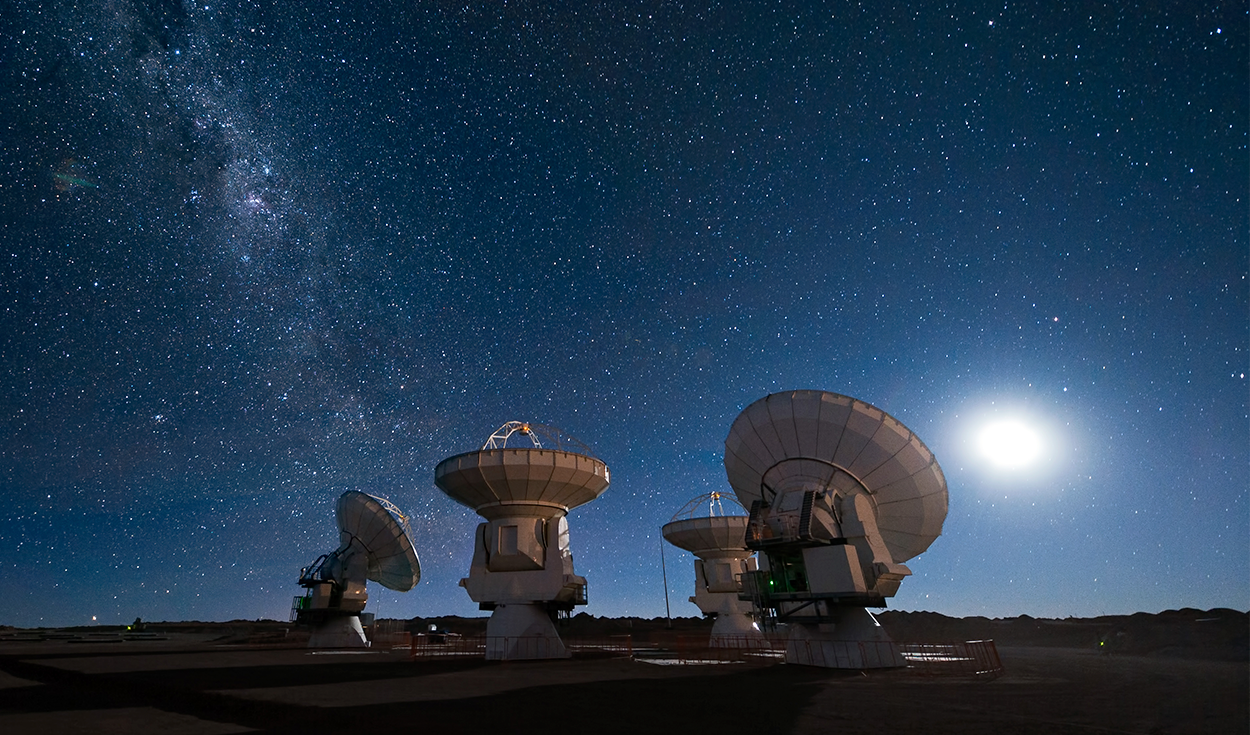
Astronomers have detected direct radio emissions from exoplanet Beta Pictoris b, situated roughly 63.4 light-years from Earth, using South Africa's MeerKAT radio telescope.
The signals consisted of short, repetitive radio pulses with strong circular polarization, which are characteristic of planetary auroras. Researchers confirmed that the emissions originate from the magnetic field of the giant extrasolar planet rather than extraterrestrial life.
Observations took place across four separate viewing sessions between 2025 and 2026. The research team recorded the radio emissions across a broad frequency band spanning between 0.85 and 3.5 gigahertz.
An exoplanet, or extrasolar planet, is a planetary body located outside the solar system that orbits a star other than the Sun. Radio astronomy involves detecting electromagnetic waves emitted by celestial objects, allowing scientists to study planetary magnetospheres, atmospheric retention, and space weather dynamics around distant stars.
Positioning Signals Using Distant Quasars
To determine the precise source of the signals, the team used quasars as exact reference points. Quasars are extremely luminous active galactic nuclei powered by supermassive black holes at the centers of distant galaxies, serving as stable positional benchmarks in radio astronomy.
Because quasars are billions of light-years away, their positions in the sky remain virtually fixed over human time scales, making them ideal coordinate markers for precise astronomical calibration.
By anchoring their measurements against these distant celestial beacons, astronomers successfully isolated the exoplanet's emissions from those of its host star, Beta Pictoris. Beta Pictoris is an early-type star that is significantly hotter than the Sun and possesses distinct stellar characteristics.
The researchers noted that no known physical mechanism capable of generating radio emissions in early-type stars could explain the specific signals captured during the observations.
In their study, the researchers explained that while auroral radio bursts are routinely observed across planets in the solar system and on certain ultra-cool dwarf stars, no radio detection had previously been localized unequivocally to an extrasolar planet instead of its host star.
The MeerKAT telescope array, located in the arid Karoo region of South Africa, consists of 64 interlinked radio dishes designed to detect faint cosmic radio signals. It serves as a precursor facility to the international Square Kilometre Array observatory, which will explore the radio universe with unprecedented sensitivity.

Measuring a Powerful Magnetic Field
In addition to the brief, repetitive radio pulses, scientists identified a persistent background radio emission coming from Beta Pictoris b. The characteristics of this steady signal point to electron cyclotron maser instability, a physical process associated with auroral phenomena on Earth and Jupiter.
Electron cyclotron maser instability is a resonant process where energetic electrons spiraling around magnetic field lines emit intense, coherent radio waves at frequencies tied directly to the strength of the surrounding magnetic field.
Data gathered from the signal allowed scientists to calculate the strength of the exoplanet's magnetic shield. The team concluded that Beta Pictoris b possesses an intense magnetic field that is thousands of times stronger than Earth's magnetic field.
The authors stated that the findings represent the first direct measurement of an exoplanet's magnetic field strength. They added that the measurement aligns with predictions derived from dynamo models for a young, massive giant planet.
Planetary magnetic fields are generated by internal dynamos, which operate through the movement of electrically conductive fluids deep within planetary interiors. A strong magnetic field protects a planet's atmosphere from high-energy stellar winds and cosmic radiation.
Characteristics of Beta Pictoris b
Beta Pictoris b was first discovered in 2008 and is classified as a massive gas giant with a mass approximately 10 times that of Jupiter. The planet orbits within the young Beta Pictoris system, located in the southern constellation of Pictor.
The Beta Pictoris system is famous in astronomy as one of the first stellar systems found to possess a prominent debris disk of gas and dust, providing a natural laboratory for studying early planet formation.
The exoplanet completes a full rotation on its axis in roughly 8 to 9 hours. Researchers indicated that this rapid rotational speed could supply the necessary kinetic energy to power its strong auroral radio emissions.
Gas giants like Jupiter and Saturn in the solar system experience intense auroras when energetic particles interact with their magnetospheres. Jupiter's rapid rotation rate of under 10 hours similarly drives powerful auroral radio outputs detected by radio telescopes on Earth.
Publication Status and Future Outlook
The research paper documenting the discovery has been authored by Ceballos and colleagues but has not yet been published in a peer-reviewed scientific journal.
Peer review is the standard scientific process in which independent experts evaluate research methodology and conclusions prior to formal journal publication. Scientific pre-print repositories like arXiv allow researchers to share preliminary findings with the academic community while formal review takes place.
Looking ahead, the authors noted that seven other giant exoplanets across five nearby star systems could be examined using the same observational technique once next-generation radio observatories reach sensitivity levels five to seven times higher than current instruments.