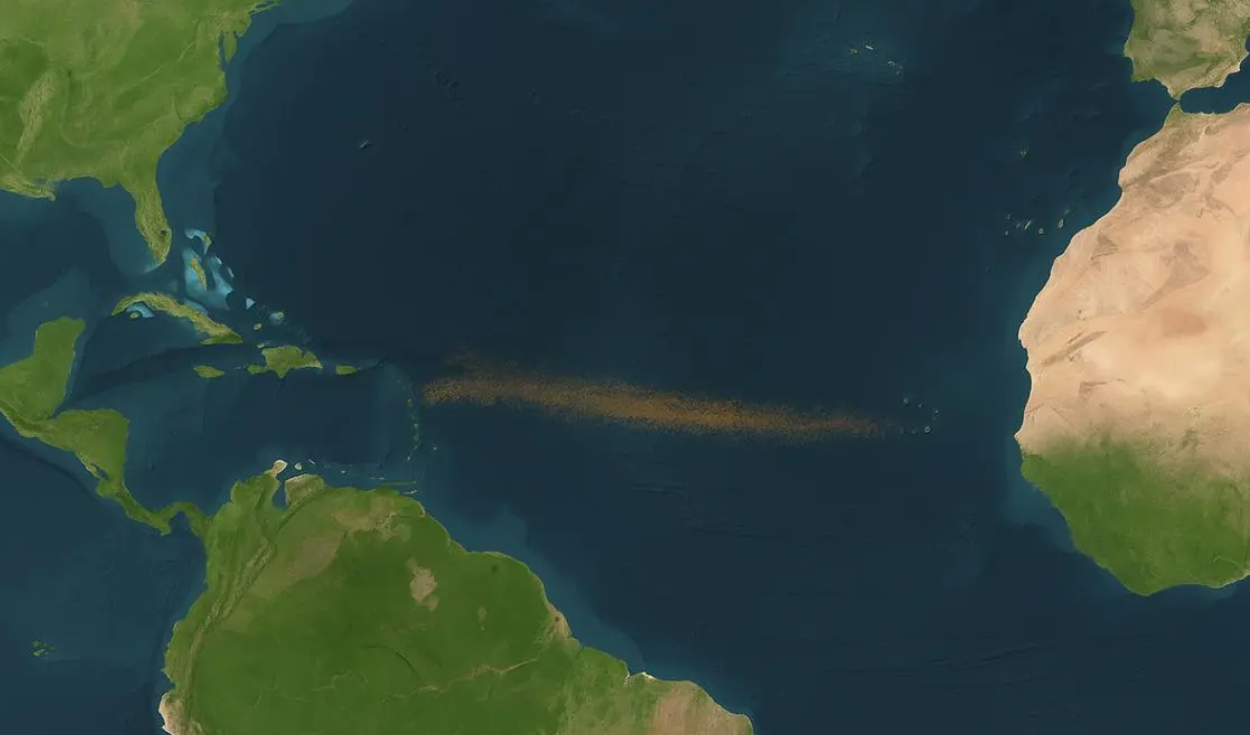
Satellite observations have revealed a 37.5 million metric ton brown sargassum seaweed belt stretching 8,800 kilometres across the Atlantic Ocean from Africa to Mexico.
Scientists expressed astonishment at the gigantic brown ribbon, known as the Great Atlantic Sargassum Belt, which reached a record length in 2025 that spans more than twice the width of the United States.
Researchers reported that the blooms of brown algae have expanded almost every year since 2011, with 2013 being the only exception. Satellite tracking indicates that the massive oceanic phenomenon did not exist 15 years ago.
A study published in the journal Harmful Algae by researchers at the Harbor Branch Oceanographic Institute of Florida Atlantic University evaluated four decades of satellite records, field observations, and tissue chemistry. Harbor Branch, an oceanographic research facility in Fort Pierce, Florida, specializes in long-term marine science studies.
Rising nitrogen levels in ocean waters
Sargassum is a genus of free-floating brown macroalgae that requires nitrogen and phosphorus to grow. Chemical testing of the seaweed revealed a major shift in nutrient availability over the past 40 years.
Between 1980 and 2020, the nitrogen content in sargassum tissue rose by 55 per cent, while the ratio between nitrogen and phosphorus increased by 50 per cent. Scientists found that in nutrient-rich waters, the total biomass of the seaweed can double in just 11 days.
Researchers noted that the surge of nutrients feeding the seaweed no longer comes solely from natural ocean processes like upwelling and vertical mixing. Land-based sources have gained major significance through agricultural runoff, untreated sewage, and atmospheric deposition.
The Amazon River plays a major role in encouraging the growth of the algae. During flood periods, the river releases massive quantities of terrestrial nutrients into the Atlantic Ocean, favoring explosive blooms, while droughts in the basin reduce bloom intensity.
Ocean currents complete the distribution across the sea. The Gulf Stream and the Loop Current transport floating sargassum masses through different regions of the Atlantic Ocean. Large cords of seaweed previously appeared in the Gulf of Mexico in 2004 and 2005 due to nutrient flows from the Mississippi and Atchafalaya rivers.
Coastal threats and ecological impact
In the open sea, floating sargassum serves an important ecological role. The National Oceanic and Atmospheric Administration, a US scientific agency, recognizes the seaweed as an essential shelter for more than 100 species, including fish, invertebrates, and sea turtles, offering food, protection, and breeding grounds.
Severe environmental hazards occur when large amounts of the seaweed reach the coast and pile up on beaches. As the decaying masses decompose, they release hydrogen sulfide, a toxic gas that creates foul odors and health risks for beachgoers.
The rotting vegetation depletes oxygen levels in shallow coastal waters, creating low-oxygen marine zones that deteriorate coral reefs and severely affect local tourism economies.
The accumulated seaweed can also disrupt major coastal infrastructure. In 1991, a massive accumulation of sargassum clogged the seawater intake system of the St. Lucie nuclear power plant in Florida, forcing an emergency shutdown of the facility.
International monitoring and prevention
To mitigate future damage, scientists said that international surveillance systems must be established to monitor the movement of seaweed masses across the ocean.
Researchers also called for improved forecasting models to give coastal communities early warnings. In addition, scientists emphasized the need for long-term reductions in nutrient pollution washing into the sea from land sources.