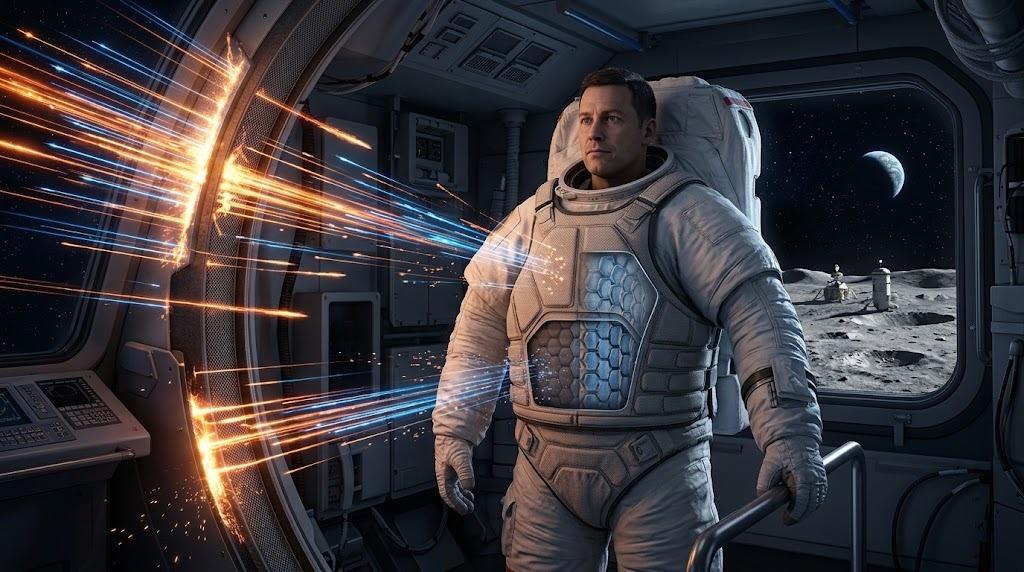
StemRad and Lockheed Martin tested the AstroRad radiation vest on NASA's Artemis I mission, reducing simulated solar storm radiation exposure by up to 60 percent. Researchers reported that targeting protective material over the human body's most vulnerable organs significantly lowers radiation doses beyond Earth's magnetosphere.
Ionizing radiation remains a major hazard for deep space exploration. Solar particle events unleash intense bursts of high-energy protons that can dramatically raise an astronaut's radiation dose within hours. Shielding an entire spacecraft is difficult due to launch mass limits, prompting scientists to evaluate personal body shielding as a flexible alternative.
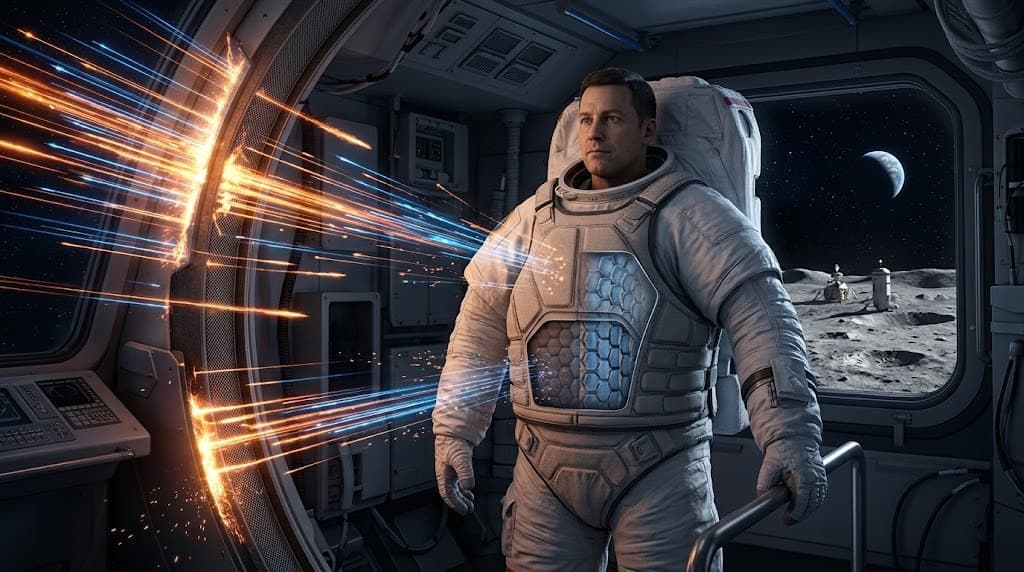
Engineers designed the 26-kilogram test vest to concentrate hydrogen-bearing high-density polyethylene over selective organs rather than covering the body evenly. The material protects red bone marrow, lungs, stomach, intestines, chest tissue, and reproductive organs. To maintain mobility, developers divided the thick polymer layer into flexible hexagonal segments of varying sizes.
The test took place in 2022 aboard the uncrewed Orion spacecraft during its lunar orbit. Researchers placed two tissue-simulating phantoms named Helga and Zohar inside the cabin, fitting Zohar with the AstroRad vest while leaving Helga unprotected. Both phantoms carried active and passive dosimeters across their surfaces and internal structures.
Flight Modeling and Storm Simulations
Because no major solar storm occurred during the flight, researchers gathered radiation data as Orion passed through the inner Van Allen radiation belt. They used those measurements to build and validate a radiation transport computer model using the Monte Carlo method, which accurately matched the measured radiation doses.
Scientists then tested the model against data from two historic solar storms. In a simulation of the powerful August 1972 solar storm, the vest reduced the effective radiation dose by 60 percent, lowering exposure from 222.3 millisieverts to 87.5 millisieverts. During a simulation of the October 1989 storm, which contained higher-energy protons, the vest reduced effective exposure by 38.5 percent, from 233.5 millisieverts to 143.6 millisieverts.
The vest stopped low-energy protons more easily than higher-energy particles, making protection dependent on the storm's energy spectrum. In the 1972 simulation, breast radiation fell by 75 percent, stomach exposure dropped by 66 percent, colon dose decreased by 65 percent, and lung exposure dropped by 61 percent. For the 1989 storm, reductions reached 55 percent for the breast, 39 percent for the stomach and colon, and 40 percent for the lungs.
Brain tissue received only a 3 percent dose reduction in the tests. Researchers stated that this small change aligns with the vest's design logic, which prioritizes material placement over organs where radiation damage contributes most to overall health risks.
NASA Safety Limits and Operational Benefits
The simulations demonstrated that the vest keeps solar storm radiation within NASA safety thresholds. Without personal shielding, crew members in the 1972 storm scenario would receive 204 millisieverts and 219 millisieverts in the 1989 scenario. Wearing AstroRad brought those levels down to 85.3 millisieverts and 138.2 millisieverts, well below NASA's single-event exposure limit of 250 millisieverts.
Researchers calculated that wearing the vest preserves valuable deep space mission time when factoring in background cosmic radiation. Depending on the solar cycle phase, the vest saves between 59 and 193 days of allowable mission time for a 1972-scale storm, and 40 to 131 days for a 1989-scale storm.
The vest is intended specifically as emergency protection during solar storms rather than continuous shielding against galactic cosmic rays. Galactic cosmic rays consist of far higher-energy particles that require significantly more mass to block. AstroRad serves as a temporary safeguard during peak storm hours or days.
Compared to moving crew members into Orion's built-in storm shelter, the vest allows astronauts to move freely and continue essential tasks in working areas. However, researchers noted that the findings rely on validated computer extrapolations rather than direct measurements during an active solar storm.
Following the Artemis I test, developers refined the vest design to reduce its mass from 26 kilograms to 16 kilograms without losing protective capability. Future plans call for evaluating even lighter designs and exploring in-space manufacturing of radiation shielding using available materials.
Scientists noted that the study provides the first flight-tested evidence that personal wearable shielding effectively mitigates solar particle risks inside spacecraft beyond low Earth orbit. For future lunar and Martian missions, team members view the vest as an extra layer of defense alongside existing spacecraft structures. The findings were published in Science Advances and reported by Ars Technica.