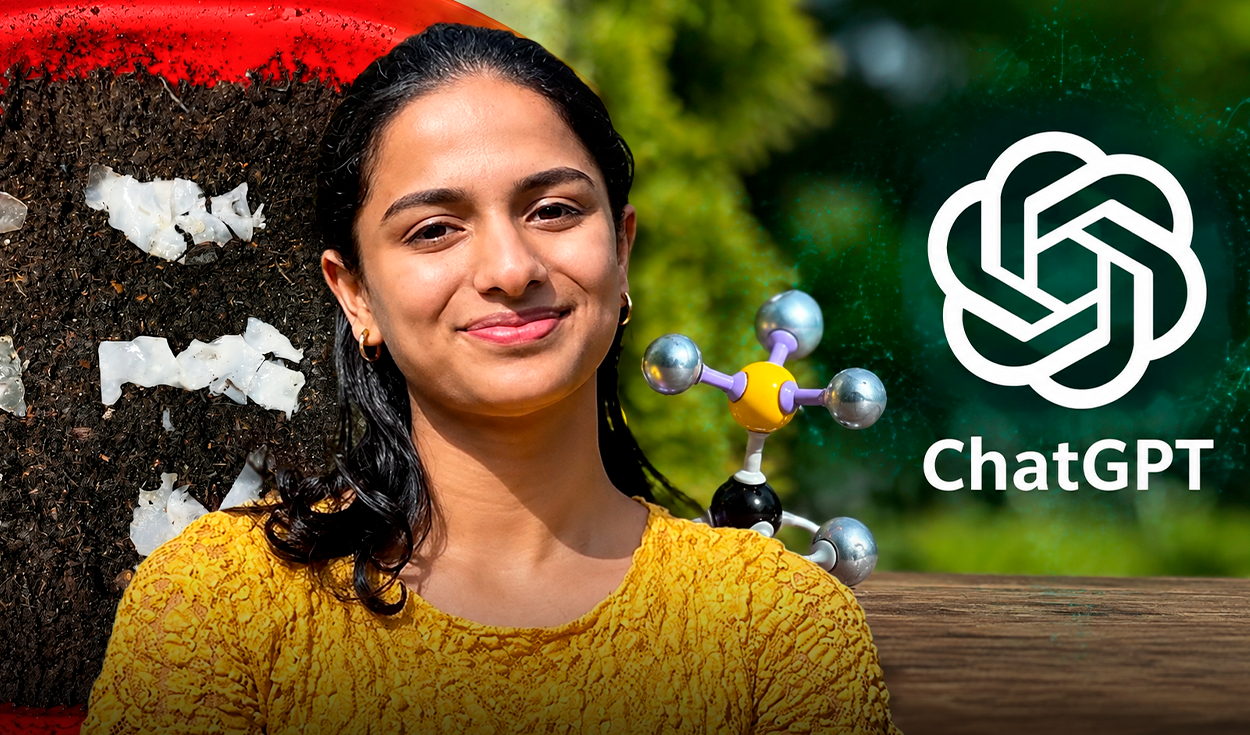
Irish student Arya Satheesh has developed a plant-based bioplastic capable of removing microscopic plastic waste from land and water ecosystems, securing international recognition and a $12,500 prize in The Earth Prize 2026.
The 18-year-old researcher, who lives in County Donegal in northwest Ireland, created the material, named Eco Purge, with the assistance of artificial intelligence tools including ChatGPT to address complex technical challenges during her scientific investigations.
Eco Purge functions as a plant-derived bioplastic that decomposes naturally while releasing specialized enzymes into soil, freshwater, and saltwater. According to competition organizers at The Earth Prize, the bioactive substances remain stable inside the material until decomposition begins, allowing it to replace traditional polymers while actively clearing accumulated environmental waste.
In six-week laboratory tests reported by Smithsonian Magazine, the material successfully dissolved harmful particles following an initial period of biodegradation. However, scientists have warned that the prototype currently targets only polyethylene terephthalate, commonly known as PET, and faces potential dilution risks when deployed in open natural ecosystems.
Overcoming Technical and Supply Obstacles
Satheesh initially conceived the project after developing a system to detect contaminants in drinking water. She told Smithsonian Magazine that her initial research inspired her to find an active solution to remove pollutants rather than merely identify them.
During her research, Satheesh turned to OpenAI's ChatGPT chatbot to identify chemical suppliers across Europe and the United States for necessary biological catalysts. When commercial quotes reached $2,500 for just three milligrams of material, she sought academic assistance to source affordable testing supplies.
Kevin O'Connor, director of the Irish research center BiOrbic, stepped in to coordinate enzyme samples sent from Denmark and Germany. The biological materials were subsequently stored and preserved at Atlantic Technological University in Letterkenny for experimental use.
Project Origins and Early Recognition
Prior to her international award, Satheesh achieved second place in the senior individual category at the Stripe Young Scientist and Technology Exhibition in Ireland in January 2026. Her submission in the Biological and Ecological Sciences category was titled Eco Purge: Biodegradable Plastic with Enzyme-Driven Microplastic Degradation.
Her initial research hypothesis developed into a functional technology through ongoing partnerships with academic experts at University College Dublin, Atlantic Technological University Letterkenny, and the BiOrbic research center.
Funding and Commercial Expansion Plans
Satheesh received the regional title for Europe in The Earth Prize 2026, an annual competition organized by The Earth Foundation for young innovators aged 13 to 19. She was one of seven global winners awarded $12,500 to refine their projects, alongside specialized mentorship and training.
Following her win, Satheesh stated that Eco Purge was designed to replace conventional plastics while helping eliminate existing microplastics, adding that the milestone was only the beginning of her work.
Over the next five years, Satheesh aims to demonstrate the economic viability of her invention outside laboratory settings. Her long-term targets include launching compostable packaging and bags, as well as founding a dedicated bioplastics company. She admitted that the project had not transformed overnight but had instead progressed step by step, as she continues addressing challenges such as preserving enzymes during industrial processing and lowering production costs.