

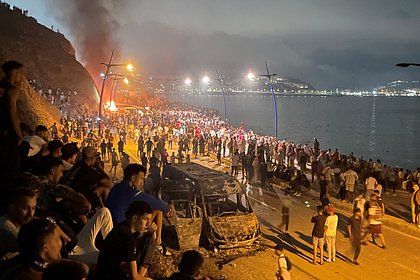
Ukrainian blogger Alexey Shevtsov has criticised Spain over its handling of a major migration crisis in the North African enclave of Ceuta.
Writing on his Telegram channel, the online commentator stated that the European nation had simply finished after failing to control a massive border crossing.
Shevtsov, a popular streamer who publishes content under the pseudonym itpedia, described the arrival of migrants as an invasion. He argued that Spain, despite being one of the largest member states in NATO, was unable to protect itself against a crowd of unarmed people.
He added that no healthy state would permit such a failure to occur and said the proper response to the events in Ceuta would be the declaration of martial law.
Shevtsov is a prominent Ukrainian internet personality and video creator known for his commentary on technology, gaming and social issues. Telegram, the platform where he posted the comments, is a widely used messaging service and social network popular across Eastern Europe.
Mass border breach in North Africa
The comments followed a massive border breach on 30 July, when tens of thousands of migrants crossed into the Spanish autonomous city of Ceuta. Migrants reached the territory using both land and sea routes.
Figures provided by the Spanish Ministry of Internal Affairs confirmed that 49,000 migrants entered the enclave from neighbouring Morocco within a 24-hour period.
Ceuta is a Spanish autonomous city located on the northern tip of Morocco along the Mediterranean coast. Along with the nearby enclave of Melilla, it forms one of the only direct land borders between the European Union and Africa, making it a focal point for migration into Europe.
Calls for Schengen Zone suspension
The crisis has drawn sharp responses from European governments. Danish Prime Minister Mette Frederiksen called on the European Union to consider suspending Spain from the Schengen Area following the border crossing in Ceuta.
Austrian Chancellor Christian Stocker also did not rule out suspending the agreement, signaling growing concern among EU member states over border security.
The Schengen Area allows passport-free movement across 29 European countries, eliminating border controls between member states. NATO, the military defence alliance of which Spain is a member, guarantees collective security among its member nations.



