Japanese avant-garde artist Yayoi Kusama, known around the world as the Polka Dot Queen, died in a Tokyo hospital on August 14, 2026, at age 97.
Her company announced her passing in a statement released on Thursday, August 27, 2026, without providing details regarding the cause of death.
According to the statement, Kusama continued to paint until her final days, never letting go of her paintbrush while continuing to explore eternal love and the immortal soul.
Her company expressed deep sadness over her death and stated that it will carry on her legacy to bring hope and strength for the future to people around the world through art.
Artistic Origins and Mental Health
Born in 1929 into a wealthy merchant family, Kusama suffered from hallucinations, obsessive-compulsive disorder, and suicidal tendencies from childhood. She also stated on multiple occasions that she endured physical and psychological abuse from her mother during her youth.
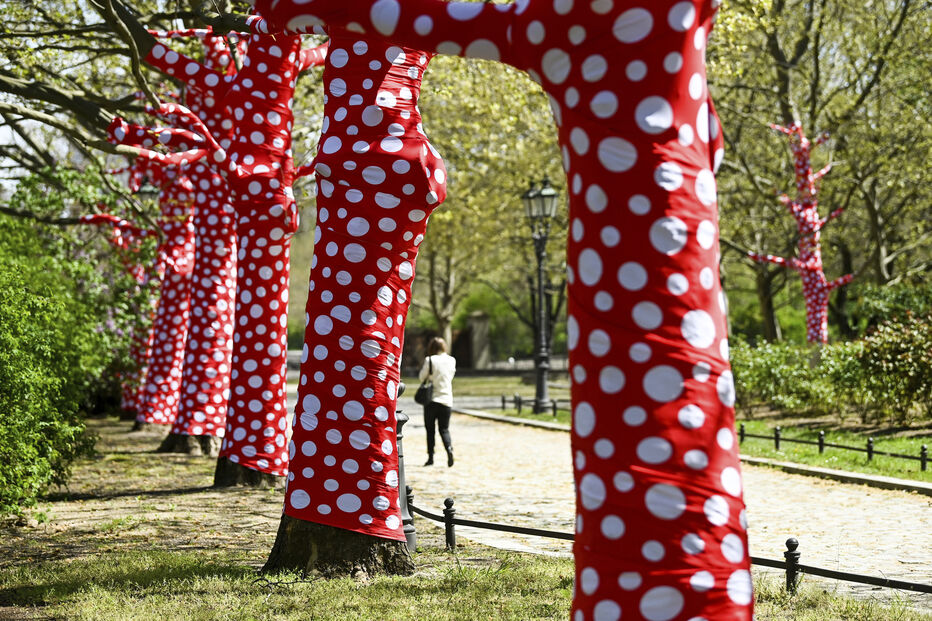
Kusama drew inspiration from her childhood hallucinations to create her signature polka dot patterns and immersive installations. She also became instantly recognizable for wearing a vibrant red wig.
As a major figure of psychedelia and one of the most prominent artists of the 20th century, Kusama translated her internal experiences into a wide body of work that encompassed painting, sculpture, performance, literature, and poetry.
She trained in Nihonga, a traditional style of Japanese painting established in the late 19th century, at the Kyoto Municipal School of Arts and Crafts in western Japan.
Career in the United States and Activism
In the late 1950s, Kusama moved to the United States to escape the strict formalism of Japan and build her reputation within the artistic avant-garde.
While living in New York City, she created artworks in public spaces such as Central Park to protest against the Vietnam War. Her anti-war stance developed at age 16, when the United States dropped atomic bombs on Hiroshima and Nagasaki at the end of World War II.
Kusama achieved significant success in the United States and influenced contemporary artists including Andy Warhol and Claes Oldenburg.
Return to Japan and Global Recognition
Kusama returned to Japan in 1973 following a decline in her mental health. In 1990, she voluntarily entered a psychiatric hospital, where she continued producing artistic works across various disciplines.
Her company highlighted that throughout a life dedicated to artistic creation, Kusama established an internationally acclaimed career across visual arts, performance, fiction, and poetry.
Over her career, Kusama presented her work in museums across the globe and earned major honors, including Japan's Order of Arts and Letters and Order of Culture. In 2006, she became the first woman to win the Praemium Imperiale from the Japan Art Association, one of the most prestigious international art awards.