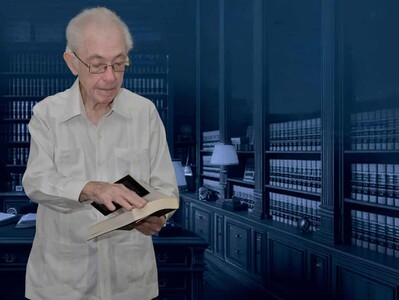
Wenceslao Vega Boyrie, the prominent Dominican civil lawyer, legal historian, and democratic campaigner, has died after a life spanning over nine decades. Known affectionately in family circles as Lao, a nickname used by Pedro Troncoso Sánchez for his younger brother at the Oficina de Abogados Troncoso law firm, or simply as Wences, he established himself as one of the leading legal minds of his generation in the Dominican Republic while helping expand civic freedoms.
Born into an iconic family from Santiago in the northern Dominican Republic, Vega inherited a legal tradition established by his father, Julio Vega Batlle. His father served as a prominent government official, university rector, diplomat, and author of the novel Anadel: La novela de la gastrosofía, set along Samaná beach.
Vega practiced law alongside his cousin Gustavo Vega Vega at the firm Vega & Asociados between 1970 and 2000. The family legal legacy also extended to the Santiago firm Vega Imbert & Asociados, headed by José Augusto Vega Imbert, a former 1965 activist who later served as foreign minister under President Salvador Jorge Blanco. Other relatives excelled across public life, led by economist Bernardo Vega, who worked at ALCOA, the International Finance Corporation, and as governor of the Central Bank before directing the Museum of Dominican Man, the Dominican Academy of History, the Society of Bibliophiles, El Caribe newspaper, and the Dominican Embassy in Washington. Cousin Gustavo Vega Imbert served as an economist at the Universidad Nacional Pedro Henríquez Ureña, while architect Edgardo Gay Vega Malagón, museographer Pedro José "Pilito" Vega Vega of the Centro León and Museum of Dominican Man, and diplomat Otto Vega also achieved distinction.
Intellectual Gatherings and Political Reform
During the 1970s, Vega became a central figure in Santo Domingo intellectual circles, frequently meeting at the Edificio Buenaventura apartment of former university history professor Hugo Tolentino, located at the intersection of Avenida Independencia and Avenida Delgado. Vega, who was then a bachelor before marrying educator Ligia Evangelina Bonetti Guerra, hosted gatherings at Buenaventura and later at their family apartment on Avenida Bolívar, near the Golfito Tenis Club owned by Pouppe Soler de Molinari.
Regular guests at these gatherings included food critic José Luis Parra, Félix Servio Ducoudray, Pedro Mir, Juan Basanta, Milagros Ortiz Bosch, Enzo Mastrolilli, Enriquito de Castro, Máximo Avilés Blonda, Bosco Guerrero, Andresito Avelino, José Antonio Martínez Rojas, María Elena Muñoz, Camilo Lluberes, and Chito Henríquez. Former president Juan Bosch frequently consulted Tolentino's personal library to research his historical essays. Tolentino hosted guests at his modest beach house in Guayacanes, serving fresh lobster, at his country home in Caballona using a roasting box for pork, and at a Lincoln Avenue home shared with Sarah Bermúdez that sold ornamental plants, before moving to his final apartment at PHU.
Vega later joined the 1982 presidential campaign of Salvador Jorge Blanco, a Santiago lawyer and senator for the National District who proposed liberal modernization under the Change movement succeeding Antonio Guzmán. The candidacy launch at the Salón La Mancha of the Hotel Lina featured business leader Alejandro Grullón in the front row, while Carlucho Bermúdez frequently visited the candidate's home with his wife Asela. Support grew among a group from Calle Vega Real in Jarabacoa, including Orlando Haza del Castillo, Ivonne Haza del Castillo, Virgilio Díaz Grullón, Milton Messina, and Julito Senior. Díaz Grullón and Alejandro Grullón shared a great-grandfather, Manuel Rodríguez Objío. Faculty members from the Instituto Tecnológico de Santo Domingo, including Manuel Cocco, Eduardo García Michel, and Ramón Pérez Minaya, also backed the movement.
Through the Avanzada Electoral group, former social democrats and prominent citizens joined the campaign, including Antonio Rosario, Enmanuel Esquea, José Joaquín Puello, Bernardo Defilló, master musician Rafael Solano, Toñito Flaquer, Manuel de Ovín, Pacho Saviñón, Albert Giraldi, Rómulo Vallejo, Pedritín Delgado Malagón, and Franklin Báez Brugal. Strategy firm Consultores Asociados analyzed election data precinct by precinct from 1962 to 1978, matching demographic, economic, and political factors to map voting trends for 1982. Advertising creators Nandy Rivas, René Alfonso, and José Dorín Cabrera developed targeted media campaigns, while polling firm Penn & Schoen conducted five tracking surveys to assess shifting voter perceptions.
Blanco built a political core led by Hatuey Decamps, José Ovalle, José Michelén, José del Carmen Marcano, Fulgencio Espinal, Rafael Flores Estrella, and Rafael Ángeles Suárez. The campaign secured backing from leader José Francisco Peña Gómez and close associates Hugo Tolentino and Milagros Ortiz Bosch. Independent figures collaborating with the campaign included Vega, Bernardo Vega, Meme Cáceres, Hugo Guiliani Cury, Frank Moya Pons, Tirso Mejía Ricart, and José Augusto Vega Imbert. The Friedrich Ebert Foundation of Germany's Social Democratic Party also provided support, inviting Blanco to visit West Germany.
Civic Education and Discussion Groups
Vega presided over the Ulises Francisco Espaillat Foundation, operating on Calle Rafael Augusto Sánchez in the Naco neighborhood of Santo Domingo. Dedicated to social science research and political education for young people, the foundation board included political scientists Julio Brea Franco, Clodoaldo Mateo Villanueva, Leonte Brea, Nolberto Soto, and José Silié Gatón, who published his book Administración Electoral in 1990. In 1989, the foundation held a workshop on electoral techniques led by Silié, Mateo Villanueva, and Flavio Monción.
For nearly four decades, Vega participated in a reflection group launched by Eduardo Latorre and organized by Rafael Toribio. Initial members included visionary businessman José Turull, Hamlet Hermann, Julio Brea Franco, Frank Castillo, Father Jorge Cela, José Gómez Cerda, Juan Bolívar Díaz, César García, Eduardo García Michel, Ramón Pérez Minaya, Isidoro Santana, Ramón de la Rosa Carpio, and Reverend Manuel Estrella. The circle later expanded to include José Singer, Celso Marranzini, Fausto Rosario Adames, Miguel Ceara Hatton, Flavio Darío Espinal, and Andrés L. Mateo.
Meetings rotated through members' homes, including the Naco and La Castellana residences of Vega and his educator partner Nereida Jiménez. Culinary details were prepared by Vega's son, Emil Vega, a chef and former operator of the Asia Mía restaurant who serves as a gastronomic authority for Centro Cuesta Nacional's Origen select meat line.
Academic Leadership and Legal Scholarship
Vega served as a full member of the Dominican Academy of History, occupying Chair J since the early 2000s. He contributed regularly to the academy's journal, CLIO, served on its board of directors, and worked on statutory reforms alongside jurists Américo Moreta Castillo and Amadeo Julián. During internal academy elections, Vega routinely paired with Raymundo González to hand out ballots, count votes, and announce election results out loud.
Vega authored major works on legal history and judicial institutions. His textbook Historia del Derecho Dominicano has gone through multiple editions as a university text. His publications include Historia de la Corte de Casación Dominicana (1908-2008) and Historia del Poder Judicial Dominicano, co-authored with Américo Moreta Castillo and published by the Supreme Court of Justice. He also wrote La Constitución de Cádiz y Santo Domingo, as well as Historia Constitucional Dominicana, which was added to the Constitutional Court catalog in 2022.