


Political parties in Les Corts Valencianes have submitted competing proposals to lower housing prices across the region ahead of next week's parliamentary session.
The parliamentary debate in Valencia comes as political groups agree that home prices have become unaffordable for most residents, particularly in major urban centers and surrounding metropolitan areas, despite deep ideological divides over potential solutions. Les Corts Valencianes serves as the regional parliament of the Valencian Community in eastern Spain, where political factions remain split on how to address the housing crisis.
The agenda agreed upon yesterday by the parliamentary Board of Spokespersons confirms that housing initiatives will dominate the upcoming legislative session in Valencia.
Partido Popular housing initiatives
The ruling Partido Popular has proposed expanding its regional housing program, known as the Plan Vive, while requesting that the central Spanish government mobilize all state-owned land for affordable rental housing construction.
The party's measure also calls for personal income tax exemptions or reductions for young workers during their first four years in the workforce to help them save money, alongside a reduction of value added tax to 4 percent on first-home purchases and residential renovations.
In its proposal, the Partido Popular blamed the central government led by Prime Minister Pedro Sánchez for driving up housing costs, noting that residential prices have surged by 13.4 percent over the past year and by 52 percent since the socialist leader arrived at the Moncloa Palace in Madrid.
Partido Popular parliamentary spokesperson Nando Pastor said yesterday that housing was never the real reason Pedro Sánchez called general elections for November 29, describing the issue as an excuse used by the Prime Minister.
Pastor further criticized the previous left-wing Botànic coalition government, which governed the Valencian region for eight years, claiming that it failed to carry out effective housing work during its entire tenure.
Pastor pointed out that under the previous administration, the price cap module for protected public housing rose from 1,800 euros to 2,400 euros per square metre, marking a 30 percent increase, while zero public homes were built under any modality and tax burdens increased.
He noted that the current regional government has launched the Plan Vive with 4,800 public housing units currently in various stages of development, with the objective of pushing 10,000 public units by the end of the legislative term next May.
Opposition housing demands
Opposition parties PSPV and Compromís have introduced more specific proposals targeting recent action by the regional government led by Juanfran Pérez Llorca, specifically an increase in the maximum price module for privately developed public protection housing.
The socialist PSPV group is calling for the immediate repeal of the price cap increase on privately promoted public housing, demanding that the maximum price limit of 2,200 euros per square metre be restored.
The socialist initiative also demands that any public housing constructed on public land or built using public funds and subsidies maintain its protected status permanently.
PSPV spokesperson José Muñoz denounced current housing market conditions, stating that it makes no sense for protected public homes in the Valencian Community to reach prices between 250,000 and 300,000 euros.
Muñoz added that the upcoming parliamentary session would showcase two contrasting country models, accusing the Partido Popular, Vox, and Junts of proposing that housing be treated as a business.
Compromís submitted a similar initiative calling for the reversal of maximum price increases on protected housing, requesting measures to ensure that financial commitments for protected homes remain within accessible limits, and insisting on permanent public protection status for all qualifying properties.
Responding to the opposition, Pastor dismissed the socialists' demands as hypocritical and cynical, asserting that their past governing record proved their failure on housing policy.
Vox motion on public services
Right-wing party Vox chose to remain outside the direct housing policy debate, submitting instead a non-binding resolution focused on the saturation of public services attributed to massive illegal immigration.
Vox parliamentary spokesperson José María Llanos stated that large-scale illegal immigration has placed severe strain on social services, healthcare, education, public security, and housing infrastructure across the region.
Public housing development in Rabasa
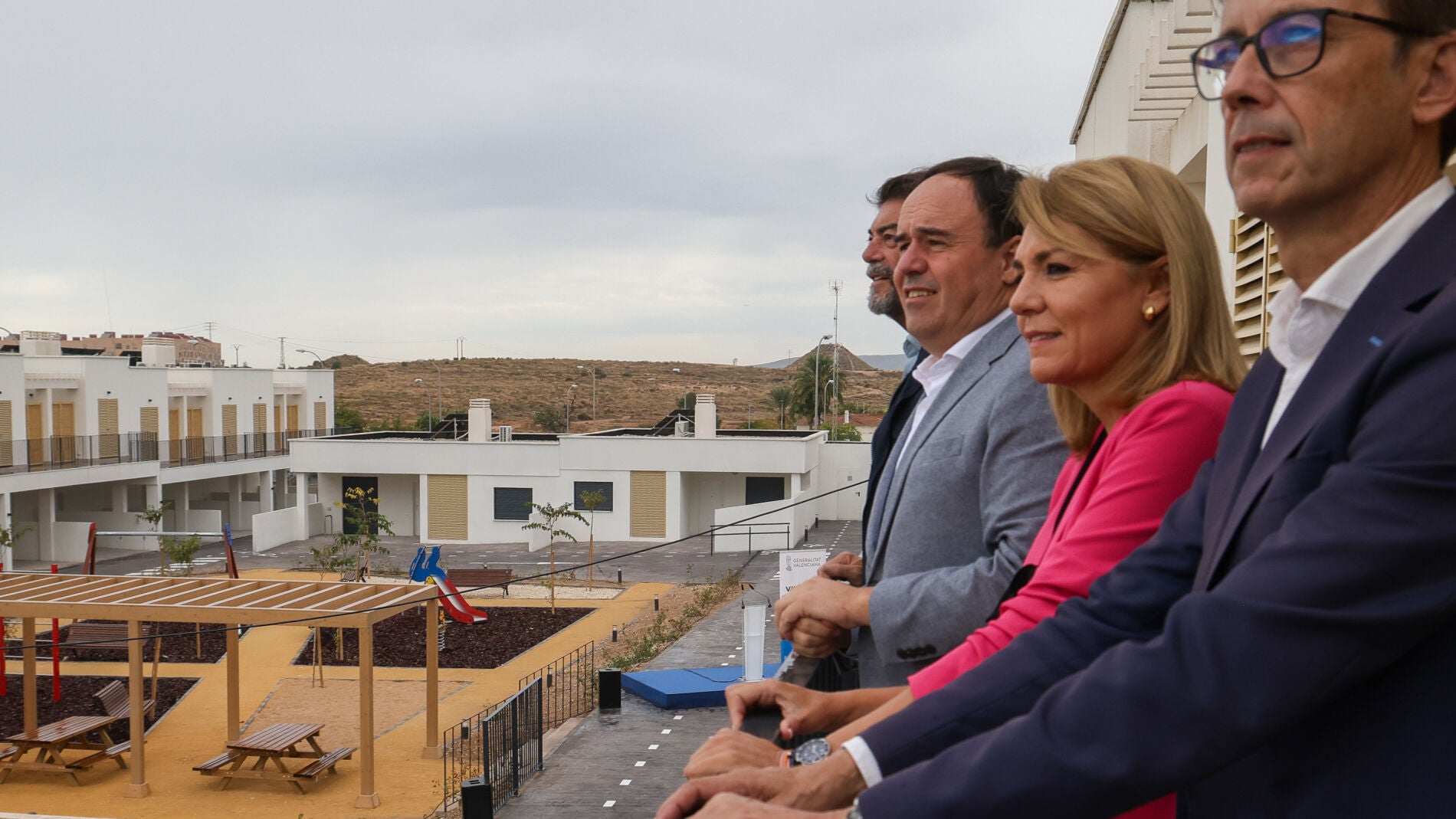
Regional government leader Juanfran Pérez Llorca visited a newly completed 34-unit protected housing development in the Rabasa neighborhood of Alicante yesterday, underscoring the administration's focus on expanding affordable rentals through the Plan Vive.
The finished Rabasa development is designated for affordable rental housing, with monthly rents set at 580 euros plus an additional 65 euros per month for an assigned parking space.
The development consists of 30 three-bedroom apartments, two two-bedroom apartments, and two housing units specifically adapted for individuals with reduced mobility, with all properties offering garage space and access to shared amenities.
Pérez Llorca confirmed that 255 properties have been awarded in Rabasa under the Plan Vive framework, while approximately 800 protected public homes are currently undergoing development across various phases in Alicante.
The regional leader highlighted that 320 municipal councils across the Valencian Community have joined the Plan Vive initiative, including 85 municipalities governed by the PSPV.


